What is The 11th House?
The 11th house is the sector of a birth chart that governs your relationship to the wider collective: friendships, groups, shared ideals, and the long-range vision you hold for your own future and for the world you belong to. It sits directly opposite the 5th House of personal self-expression, which means it asks how your singular gifts get folded into something larger than yourself. Traditional astrology called this sector the "Joy of Jupiter" and the place of the "Good Spirit," a hopeful field of alliance and support. Put plainly, the eleventh house is the chart's field of belonging, alliance, and future hope.
- Governs friendship, group membership, and the people who share your aims
- Holds your social ideals and the future you are quietly working toward
- Reveals how individual talent gets received, supported, or amplified by a collective
This house sits inside the broader pillar page on the twelve astrological houses, which maps how every house connects into one readable wheel.
Why It Matters for Self-Awareness
Understanding the 11th House matters because most write-ups flatten it into a single word, "friendship," and that label quietly fails the very people searching for it. Students of astrology overlook this house's expansionary logic precisely because the reductionist "friends and networks" tag offers nothing to someone who lacks a large social circle, leads a solitary practice, or builds their contribution alone. Over more than eighteen years guiding people through questions of community, group belonging, and the long-range vision they are quietly building toward, I have found this sector the one clients most often dismiss as irrelevant to them, when in fact it asks a deeper question they very much want answered.
That question is about alignment rather than popularity, and missing it is where self-awareness stalls. The friction shows up in a few recognizable ways:
- The popularity misread. Readers assume an active sector here demands a crowded calendar, so the introvert concludes the house simply does not apply to them.
- The hidden vision. The real prompt is whether your personal aims connect to a larger purpose, a thread that solo practitioners feel keenly but rarely name.
- The support blind spot. Many people overlook how a small, aligned group can carry an individual's work further, mistaking real support for mere socializing.
A concrete example makes the stakes visible. Picture a quiet researcher who works mostly alone and assumes this house is dead weight, since they have no large circle to point to; read through the friction above, their three long-time correspondents who trade ideas and open doors are exactly the aligned support this sector describes, and the open-access vision they keep refining is the future this part of the wheel governs. The same correction applies to the founder who networks constantly yet feels strangely unsupported, because contacts collected for advantage are not the mutual, ideal-driven bonds the tradition points to. In both cases the real measure is alignment, not volume. Read this way, building on the depth-psychological lineage Liz Greene and Howard Sasportas helped shape, the house becomes a field of development rather than a verdict on your friend count, and a working grasp of the 5th house of self-expression sharpens it further, since the two houses form one axis between the individual and the collective.
The 11th House vs Adjacent Concepts: How It Works + Trade-offs
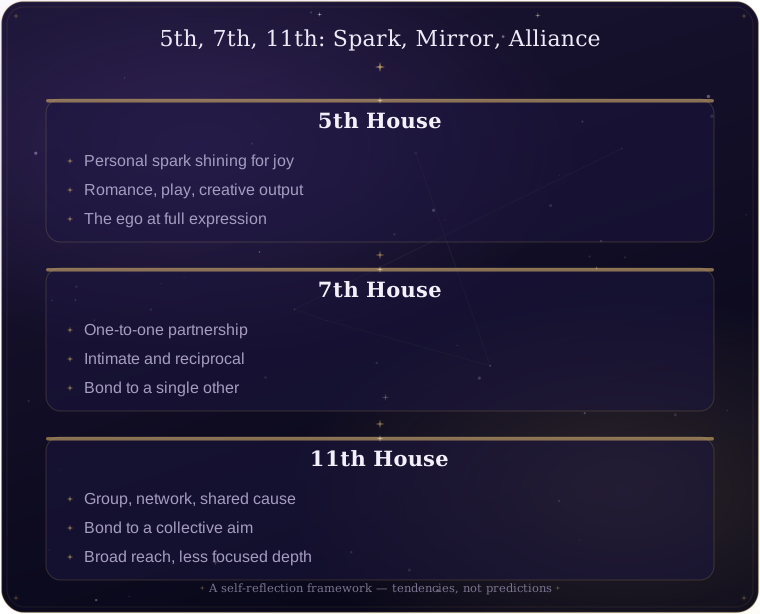
The eleventh house is most often confused with the 7th House and the 5th House, yet each answers a different question, and reading it well means accepting a trade-off rather than collapsing one into the other. The 7th House covers one-to-one partnership, the close mirror of a single significant other; the way it works is intimate and reciprocal. This house, by contrast, operates at the level of the group, the network, and the shared cause, where the bond is to a collective aim rather than a single face. To gain the broad reach and group support this sector supplies, you sacrifice the focused depth of the one-to-one tie; to gain the intimacy of the 7th, you give up the wider alignment a group can offer. Neither layer is complete alone, which is why a full reading places both.
A second comparison runs along the 5th-to-11th axis itself, and here the trade-off is sharpest. The 5th House is where your unique self wants to shine for the pure joy of it, romance, play, creative output, the individual ego at full expression. This house takes that same individuality and asks how it serves a future larger than the self. The way it functions is a deliberate handoff: personal creation in the 5th becomes contribution in the 11th. To get the collective meaning and lasting legacy this sector offers, you trade away some of the spontaneous, self-centered delight the 5th House protects. Saturn placed here can make that handoff feel especially loaded, since the person both longs for the group and quietly fears being absorbed by it.
A third confusion worth untangling is the overlap with the 10th House of career and public standing. The 10th is about your visible role and the reputation you build through it; the way it works is vertical, a climb toward recognition. This house is horizontal instead, concerned with peers, allies, and the causes you join as an equal rather than the status you reach. To gain the lateral support and shared purpose this sector offers, you set aside the solo authority the 10th rewards; to gain the public standing of the 10th, you give up some of the easy belonging a group of equals provides. A person with strong placements in both often feels the pull between leading from the front and standing shoulder to shoulder, which is less a contradiction than a rhythm to learn. Knowing which house a given motivation belongs to keeps a reading honest rather than blurring ambition and affiliation into one vague drive.
How to Read The 11th House in Your Chart
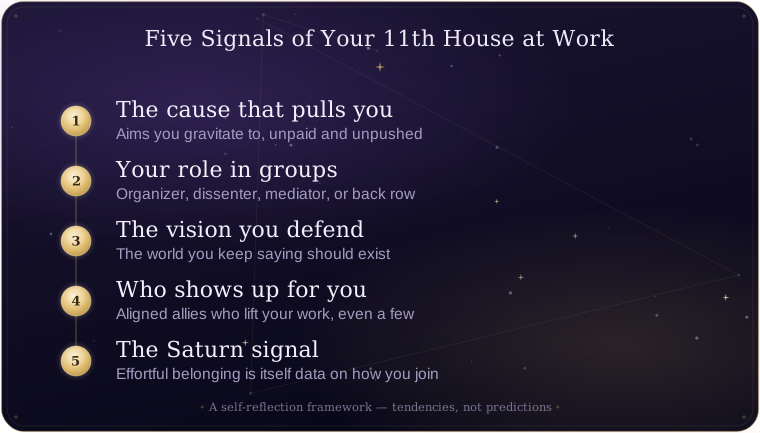
Reading this house in your own chart works best as a set of observable cues rather than a memory test. Find the sign on the house cusp and any planets inside it, then look for these signals:
- The cause that pulls you. Notice which shared aims or communities you gravitate toward without being paid or pushed.
- Your role in groups. Track whether you organize, dissent, mediate, or hang back when a collective forms around a goal.
- The vision you defend. Watch for the future you argue for in conversation, the world you keep saying should exist.
- Who shows up for you. Observe the aligned allies who appear when your work needs lift, even if there are only a few.
- The Saturn signal. If belonging feels effortful or guarded, that hesitation itself is data about how you join.
Common Misreadings
The most common misreadings of this house all flow from the narrow "friendship" label, and three trip up readers more than any others:
- Misread: it only matters if you are highly social. In practice, the house tracks alignment with a cause and a vision, not headcount, so a solitary person can have a richly active sector here.
- Misread: it is purely about networking for gain. The traditional reading frames it as the "Good Spirit" of mutual support and shared ideals, not transactional contact-collecting.
- Misread: an empty house means no community or future. A house with no planets simply runs on its cusp sign and that sign's ruler; the life area stays live, just quieter.
The 11th House at a Glance
| Property | How It Works | Natural Ruler | How to Observe |
|---|---|---|---|
| Friendship and alliance | Connects you to people who share your aims | Aquarius / Saturn (traditional), Uranus (modern) | Notice who shows up when your work needs support |
| Groups and community | Folds individual effort into collective action | Aquarius / Uranus | Track the role you take when a group forms |
| Hopes and future vision | Directs energy toward a longed-for outcome | Aquarius / Saturn | Listen for the future you keep arguing should exist |
| Gains from effort | Returns support and reward for contribution | Jupiter (its traditional joy) | Watch what flows back after you give to a cause |
Questions People Ask About The 11th House
What does this house govern in astrology?
It governs friendship, groups, social ideals, and your vision for the future. The placement shows how your individual gifts connect to a collective and what kind of community supports your long-range aims.
Is this house only about friends?
No. Friendship is one expression, but the sector more broadly covers shared causes, group belonging, and hopes. A solitary person aligned with a larger purpose can still have a strongly active placement here.
What is it known as in traditional astrology?
It was called the "Joy of Jupiter" and the place of the "Good Spirit," a fortunate sector of alliance and support. The label points to benefit arriving through aligned community rather than solo effort.
What happens if my house here is empty?
An empty house operates through its cusp sign and that sign's ruler, so the life area remains active. It simply is not a high-focus arena in this particular chart, not a sign that community is absent.
Reflection Prompts
- Think of a recent moment when a group's shared aim genuinely energized you; what was the cause?
- Recall a time your individual work was carried further by a few aligned allies.
- Name one future you quietly hope for; which community would help build it?
Related Reading
These topics extend the house framework without repeating what is above:
- the 7th house of partnership — clarifies how one-to-one bonds differ from the group alliance this house tracks.
- Saturn through the houses — a closer look at this transit unpacks the complex belonging signal Saturn brings to this placement.
Take Action
Place this house inside the whole wheel before reading it in isolation. Read the full Astrological Houses guide to see how this house connects to the eleven other life areas, and you come away with a working map of the entire chart. More than a list of meanings, you gain a steadier sense of where your individual path meets the larger world it belongs to, and a clearer view of which alliances and hopes are quietly shaping the direction you are already moving in.
Sources
- Liz Greene — helped establish the depth-psychological lineage that reads each house as a field of development
- Howard Sasportas — advanced the psychological reading of the houses as arenas of lived experience, including the individual-to-collective axis