
What is The 1st House?
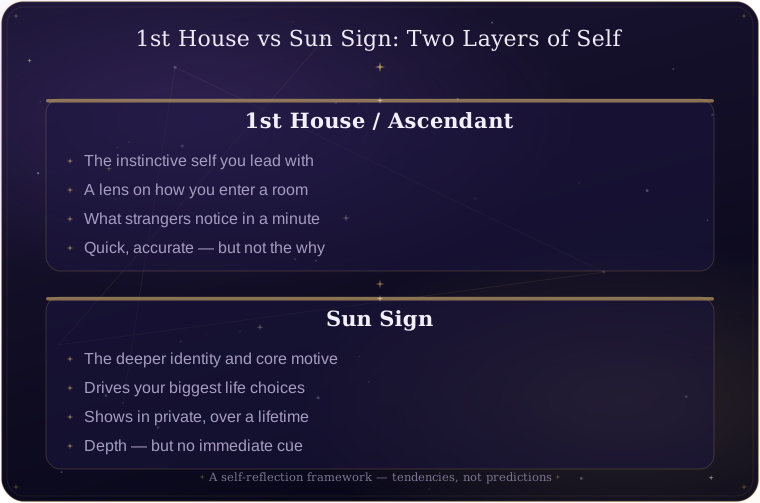
The 1st House is the segment of the birth chart that opens at the Ascendant, the exact zodiac degree rising on the eastern horizon at the moment you were born. In everyday terms, the 1st house meaning is the instinctive self you lead with, not the deeper identity your Sun sign carries.
- Shapes first impressions, physical presence, and the manner in which you meet the world
- Anchored by the Ascendant, the point many people call the rising sign
- Often mistaken for the Sun sign, though the two answer very different questions
Think of it as the front door of the chart, the part of you that walks into a room and registers with other people before you have said a word. That placement at the very start of the chart is why it sits at the head of the wider pillar guide to the astrological houses, which maps how all twelve houses divide a chart and where the self-presentation layer fits among them.
Where the 1st House Comes From: A Short History
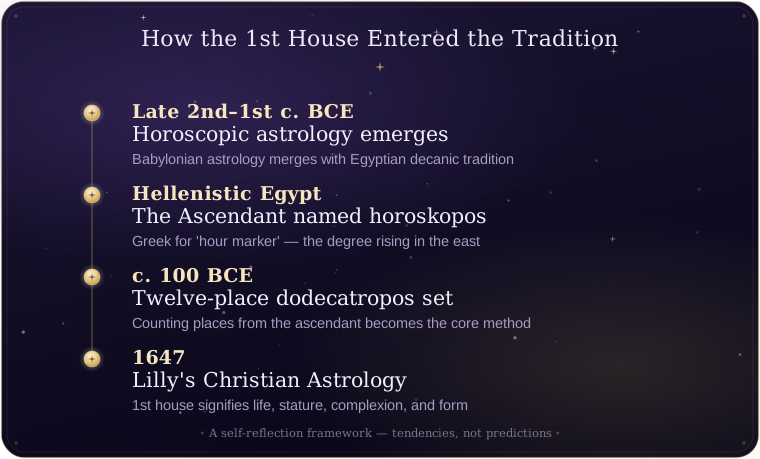
The 1st house has a traceable history, not just a set of trait descriptions. Horoscopic astrology — the tradition that introduced the Ascendant and the system of twelve houses — developed in the Hellenistic Mediterranean, especially Egypt, around the late 2nd to early 1st century BCE, when Babylonian astrology merged with the Egyptian tradition of decanic astrology (Hellenistic astrology, Wikipedia). The 1st house is anchored to that rising point: the Ascendant is called the horoskopos, Greek for "hour marker," the degree rising on the eastern horizon at birth (Hellenistic astrology, Wikipedia). Encyclopaedia Britannica describes how astrologers regarded "the one that is momentarily in the ascendant as the first place, the one to follow it as the second, and so on," forming the twelve-place dodecatropos — what later house language calls the first house — a method that has been the essential procedure of astrology since about 100 BCE (Encyclopaedia Britannica). The traditional signification of the house has centered on the self, the body, and vitality for two millennia: in a community transcription of William Lilly's Christian Astrology (1647), the first house "hath signification of the life of man, of the stature, colour, complexion, form and shape of him that propounds the Question, or is born" (Skyscript, transcription of Lilly's Christian Astrology, 1647). Read these as the documented history of how the tradition has defined the first house, not as empirical claims about outcomes.
Why It Matters for Self-Awareness
Understanding 1st house meaning matters because most people reach for their Sun sign to describe themselves, then feel quietly misread. The gap shows up in a few predictable ways:
- The wrong label sticks. Someone reads a Sun-sign profile, decides it does not fit, and never learns that the Ascendant describes the self they actually lead with day to day.
- The instinct goes unnamed. People sense they greet the world one way and feel another way underneath, yet they lack the language to separate the reflex from the core motive.
- Self-criticism creeps in. Without the 1st house frame, a reserved rising sign can read its own caution as a personal flaw rather than a recognizable, workable pattern.
In twelve years of integrating psychological frameworks with evolutionary astrology, I have found that this single distinction tends to land harder than almost any other, because it lets people stop forcing two different parts of themselves into one description. Picture someone with a guarded Capricorn rising and an expressive Leo Sun: friends meet the careful exterior first and only later find the warmth, and that person can spend years feeling like neither sign quite fits. Or consider a soft Pisces rising over a driven Aries Sun, where colleagues read gentleness and miss the competitive engine underneath, leaving the person privately frustrated at being underestimated. Naming the 1st house separately from the Sun gives that frustration somewhere to go, because it reframes the mismatch as two real layers rather than a personality that does not add up. The spoke worth reading next to this is the explainer on the Ascendant and rising sign, which goes deeper on how that rising degree is calculated.
The 1st House vs Adjacent Concepts: How It Works + Trade-offs
1st house meaning differs from the Sun sign because the two describe separate layers of a person, and reading one as though it were the other is where most self-descriptions break down. The Ascendant works like a lens at the front of the chart, filtering how your energy enters a situation before any conscious choice kicks in, while the Sun describes the motive you move toward across a lifetime. To get the quick, accurate read the rising sign offers, you sacrifice depth, because the Ascendant says nothing about why you act as you do. To reach that deeper why, you turn to the Sun, but you lose the immediate behavioral cue that explains how a stranger first experiences you. A simple test makes the split obvious: ask what a stranger notices about you in the first minute, then ask what actually drives your biggest life choices, and you are usually describing two different signs.
A second comparison sharpens the picture. Planets sitting inside the 1st house behave differently from the Ascendant itself: the Ascendant sets the overall tone of arrival, while a planet there, say Mars or Saturn, colors that arrival with its own charge. Building on the framework Howard Sasportas mapped, the way it works is that the 1st house first asks whether you feel entitled to take up space at all, and any planet in the house then sharpens or complicates that question. To lead with Mars in the 1st, you gain force and immediacy, but you sacrifice some ease, because that same drive can read as impatience before people meet the warmth underneath. Saturn in the same spot trades spontaneity for caution: you gain self-control, yet you may carry a heavier self-consciousness, as if each entrance were a test you are not sure you pass.
A third distinction often gets skipped. The Ascendant is involuntary, while the image you deliberately craft, the polished version you choose for an interview or a first date, is a conscious overlay. To present a curated self, you gain control over the message, but you sacrifice some authenticity, because the instinctive 1st house tone tends to leak through anyway in your posture, your pace, and your tone of voice. This is why a rehearsed introduction can still feel slightly off to the listener: the deliberate words say one thing while the rising sign quietly says another, and most people register that second signal without knowing why.
How to Read The 1st House in Your Chart
Reading the 1st house starts with noticing concrete signals rather than memorizing trait lists, the grounded, psychological approach Liz Greene helped establish. Watch for these in your own chart and behavior:
- Find your Ascendant first. Locate the sign on the cusp of the 1st house; that rising sign is your starting point, not your Sun sign.
- Watch your entrances. Notice how you physically walk into an unfamiliar room, since the 1st house often surfaces in that unguarded first move.
- Catch your reflex reaction. Track what you say in the first three seconds of surprise, before deliberate thought edits the response.
- Listen to strangers. Pay attention to the words people use to describe you on first meeting; they often name your rising sign, not your core self.
- Read any 1st-house planets. If a planet sits in the house, observe how its flavor, drive, caution, or charm, tints every entrance you make.
Taken together, these signals point to one quiet truth: the self you lead with is observable from the outside long before you have words for it on the inside, which is why other people sometimes name your Ascendant more accurately than you do.
Common Misreadings
The most common 1st house meaning mistakes come from collapsing the house into something it is not, and because these errors feel intuitive, they get repeated everywhere. Here is what popular write-ups get wrong, and what is actually true:
- Misread: the rising sign is just a "mask." In practice it is a genuine layer of self, the instinctive way you engage, not a costume hiding the real you.
- Misread: the Sun sign overrides the Ascendant. The two operate side by side; the Sun is your motive, the 1st house is your approach, and both are equally real.
- Misread: a quiet rising sign means a quiet person. A reserved Ascendant can sit over a bold Sun, which is exactly why people feel mislabeled by single-sign profiles.
- Misread: you can "fix" an Ascendant you dislike. You can work with it consciously, but the instinct does not vanish; the aim is to recognize the pattern, not erase it.
Each correction points the same direction: the 1st house is a real, observable layer of who you are, not a disguise to see past.
How Common Is Belief in the Rising Sign? What Surveys Show
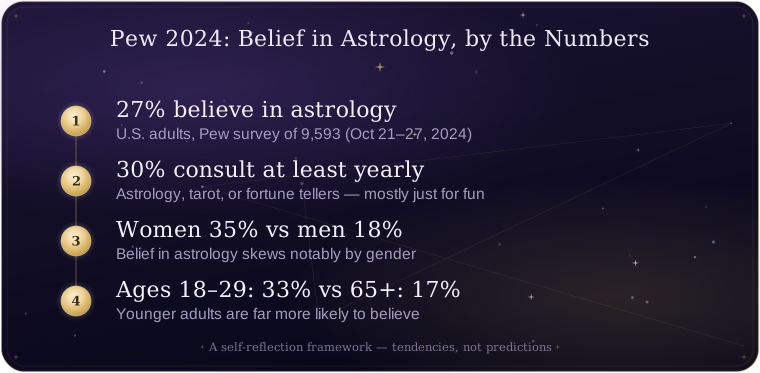
The honest quantitative lever for a subjective topic like this is not an "effect" statistic — none exists — but belief-and-practice prevalence. In a fall 2024 Pew Research Center survey of 9,593 U.S. adults (conducted Oct. 21-27, 2024), 27% said they believe in astrology, meaning that the position of the stars and planets can affect people's lives; and 30% said they consult astrology or a horoscope, tarot cards, or a fortune teller at least once a year, though most who do so say it is mostly "just for fun" (Pew Research Center). Belief skews by gender and age: 35% of women versus 18% of men, and 33% of adults ages 18-29 versus 17% of those 65 and older, said they believe in astrology (the age and gender breakdown appears in the survey's demographic table, October 2024 column, of the Pew report PDF). The point for the 1st house is editorial: because so many people engage with rising-sign and Ascendant content casually, the most common error is treating a popular single-sign read as the whole self — which loops back to this page's thesis that the 1st house is one observable layer, not a verdict.
The 1st House at a Glance
| Property | How It Works | Natural Ruler & Sign | How to Observe |
|---|---|---|---|
| First impressions | The rising sign filters how your energy enters a room | Ascendant degree | Notice the vibe strangers name before they know you |
| Physical presence | Colors appearance, posture, and bearing you project | Ascendant and Mars | Watch how you physically cross a threshold |
| Instinctive self | The reflex you lead with before conscious thought | Aries (natural sign), Mars (natural ruler) | Catch your unscripted first reaction under pressure |
| Self-image | How you picture and assert the words "I am" | Any 1st-house planets | Listen for how you describe yourself to new people |
Questions People Ask About the 1st House
Is the 1st house the same as my rising sign?
Not quite, though they are tightly linked. The rising sign is the specific zodiac sign sitting on the 1st house cusp, while the house itself is the whole field of self-presentation, physical bearing, and instinctive approach that the Ascendant opens up.
Why does my 1st house feel more accurate than my Sun sign?
Because the 1st house meaning describes the self you lead with in real time, which is exactly what other people react to first. Your Sun sign runs deeper and tends to show up more in private settings or across the long arc of your life, so it can feel less obvious day to day.
Can the 1st house change how I come across?
It shapes how you come across far more than who you are underneath. The same core person can read as brisk, gentle, or guarded on first contact depending on the rising sign and any planets sitting in the house.
Do planets in the 1st house matter more than the Ascendant?
They work together rather than competing for control. The Ascendant sets the baseline manner of your arrival, and a planet in the house adds its own particular charge, drive, caution, or charm, to that arrival instead of replacing it.
Reflection Prompts
- Think of a recent moment when you first walked into a room full of strangers; what did your body do before you spoke?
- Recall a time someone described you on first meeting; how did their read compare with how you feel inside?
- Notice your next instinctive reaction under mild pressure; does it match the self you usually claim, or the one you lead with?
Related Reading
- explainer on the 7th house of relationships — the opposite house, showing how the self you lead with meets the people you partner with.
- guide to reading your Sun sign — the core-identity layer that pairs with the 1st house to complete the full picture of who you are.
Take Action
Open your birth chart, find the sign on your 1st house cusp, and read that rising sign next to your Sun sign side by side. You come away with a clear, two-layer picture: the instinctive self you lead with and the deeper identity that sits beneath it. Seen together, they tend to explain the small daily gap between how the world meets you and how you experience yourself, and that gap is where honest self-awareness usually begins. Read the full Astrological Houses guide to place the 1st house within the whole chart.
Sources
- Howard Sasportas — developed the psychological reading of the astrological houses this page draws on, especially the 1st house as the self you lead with rather than a surface image.
- Liz Greene — shaped the depth-psychology lineage that treats the rising self as a genuine layer of identity instead of a mask to see past.