
What is The 2nd House?
The 2nd House is the sector of an astrological chart that governs what you earn, what you own, and the quieter question sitting beneath both: how much you believe you are worth. In practice, 2nd house astrology maps the link between material security and self-worth.
- Tracks income, possessions, and the resources you can genuinely call your own
- Reads self-worth as the felt sense underneath how you handle money
- Often misread as a plain money-meter rather than a signal about values
This house belongs to the broader pillar guide to the twelve astrological houses, which maps how each life area connects to the next. Where the 1st house asks "who am I," the 2nd house asks "what is mine, and what do I value enough to keep." Reading it well means treating money as evidence of an inner relationship, not just a balance in an account.
Why It Matters for Self-Awareness
Most people meet 2nd house astrology expecting a forecast about salary or savings, and that expectation is exactly where the misreading starts. Reducing the house to income alone hides its real subject: the ongoing negotiation between feeling secure and feeling worthy. In over a decade of integrating psychological frameworks with evolutionary astrology, including community-counseling work and thousands of hours of chart consultation, I have watched the same pattern surface again and again—a person arrives describing a money problem that turns out to be a worth problem wearing a financial costume. The lineage descending from Liz Greene's psychological astrology reads that costume as a projection of inner scarcity rather than a fixed fate, which means the house works as a starting point instead of a verdict.
That blind spot tends to show up in a few recognizable ways:
- The income trap. Readers check the house for earnings and stop there. They miss that it also tracks what a person feels entitled to keep, to ask for, and to protect, so a raise rarely fixes a worth question the salary never created.
- The security gap. A full bank account can sit beside a hollow sense of worth. The house describes that gap with unusual precision, which is why financial comfort does not always translate into feeling like enough.
- The values silence. Few people pause to name what they genuinely value before they spend. Without that clarity money leaks toward whatever soothes the moment, and the deeper story stays out of view.
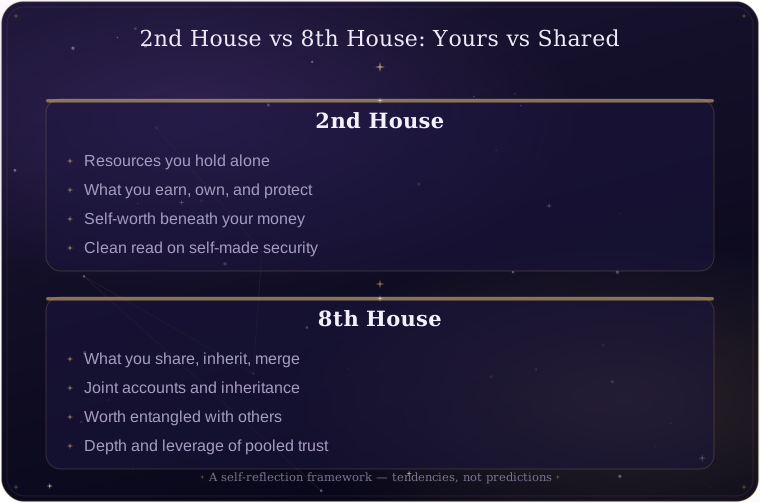
This is also why a sibling placement like spoke article on the 8th house and shared resources reads so differently: it handles what you merge, inherit, and owe alongside other people, while the 2nd house holds what is yours alone to build. Keeping the two distinct stops you from blaming a partner for a worth question that lives squarely in your own chart.
The 2nd House vs Adjacent Concepts: How It Works + Trade-offs
2nd house astrology is easy to confuse with the placements closest to it, and separating them is the clearest way to see how the house actually works. Each comparison below carries a trade-off—an emphasis you gain and something you give up in return:
- Versus the 8th house. The 2nd governs resources you hold alone, while the 8th governs what you share, inherit, or merge with others. Picture one person quietly building personal savings and another untangling a joint inheritance; both involve money, yet only the first is pure 2nd house territory. To gain a clean read on self-generated security, you sacrifice sight of how entangled your worth already is with other people.
- Versus the sign Taurus. Taurus describes the texture of how you hold resources—slowly, sensually, with attachment—while the house is the life arena where worth actually gets tested. The sign tells you the style; the house tells you the stage on which that style performs. To gain the sign's vivid detail, you sacrifice the situational context that only the house supplies.
- Versus Venus, the natural ruler. Venus shows what you find valuable and beautiful, while the house shows the practical ground where those preferences meet real money. Building on the framework Howard Sasportas established, the way it functions is less a bank balance than a barometer of felt worth, so to prize Venusian taste you sometimes sacrifice the discipline the house quietly demands when funds run tight.
Held together, these lenses keep you from collapsing the house into a single keyword and let you read it as a living relationship between what you own and who you believe yourself to be.
How to Read The 2nd House in Your Chart
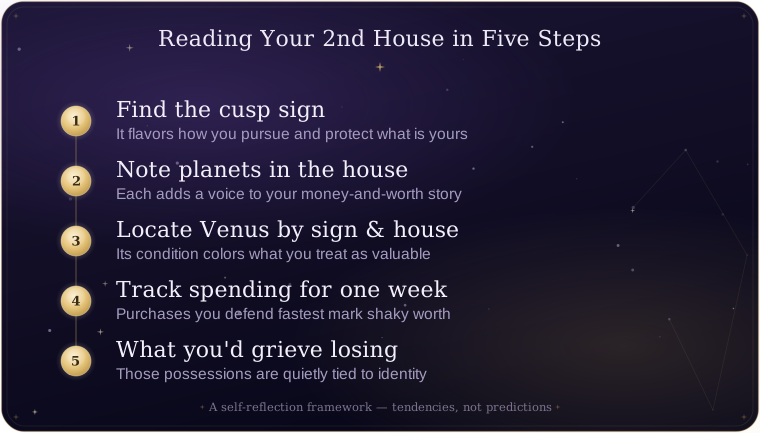
Reading 2nd house astrology in your own chart means watching for concrete signals rather than memorizing keywords. Look for these patterns in order:
- Find the sign on the 2nd house cusp; it flavors how you instinctively pursue and protect what is yours.
- Note any planets sitting in the house, since each one adds a distinct voice to your money-and-worth story.
- Locate Venus by sign and house, because its condition colors what you treat as genuinely valuable.
- Track your spending for one week; the purchases you defend most quickly point to where worth feels shaky.
- Notice which possessions you would grieve losing, as those reveal what you have quietly tied to your identity.
Common Misreadings
The friction most readers bring to 2nd house astrology comes from a handful of stubborn misreadings, and correcting each one changes the whole interpretation:
- Misread: it only means money. Income is just the visible surface. The house actually tracks the self-worth that shapes how you earn, keep, and spend, which is why two identical salaries can feel completely different from the inside.
- Misread: a strong 2nd house guarantees wealth. The placement describes your relationship with resources, not a fixed financial outcome. Genuine comfort and quiet insecurity can occupy the same chart at once, and prosperity tends to follow how you handle worth rather than the reverse.
- Misread: an empty 2nd house means money trouble. No planets in the house simply means its story is told by the cusp sign and that sign's ruler. It signals nothing broken about your finances, only that the theme plays out more subtly.
- Misread: the house is purely material. Values, natural talents, and what you consider beautiful all live here too. That is precisely why thoughtful readers treat it as a house of worth rather than a house of wealth alone.
Notice that every correction points the same direction: away from a fixed prediction and toward a pattern you can observe and gradually reshape.
The 2nd House at a Glance
| Property | How It Works | Natural Ruler & Sign | How to Observe |
|---|---|---|---|
| Core theme | Links material security to self-worth | Ruled by Venus, earthy Taurus | Notice where money and self-esteem rise and fall together |
| Natural sign | Taurus lends steadiness and attachment | Earth element, fixed mode | Watch for slow, deliberate handling of what you own |
| Resources held | Defines what is yours alone to earn and keep | 2nd of twelve houses | List the assets you feel are truly "mine" |
| Polarity | Balances personal worth against shared resources | Opposes the 8th house | Compare what you hold solo versus what you merge |
Common Questions About 2nd House Astrology
What does the 2nd house mean in astrology?
The 2nd house governs personal resources—money, possessions, and earning power—alongside the self-worth that quietly underlies them. It reads less as a wealth forecast and more as a map of how you value yourself.
Is the 2nd house only about money?
No; money is the visible layer, while the deeper subject is self-worth, personal values, and the talents you can convert into resources. Two people with identical incomes often experience this house in completely different ways.
What happens if the 2nd house is empty?
In 2nd house astrology, an empty house simply means no planets sit there, so you read the cusp sign and its ruler instead. It says nothing negative about your finances or your sense of worth.
Which planet rules the 2nd house?
Venus is the natural ruler, linking the house to value, beauty, and what you find worth keeping. The sign on the cusp and its ruling planet then refine the picture for your specific chart.
Reflection Prompts
- Think of a recent purchase you justified instantly—what feeling were you trying to secure or soothe in that moment?
- Recall a time you undercharged or downplayed your value—what belief about your worth was quietly driving the choice?
- Notice the last thing you refused to spend on yourself—what does that hesitation say about what you feel you deserve?
Related Reading
- explainer on Venus as the planet of value and attraction — shows how the 2nd house's ruler shapes what you treasure
- House (astrology) (Wikipedia) — context on how astrological houses are defined and numbered
Take Action
Take one placement you found in your own 2nd house and trace it through a full week of spending, saving, and earning decisions. Read the full Astrological Houses guide to see how the 2nd house fits the whole chart, and you walk away with a map of how this single area threads into the other eleven. Done honestly, that exercise tends to turn money from a source of background anxiety into a clear mirror of what you genuinely value.
Sources
- Howard Sasportas — developed the psychological reading of the astrological houses, framing the 2nd house as a mirror of self-worth rather than mere income
- Liz Greene — integrated depth psychology with astrology, showing how inner scarcity and value can project onto outer circumstance