
What Is the 6th House in Astrology?
The 6th house, also called the sixth house, is the part of the birth chart that governs daily work, physical health, and the small routines that hold ordinary life together. In 6th house astrology, that combination is the real subject — not work on its own, not the body on its own, but the daily habits that bind them. If you searched "6th house astrology" hoping for a one-line meaning, here it is: this is the house of maintenance — how you tend a job, a body, and a schedule day after day, and how those three quietly keep one another running. It sits inside the broader pillar guide to the astrological houses, which maps how all twelve houses divide a chart. Howard Sasportas framed its core theme as self-improvement — not chasing perfection, but moving toward a steadier self through repeated daily practice. Read this way, the house becomes the feedback loop linking work habits and physical health.
- Tracks the texture of everyday life: tasks, schedules, maintenance, and self-care
- Treats work and health as one connected system rather than two separate topics
- Often dismissed as a minor "chores" house when it quietly sets your baseline well-being
Unlike the 10th house, which asks what you achieve, the 6th house asks how you get through an ordinary Tuesday — and whether that Tuesday leaves you steadier or more depleted. That distinction is the whole reason it deserves its own reading rather than being folded into a career house. Naturally ruled by Mercury and associated with Virgo, it is the most procedural house in the chart: the one that turns intention into a repeatable process.
Why It Matters for Self-Awareness
Most people who look up 6th house astrology arrive with two separate questions — one about their job, one about their health — and never connect them. That gap is exactly where the trouble starts. The 6th house treats a skipped lunch, a chaotic inbox, and a restless night as parts of the same story: when the work rhythm frays, the body usually registers it first, and when the body is depleted, the work quietly suffers in turn. Seeing this as one loop rather than two unrelated complaints is what turns the house from a dull list of chores into a real tool for self-awareness.
The split tends to surface in a few recognizable patterns, and most readers will see themselves in at least one:
- The over-organizer. With an analytical, Mercury-flavored 6th house, you may manage low-grade unease by perfecting systems — color-coding the calendar, re-checking the same task, optimizing a workflow that was already fine. Sasportas noticed that this drive for order can quietly become a way to dodge a deeper question about whether you are good enough, while the physical tension behind it goes unnoticed until it surfaces as fatigue.
- The misfit worker. A more sensitive, Neptune-flavored placement can make a rigid nine-to-five feel slowly suffocating. The body often reacts to an environment that doesn't fit long before the mind admits anything is wrong, which is why people with this signature tend to do better in flexible, creative, or caretaking work than in fixed routines that ignore their need for meaning.
- The ungrounded seeker. When the 6th house carries a strong growth signal, big insights tend to stall until they are tied to one concrete daily practice. The realization stays abstract — inspiring on a Sunday, gone by Tuesday — until a small, repeatable routine gives it somewhere to live.
In my own work — twelve years integrating psychological frameworks with evolutionary astrology, and thousands of hours spent reading charts — the people who shifted fastest were rarely the ones who overhauled an entire career. They were the ones who repaired a single recurring routine and let the effect ripple outward into both their work and their health.
Work, Service, and Health: The Three Threads of the 6th House
What makes 6th house astrology distinct from every other house is that it braids together three things most people read separately: how you work, how you serve, and how you keep your body running. The other "doing" houses isolate one strand each — the 10th takes status, the 2nd takes earning, the 1st takes vitality. The 6th insists on the seam where all three meet, which is exactly why it rewards a more careful reading than its dull "house of chores" reputation suggests.
Work vs Service — Two Different Engines
The 6th house covers work, but work here is not ambition; it is the craft of the task itself. There is a real and readable difference between a person whose 6th house is wired toward work — efficiency, output, getting the system to run clean — and one whose 6th house leans toward service, where the satisfaction comes from being useful to a specific person or team. Earth-sign placements (Virgo, Taurus, Capricorn) on the cusp often read as the former: they want the process tight. Water-flavored placements or a 6th-house Moon often read as the latter: they need the work to help someone, or it goes hollow. Many burnout cases I see are not overwork at all — they are service-wired people stuck in pure-output jobs, or output-wired people drowning in caretaking. Naming which engine your 6th house runs on is often the single most practical thing this house gives you.
Reading the 6th House for Health Anxiety
Because the 6th house governs the body's daily maintenance, it is also where chart anxiety concentrates. A heavily tenanted 6th house — especially with Saturn, Mars, or a stressed Mercury — does not forecast illness, and reading it that way is the oldest and most harmful misuse of this house. What it reliably shows is the style of your relationship with health: whether you tend to over-monitor (checking symptoms, optimizing diets, never quite trusting the body is fine) or under-attend (ignoring signals until they shout). A 6th house under tension usually points to a feedback habit that needs adjusting, not a diagnosis hiding in the chart. Reading it as "what is my body doing wrong" closes the loop too early; reading it as "how do I relate to my body's signals" is what makes it useful.
Why Daily Routine Is the House's Real Subject
Strip away the work and the health, and what is left is the most underrated theme of all: routine. The 6th house is where compounding lives. A single skipped routine rarely matters; the same routine kept or dropped across a year is what quietly decides your baseline. This is the house that explains why one small keystone habit — a real lunch, a wind-down, a fixed start to the workday — can move both your output and your mood more than any grand resolution. The 10th house gets the credit; the 6th house does the work.
How the 6th House Differs From the Houses Around It
6th house astrology is easy to confuse with the houses around it, and the distinctions are practical rather than abstract. Each neighbor shares a border with the 6th but answers a different question, and knowing which is which keeps a reading honest. The three comparisons below are the ones that actually change how you read a chart.
6th House vs 10th House — Health Habits vs Career Identity
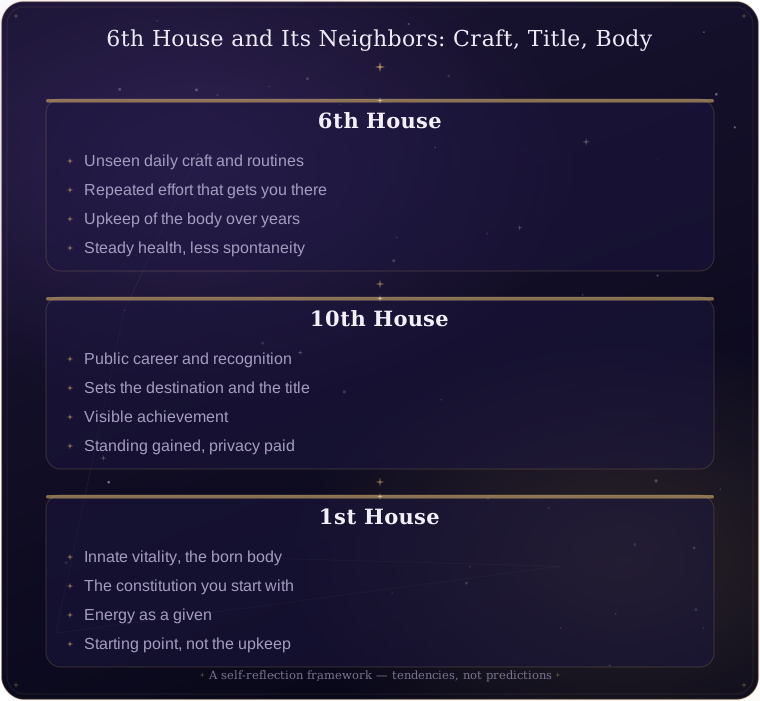
The 10th house is your public career and the recognition attached to it; the 6th is the unseen daily craft beneath that title, much the way the companion guide to the astrological houses maps the public-facing side of the same effort. The way it works is straightforward — the 10th sets the destination, while the 6th supplies the repeated effort that actually gets you there. To get the visible achievement the 10th promises, you sacrifice the comfort of unstructured days, and the 6th is where that trade is paid, one ordinary routine at a time. A practical test: if you are asking "where am I headed and how will I be seen," that is a 10th house question; if you are asking "why am I exhausted by Thursday," that is squarely the 6th.
6th House vs 1st House — Upkeep vs Innate Vitality
The 1st house is your innate vitality and the body you were born with; the 6th is how you tend that body over months and years. The first is the constitution you start with, the second is the upkeep that decides what shape it stays in. To get the steady, dependable health the 6th rewards, you give up spontaneity, because its energy favors the person who keeps consistent sleep, food, and movement over the one always chasing the next novelty. Two people can share the same robust 1st-house constitution and end up in very different places, because one tended the 6th house upkeep and the other spent the inheritance.
6th House vs 12th House — Service vs Withdrawal
The 12th house is retreat, rest, and quiet dissolution; the 6th is structured, visible activity. To get the productivity and order the 6th offers, you trade away some of the open, unstructured downtime the 12th needs — and a life that leans too hard into 6th house busyness tends to borrow that rest back later, often as burnout. The pair works best read together: the 6th is daily service to the world, the 12th house is the withdrawal that refills the well. Skip the 12th and the 6th eventually collapses; skip the 6th and the 12th's insights never touch the ground.
How to Read the 6th House in Your Chart
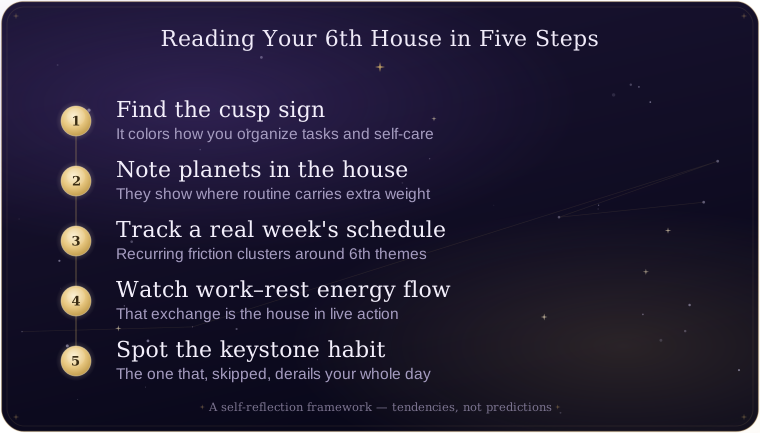
Reading 6th house astrology in your own chart is less about the sign on the cusp alone and more about noticing where work and body intersect over an ordinary week. The sign and any planets there set the tone, but the living pattern shows up in your actual schedule. A few concrete signals make it readable:
- Find the sign on the 6th house cusp; it colors how you prefer to organize tasks and care for yourself.
- Note any planet sitting inside the house, since it shows where daily routine carries extra weight or tension.
- Track your real schedule for a week; the recurring friction points usually cluster around a 6th house theme.
- Watch how energy moves between work and rest, because that exchange is the house in live action.
- Notice the small habit that, when skipped, throws off your whole day — that habit is a 6th house signature.
Sun, Moon, and Rising in the 6th House
When the Sun sits in the 6th house, identity and self-worth quietly attach to being useful and doing the work well — these are people who feel most themselves mid-task, and who can lose their footing in long stretches of unstructured leisure. A 6th-house Moon ties emotional steadiness to routine: their mood is unusually sensitive to whether they ate, slept, and moved, and a chaotic schedule reads on them as low-grade anxiety long before they name it. The rising sign's ruler placed in the 6th often produces someone whose whole approach to life runs through service and craft — they meet the world by being competent and helpful, sometimes to the point of forgetting to be cared for in return.
Saturn and Mars in the 6th House
Saturn in the 6th house is the placement most often read with dread, and most often misread. It does not promise illness; it describes a serious, sometimes anxious relationship with work and the body, where discipline comes naturally but rest feels unearned. Handled well, it builds remarkable reliability and physical resilience over time; handled poorly, it hardens into overwork and chronic tension. Mars in the 6th brings drive and stamina to daily tasks, but also a tendency to push the body past its signals — these are the people who run hot, get things done fast, and then crash. With both, the work of the reading is the same: convert the raw intensity into a sustainable rhythm rather than a sprint that ends in burnout.
When the 6th House Is Empty
An empty 6th house is common and not a problem — most charts have several empty houses simply because there are more houses than planets. It does not mean routine and health are switched off in your life; everyone lives those themes daily. You read an empty 6th house instead through the sign on its cusp and the planet that rules that sign, following that ruler to wherever it sits. If your 6th house cusp is in Gemini, for example, you trace Mercury across the chart to see where your daily-routine energy actually concentrates. The absence of planets usually just means this is a quieter, lower-drama arena for you — not an inactive one.
Common Misreadings
The most common errors in 6th house astrology come from treating the house as smaller or grimmer than it really is. Four misreadings keep readers stuck:
- It is only about chores. People shrink the house down to laundry and to-do lists and miss that those routines are the daily inputs feeding long-term health and competence — the small tasks are how self-care actually happens, not a distraction from it.
- Work and health are separate readings. The biggest misread is analyzing the job in one sitting and the body in another, when the house insists the two form a single feedback loop. Fix the schedule and sleep often improves on its own; ignore the body and the work output tends to slide.
- A "difficult" 6th house means a hard life. Older traditions framed this house as a place of illness and servitude, and that heavy label still lingers. The psychological lineage Liz Greene helped shape reads it instead as the training ground for self-mastery, where steady effort is the entire point.
- An empty 6th house means it doesn't matter. A house with no planets is not switched off; it still operates through the sign on its cusp and that sign's ruler. Everyone has daily routines, so everyone has a 6th house worth reading.
The 6th House at a Glance
| Property | How It Works | Natural Ruler & Sign | How to Observe |
|---|---|---|---|
| Daily work and craft | Turns ambition into repeatable, detailed effort | Mercury (natural ruler), Virgo (natural sign) | How carefully you organize tasks and handle detail |
| Physical health | Registers the cost of your routines before the mind does | Digestion and the nervous system | Energy dips that follow changes in your schedule |
| Habits and routine | Compounds small daily actions into long-term baselines | Earth-element steadiness | The one habit that, when skipped, derails the day |
| Service to others | Channels skill into useful, ongoing, practical help | The hands and applied skill | Where you naturally pitch in without seeking applause |
Questions People Ask About The 6th House
What does the 6th house mean in 6th house astrology?
It represents daily work, physical health, and the routines that link the two into one system. Rather than predicting events, it shows the patterns in how you maintain your life day to day.
Is the 6th house a "bad" house?
Older traditions linked it to illness and servitude, which gave it a heavy reputation. Modern psychological astrology reframes it as the house of skill-building and self-care, where consistent effort tends to pay off.
What does an empty 6th house mean?
An empty 6th house is common and not a problem; it simply means no planets emphasize the area directly. You read it instead through the sign on the cusp and the planet that rules that sign.
How is the 6th house different from the 10th house?
The 10th house is your public career and status, while the 6th is the daily work and routine underneath it. One is the title; the other is the repeated effort that earns it.
Reflection Prompts
- Think of a recent week when work felt chaotic — what happened to your sleep, meals, or energy in the same stretch?
- Recall one small daily habit you dropped lately, and notice how its absence showed up in your mood or focus.
- Look at the part of your routine you protect most fiercely — what does guarding it reveal about what you actually need?
Related Reading
- companion page on the 12th house — the retreat-and-rest counterpart that balances the 6th house's daily activity.
- guide to Mercury in the natal chart — the natural significator behind the 6th house's analytical, detail-focused style.
- House (astrology) (Wikipedia) — background on how the houses are defined and counted.
Take Action
Pick one routine this week — a single meal, a wind-down, or a start-of-work ritual — and track how it shapes both your output and your mood. Within a few days you'll start to see the loop the 6th house describes: the quiet exchange between what you do and how you feel. Read the full Astrological Houses guide to see the 6th house in the whole chart, and the daily patterns you've been treating as separate will begin to read as one coherent design for a steadier, more deliberate life.
Sources
- Howard Sasportas — developed the psychological reading of the houses, framing the 6th house as a path of daily self-improvement rather than mere duty
- Liz Greene — helped establish the modern psychological school of astrology that this interpretation of the 6th house draws on