
What is The 7th House?
The 7th House is the sector of an astrological chart that governs one-to-one relationships — marriage, committed partnership, business alliances, and even open rivals. Sitting directly opposite the 1st house of self, it marks the Descendant, the angle where the chart turns from "me" toward "the other." In psychological astrology, 7th house astrology reads as a mirror of the qualities you project onto close partners — a view worth placing inside the broader pillar guide to the astrological houses. It describes less the partner you end up with and more which disowned parts of yourself you tend to meet in them. The house works by polarity: traits you under-claim on your own side of the chart tend to arrive, magnified, through the people you draw close. Read this way, the Descendant becomes less a forecast of your spouse and more a map of what you have left for others to carry.
- Marks the Descendant, the relational opposite of your rising sign and presented self
- Mirrors traits you under-claim in yourself and then notice strongly in partners
- Often misread as a marriage forecast rather than a tool for self-recognition
Why It Matters for Self-Awareness
Most people meet 7th house astrology as a marriage question — who, when, and whether it lasts. That framing is not wrong, but it stops at the surface and skips the more useful work. This mirror reading, building on the framework Liz Greene established, treats the house as a route to self-knowledge rather than fortune-telling. In twelve years of integrating psychological frameworks with evolutionary astrology, including thousands of hours of chart consultation, I've found that readers who only ask "who will I marry?" tend to miss what the house is actually showing them. The confusion usually shows up in a few recognizable ways:
- The forecast trap. People treat the house as a prediction engine for a wedding date and never ask what they keep handing partners to carry for them.
- The blame loop. When a relationship strains, the easy story becomes "wrong partner" rather than "a quality of mine I have not yet owned."
- The missed mirror. The traits that most irritate or dazzle you in a partner are often the very ones the Descendant is asking you to claim in yourself.
Consider the familiar pattern of someone who keeps ending up with controlling partners. The marriage-only reading treats this as bad luck in love and simply waits for a kinder match to arrive. The mirror reading asks a harder and more useful question: where has this person handed away their own authority, so that they keep meeting it, exaggerated, in someone else? Often the answer is that they learned early to stay small and accommodating, leaving their natural firmness for a partner to express on their behalf. When that disowned strength is recognized and slowly brought back inside, the outer pattern tends to loosen, and the next relationship rarely repeats the old dynamic with the same intensity.
This points to something the psychological astrologers described plainly: the people we meet in close relationship carry, for a while, the parts of ourselves we have not yet recognized. A quality you cannot accept in yourself does not simply vanish; it tends to reappear in the partners you choose, where it is far easier to admire or resent from the outside than to own from within. The 7th house names the address where this exchange takes place. That is why it rewards honest self-inquiry so much more than prediction — every strong reaction to a partner is a small map back to yourself.
The 7th House vs Adjacent Concepts: How It Works + Trade-offs
7th house astrology is easy to blur with its neighbors, yet each axis works differently and asks for a different trade-off. Reading the 7th against the spoke page on the 1st house and the Ascendant, the 8th, and the 5th sharpens what it actually does.
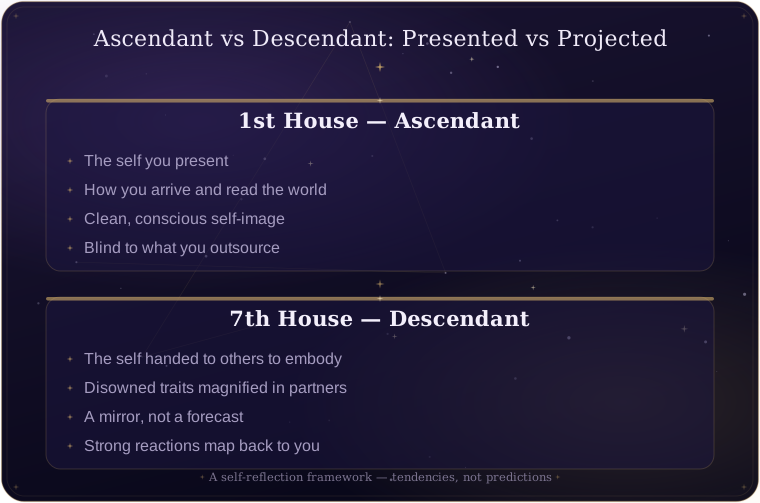
- 7th house vs the 1st house (Descendant vs Ascendant). The 1st house is the self you present; the 7th is the self you hand to others to embody. It works by simple polarity — what you under-develop on the Ascendant tends to show up, magnified, in the partners you choose. To get the clean self-image the 1st house offers, you sacrifice awareness of the traits you have quietly outsourced to the people across from you.
- 7th house vs the 8th house. The 7th is the conscious choice of partnership — contracts, commitments, the relationships you can name. The 8th is the merged, instinctive bond underneath, where shared power and vulnerability live. Read only the 7th and you gain a clear map of who you pick, but you lose sight of the deeper currents the 8th house tracks.
- 7th house vs the 5th house. The 5th is romance as play and self-expression; the 7th is the relationship as a steady mirror. Favor the 5th's spark and you get freedom and delight, but you trade away the slower self-recognition that committed partnership tends to surface.
The planets sitting in the 7th house sharpen each of these contrasts with a specific flavor. Saturn here can draw partners who feel restrictive, distant, or unavailable, mirroring a discipline or authority you have not yet claimed as your own. Mars can keep pairing you with combative or strongly driven people, reflecting an assertiveness you tend to leave on the other side of the room. Venus leans the other way, seeking harmony and charm in a partner while you quietly under-value those same qualities in yourself. In each case the house works the same way — it shows you, through the other person, the trait that is asking to come home and be integrated.
A harder version of the mirror appears when the 7th house tilts toward idealization. Instead of meeting an exaggerated trait, you meet a fantasy — the partner cast as rescuer, soulmate, or the answer to a private emptiness you have never quite named. The relationship can feel luminous until the real, limited human underneath comes into view, and the let-down often lands less like ordinary disappointment than like something collapsing. Here the trade-off is steep: you get the intoxication of seemingly perfect love, but you sacrifice the chance to see, and be genuinely seen by, an actual person standing in front of you.
How to Read The 7th House in Your Chart
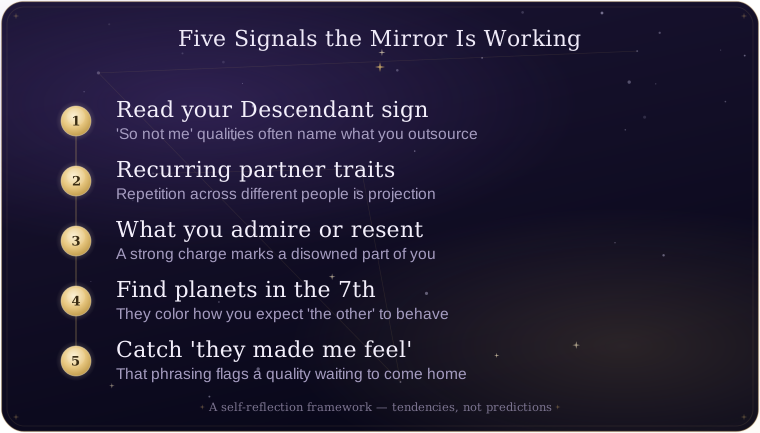
In the depth-psychological house tradition Howard Sasportas helped define, 7th house astrology becomes practical once you stop scanning for a partner type and start watching for projections. A few observable signals show where the mirror is working:
- Read the sign on your Descendant — the qualities you call "so not me" often name what you have outsourced to partners.
- Track recurring partner traits across very different people; repetition points to a projection, not a coincidence.
- Watch what you most admire or resent in a close other — a strong charge usually marks a disowned part of you.
- Find any planets sitting in the 7th house; they color how you expect "the other" to behave.
- Notice the moments you say "they made me feel" — that phrasing flags a quality waiting to be reclaimed.
These signals are most reliable when you watch them over time rather than in a single charged moment. One difficult partner proves very little; a theme that repeats across years, across genuinely different people, is the house pointing steadily at something in you. Treat each repetition not as a sentence you are stuck with, but as a clue about which quality is ready to be reclaimed.
Common Misreadings
The popular take on 7th house astrology collapses a rich mirror into a marriage horoscope, and a few misreadings surface again and again:
- "The 7th house predicts my spouse." It describes the qualities and dynamics you draw toward you, not a fixed person or a wedding date. The same placement can read very differently as you grow more conscious of what you project, which is why two people with similar charts live out very different relationships.
- "A hard 7th house means bad relationships." Tension here points to a growth question, not a verdict. It often marks exactly where self-recognition is most available, because the friction keeps drawing your attention back to the same lesson.
- "It only covers marriage." The house also governs business partners, close collaborators, and open rivals. Any defined one-to-one relationship can act as the mirror, including the people who oppose you.
- "My partner is simply the problem." Blaming the other person tends to end the inquiry before it starts. The more useful move is to ask what their most charged trait reflects back about you.
The 7th House at a Glance
| Property | How It Works | Natural Ruler & Sign | How to Observe |
|---|---|---|---|
| Core domain | Governs one-to-one bonds and "the other" | The Descendant axis | Notice who you consistently partner with |
| Natural ruler | Libra and Venus set its relational tone | Air element, relational balance | Watch where you most seek fairness |
| Psychological role | Mirrors disowned traits back through partners | Opposite the 1st house of self | Track what you over-react to in close others |
| Shadow expression | Outsources qualities you refuse to own | The projected, not the presented, self | Catch "they always..." patterns repeating |
Questions People Ask About The 7th House
What does the 7th house represent in a birth chart?
It rules one-to-one relationships — marriage, committed partnership, business alliances, and open rivals. Psychologically, it mirrors the qualities you tend to project onto the people closest to you.
Is the 7th house only about marriage?
No. Marriage is one expression, but the house covers any defined partnership, including business and close collaboration, and its deeper use is showing you which parts of yourself you meet in others.
What does it mean to have planets in the 7th house?
A planet there colors how you expect partners to behave and what you look for in "the other." It often marks a quality you find easier to see in someone else than to claim as your own.
How is the 7th house different from the Descendant?
The Descendant is the precise cusp that begins the 7th house, the angle opposite your Ascendant. The house is the wider field of partnership that the Descendant opens.
Reflection Prompts
- Think of a recent moment a partner irritated you — which quality of theirs might actually be yours, unclaimed?
- Recall a trait you most admire in someone close; where do you already carry a quieter version of it?
- Bring to mind a pattern that repeats across past relationships — what is it asking you to recognize in yourself?
Related Reading
- spoke page on the 8th house and shared intimacy — for the deeper, merged bonds that sit beneath conscious partnership.
- explainer on the Descendant and Ascendant axis — to read the self-versus-other polarity the 7th house turns on.
- House (astrology) (Wikipedia) — background on how the twelve houses are defined.
Take Action
Open your birth chart, locate the sign on your Descendant, and write down the three traits you most often notice in close partners. Reading the full Astrological Houses guide places the 7th house in context, so you can see how it speaks to the rest of your chart. The qualities you keep meeting in others are usually an invitation to recognize — and slowly reclaim — more of who you already are.
Sources
- Liz Greene — pioneered the psychological reading of relationship and the chart as a mirror of projection
- Howard Sasportas — developed the depth-psychological approach to the astrological houses this reading draws on