
What is ai astrology app?
An ai astrology app is a software application that generates personalized readings from a user's natal chart. These tools collect birth date, time, and location, then produce text about personality traits, timing themes, or relationship dynamics framed as chart-based insight.
- Spans a wide range, from tools that genuinely calculate planetary positions and house placements to apps that filter pre-written Sun-sign templates and call the result personalized
- Most outputs feel personal through inclusive language and softened hedging rather than actual celestial calculation
- A small subset — roughly 8% by content analyses of AI-generated astrological text — references real multi-variable natal chart data, including house placements and planetary aspects
These apps sit alongside the broader pillar page on astrology tools and digital chart resources, which maps the full landscape of digital interpretation tools. The gap between "sounds personal" and "is astrologically grounded" is large, and most interfaces give no clear signal about which side they fall on. Building a working picture of that landscape starts with four concepts: birth data, chart synthesis, empathy language, and the Barnum Effect.
Why It Matters for Self-Awareness
The dominant problem for anyone evaluating an ai astrology app isn't finding one — the market is wide. It's knowing whether the interpretation on screen is tied to your specific natal chart or is running on an empathy formula that would generate nearly identical text for millions of users.
That distinction matters because the two outputs feel the same — and empathy-driven output often feels more resonant on first contact, precisely because it's calibrated to produce that response. Genuine natal chart synthesis surfaces real friction: a difficult Saturn placement in hard aspect to the Moon produces a reading that acknowledges difficulty rather than smoothing it over. Empathy-first algorithms mirror a user's internal syntax and softened vocabulary, bypassing skepticism and creating the felt sense of being understood. High-review apps in this space are disproportionately the empathy-first category — they produce better feelings early, which drives ratings, regardless of chart-data depth.
Any self-reflection practice benefits from knowing whether its input is specific or generic. Treating app output as chart analysis when it's actually empathy text doesn't just produce false confidence — it quietly trains a habit of accepting undifferentiated affirmation as meaningful insight. Distinguishing one from the other isn't cynicism toward astrology; it's the baseline condition for using any of these tools in a way that serves actual reflection.
ai astrology app vs Adjacent Concepts: How It Works + Trade-offs
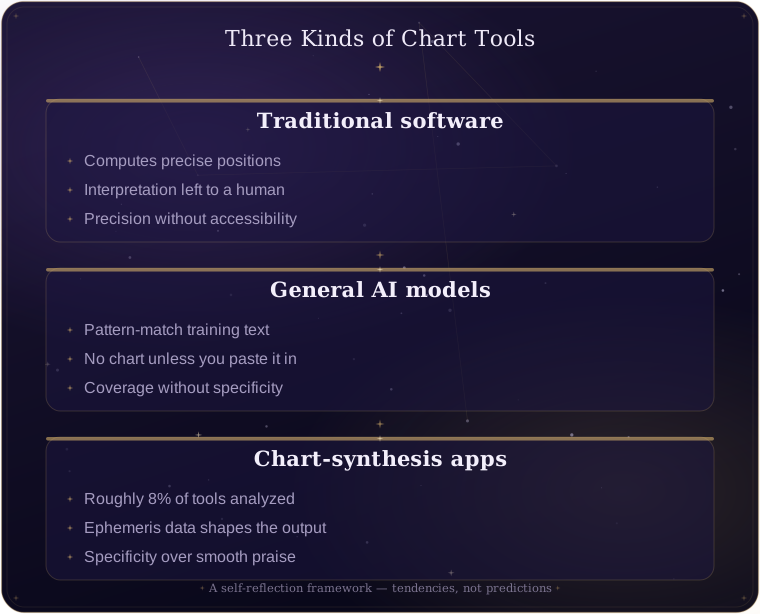
Three categories of chart-adjacent tools define most of what's available, and the differences between them are worth holding clearly:
- Traditional astrology software (chart calculation programs). How it works: the program computes precise planetary positions and displays them; interpretation is left entirely to a human astrologer or student. To get that precision, you sacrifice accessibility — someone still needs to know what Saturn in opposition to the Moon across the 4th/10th axis actually means before the math becomes insight.
- General-purpose AI language models applied to astrology questions. How it works: the model draws on training data rather than a calculated chart, producing plausible responses from pattern matching on existing astrological text. To get broad topical coverage, you sacrifice chart specificity — the model works from its training corpus on astrology books and articles, not from your calculated Ascendant, unless you paste the full chart into the conversation manually.
- Dedicated apps with genuine multi-variable chart synthesis. The roughly 8% of tools that pull planetary positions, house placements, and aspect patterns into the generation context before producing text. How it works: birth data runs through an ephemeris, producing structured chart output that shapes what the model says — a Scorpio Ascendant generates different language than a Gemini Ascendant even with the same Sun sign. To get that specificity, you sacrifice the smooth, validating tone that empathy-first apps deliver, because genuine chart synthesis introduces tension and contradiction alongside affirmation.
The comparison of AI astrology tools by chart data depth tracks specific tools across these three categories in more detail.
How to Read ai astrology app in Yourself
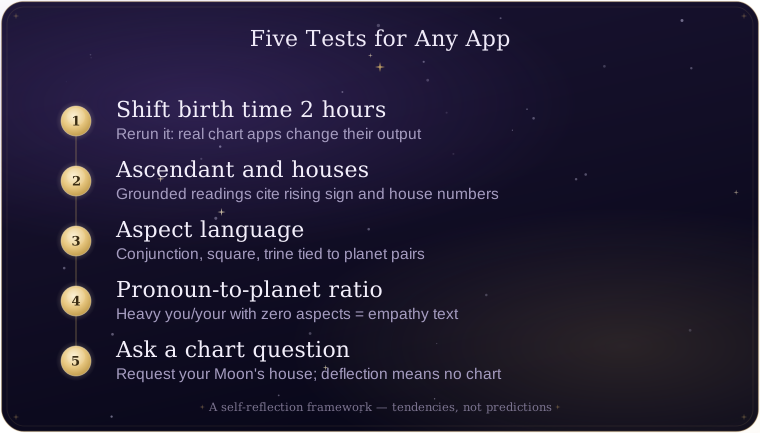
Identifying where a given ai astrology app falls on the synthesis spectrum takes deliberate testing. Most interfaces don't surface this information directly — ratings and reviews capture user experience, not chart-data depth. These observations work across most app formats:
- Shift your birth time by two hours and rerun the reading. If the output changes substantially — different Ascendant language, different house themes — the app is using chart data. Near-identical output across two different rising-sign windows means the reading is driven by Sun sign or birth year alone.
- Look for Ascendant and house references. Readings grounded in natal chart synthesis mention your rising sign, the houses occupied by personal planets, and at least one major aspect. Generic outputs stay in Sun-Moon-Venus territory and avoid house numbers entirely.
- Check for planetary aspect language. Genuine chart synthesis includes conjunction, square, or trine references tied to specific planet pairs. Empathy-driven outputs use broad phrases like "your natural sensitivity" or "your drive to lead" — descriptions applicable to large swathes of any birth cohort.
- Notice the ratio of pronouns to planetary references. High-frequency use of "you," "your," and "we" paired with softening hedges ("it may feel like," "many people in your position") is a marker of empathy-first design. High pronoun density alongside zero planetary-aspect specificity is a practical quality signal worth tracking from the first paragraph.
- Ask a chart-specific question directly. Request what your Moon's house placement suggests about how you relate to emotional security. If the app gives a generic Moon-sign response or deflects, it doesn't have your full chart in the generation context.
Common Misreadings
Several assumptions about what ai astrology app output represents tend to calcify after early use, and they shape how seriously users take the readings in ways that don't serve them.
- "Personalized" means chart-specific. Most apps apply "personalized" to mean text was filtered by Sun sign or birth month — twelve segments covering the entire human population. True natal chart personalization requires birth time and location and produces meaningfully different text for different Ascendant placements. Treat "personalized" as a marketing term until the app demonstrates otherwise.
- Accurate-feeling output equals astrologically accurate output. The Barnum Effect describes the tendency to accept vague, broadly applicable descriptions as uniquely true of oneself. Content analysis of AI-generated horoscope snippets found that over 70% included empathy markers — inclusive pronouns and hedged phrasing — while fewer than 10% referenced specific planetary positions. A reading that "really gets you" may be reflecting your own language patterns back at you rather than calculating your chart.
- Conversational warmth signals interpretive depth. Apps that feel most attuned are often the ones least tied to actual chart data. Genuine multi-variable synthesis surfaces real tension: a 12th house Sun in hard aspect to a prominent Mars doesn't produce smooth, affirming output. The reading that challenges your self-conception may actually be working harder from your data, not less.
- All tools in this category are roughly equivalent. The label covers everything from sophisticated chart-synthesis engines to Sun-sign templates dressed in chat interfaces. Ratings and download counts don't correlate with chart-data depth — the evaluation framework above (birth-time shift test, house reference check, pronoun density) applies regardless of how an app markets itself.
AI Astrology App Types at a Glance
| Property | How It Works | Chart Input | How to Observe |
|---|---|---|---|
| Sun-sign horoscope apps | Filters pre-written text by Sun sign; 12 variants covering all users | Birth date only — time and location not used in output | Identical output for all users born under the same sign |
| Full natal chart AI synthesis | Runs ephemeris calculation, then feeds structured chart data to the generation model | Full birth data: date, exact time, location | Ascendant references, house numbers, and planetary aspect language appear |
| Empathy-first conversational apps | Language model uses pronoun-heavy phrasing and mirrors user vocabulary | Minimal — birth year or sign triggers text selection | High "you / your / we" density; low or zero planetary aspect specificity |
| Vedic astrology AI (Jyotish) | Applies sidereal zodiac, nakshatra framework, and dasha period system | Full birth data plus Ayanamsa correction for sidereal positions | Nakshatra name, dasha lord, and lagna (Ascendant lord) referenced in output |
Common Questions About AI Astrology Apps
Do ai astrology apps actually calculate your natal chart?
Most don't, despite asking for birth time — the clearest test is resubmitting with a time two hours off and comparing the output word for word. Apps that genuinely calculate produce meaningfully different text when the Ascendant changes; near-identical output signals Sun-sign or birth-year templating.
What is the Barnum Effect, and why does it matter here?
The Barnum Effect (also called the Forer Effect) is the tendency to read vague, broadly applicable statements as personally accurate. In AI-generated astrology outputs, it shows up when empathy language — inclusive pronouns and softened hedges — produces text that users experience as chart-specific insight, even when no chart calculation occurred.
Can vedic astrology AI tools give chart-accurate readings?
Vedic astrology AI tools that correctly apply the sidereal zodiac and dasha period framework produce output that differs meaningfully between individuals — lagna in Scorpio generates different interpretations than lagna in Taurus. The accuracy test is the same as for any synthesis tool: does the output change when birth time changes?
What distinguishes an AI chart reading from a professional astrologer?
A working astrologer synthesizes the full natal chart holistically, tracks timing through active transits and progressions, and adjusts interpretation through conversation — a process no current app replicates. The most useful frame is "first draft of chart themes": a practical starting orientation, not a substitute for adaptive reading.
Reflection Prompts
- Think back to a reading that felt eerily accurate — would that exact phrasing have applied to most people you know?
- Recall a decision you made with astrology in mind — did you check whether the interpretation referenced your actual chart placements?
- Think of a moment when astrology contradicted your self-image — did the reading stay put, or did you quietly adjust it to fit?
Related Reading
- guide to reading a natal birth chart — for understanding which chart variables a genuine synthesis tool should reference, and how to interpret them yourself
- overview of vedic astrology and nakshatra systems — expands on the Jyotish framework discussed in the FAQ above
- Barnum Effect and astrological interpretation overview — the psychological basis for why empathy language bypasses skepticism in predictive reading contexts
Take Action
Generate your free birth chart using your exact birth date, time, and location. You'll see every planetary position, house placement, and major aspect pattern laid out — the same data a genuine ai astrology app would need to produce a reading that's actually specific to you. Having your chart in hand makes it straightforward to test any tool's output against your real placements, and often changes what you decide to trust.
Sources
- The Barnum Effect (also documented as the Forer Effect) — a documented observation in psychology describing the tendency to accept inclusive, vague descriptions as uniquely self-relevant; forms the interpretive basis for the evaluation framework in this article