What Is Am I on the Right Path?
Am I on the right path is an interpretive question in astrology that reads life direction through a handful of natal signposts instead of returning a single yes-or-no verdict. In practice it works as a symbolic lens for reflecting on life direction, not a fixed verdict. Readers usually anchor it in the natal North Node, the Midheaven, and whatever transits are active now, then treat the chart as a mirror rather than a map with one correct road. Building on the framework Howard Sasportas established for the houses and lunar nodes, the question becomes less about forecasting an outcome and more about noticing where daily choices and a longer growth arc line up. It sits alongside the broader pillar page on how to read a birth chart, which maps every placement this reading draws on.
- Reads life direction through the North Node, Midheaven, and current transits
- Treats "right" as alignment with your growth arc, not a fixed destination
- Works as reflection, not prediction — the chart describes tendencies, never certainties
Why It Matters for Self-Awareness
Understanding am i on the right path matters because the question tends to surface at real turning points — a role that no longer fits, a relationship decision, a move you keep circling — when you want language for a restlessness you can already feel. In twelve years integrating psychological frameworks with evolutionary astrology, including thousands of hours of chart consultation, I've found that people rarely need a forecast; they need a structured way to name the gap between where they stand and where they feel pulled. This mirrors the depth-psychological tradition Liz Greene helped shape, which reads placements as open questions rather than fixed answers. The reading earns its place in a few concrete ways:
- It names the pull. Instead of a vague "something's off," the North Node gives that pull a direction you can describe out loud.
- It separates mood from direction. A hard week is not the same as a wrong path, and the chart helps you tell a passing transit from a structural mismatch.
- It slows the verdict. Rather than declaring a life right or wrong, the framing invites you to sit with the question long enough to answer it honestly.
Take a common case: someone competent and well-paid who still feels a low hum of wrongness. The South Node shows why the job feels easy — they have mastered it. The North Node points elsewhere, toward a skill or role they have avoided precisely because it exposes them. Read this way, the discomfort stops looking like ingratitude and starts looking like information — not a decision made for you, but a clearer sense of what the decision is actually about.
North Node vs South Node: Which One "Right Path" Points Toward
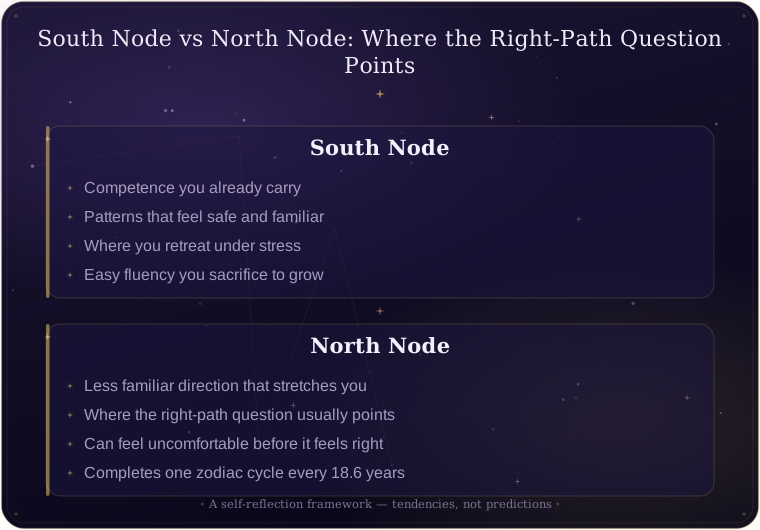
The clearest way to read am i on the right path is to compare the two lunar nodes, because they pull in opposite directions and people routinely confuse them. The South Node describes the competence you already carry — the patterns that feel safe because you have done them before. The North Node describes the less familiar direction that stretches you. How it works is straightforward: the "right path" question usually points toward the North Node, while comfort and habit keep tugging you back toward the South. The trade-off is real — to move toward the North Node's growth you sacrifice the easy fluency the South Node already offers, and that loss is exactly why the "right" path can feel wrong at first.
According to NASA, the Moon's nodes complete one full trip around the zodiac about every 18.6 years, which is why these direction questions often return on a roughly cyclical rhythm — a pattern that echoes the way Richard Tarnas has described planetary cycles lining up with lived turning points. That timing detail also separates the reading from generic purpose-coaching: it is anchored to specific placements moving at a knowable pace, not open-ended advice that could apply to anyone.
Consider two readers with the same restlessness. One has a North Node in a sign that asks for visibility while they hide in back-office work; the other has a Node that asks for depth while they scatter across surface commitments. Same question, opposite directions — which is exactly why a one-size "follow your passion" answer misses and a placement-specific read does not. You can follow this thread further through the guide to the North and South Nodes in the birth chart.
How to Read the Right-Path Question in Your Chart
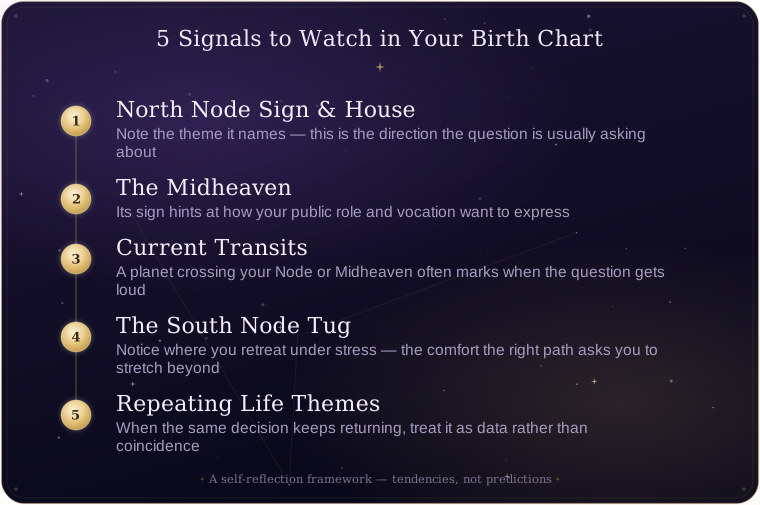
Reading am i on the right path in a chart is less about one placement and more about watching a few signals line up. Look for these:
- North Node sign and house. Note the theme it names — this is the direction the question is usually asking about.
- The Midheaven. Its sign hints at how your public role and vocation want to express, a useful cross-check against the Node.
- Current transits to either point. A planet crossing your Node or Midheaven often marks when the question gets loud.
- The South Node tug. Notice where you retreat under stress; that is the comfort the "right path" is asking you to stretch beyond.
- Repeating life themes. When the same decision keeps returning, treat it as data rather than coincidence.
Common Misreadings
Most confusion around this question comes from a few predictable misreads. Correcting them keeps the reading honest and stops it from sliding into generic life advice:
- Misread: the chart gives a yes-or-no answer. In reality it describes tendencies and tensions; the decision stays yours to make.
- Misread: the North Node promises ease. It marks growth, which can feel uncomfortable long before it starts to feel right.
- Misread: a hard transit means you chose wrong. A difficult passage often accompanies the exact stretch the Node was pointing toward.
- Misread: "right path" equals one fixed career. The framing is about alignment and direction, not a single locked-in job title.
The Right-Path Reading at a Glance
| Property | How It Works | Energy Center | How to Observe |
|---|---|---|---|
| Core question | Frames direction as alignment, not a verdict | Whole chart as context | Notice recurring "should I stay or go" moments |
| Growth direction | Points toward the unfamiliar stretch | Natal North Node (sign + house) | Track which choices feel scary but expansive |
| Comfort pull | Names the habit you retreat into | Natal South Node | Watch where you default under stress |
| Vocation cue | Signals how a public role wants to express | Midheaven | Compare your work life to your Midheaven sign |
| Timing | Flags when the question intensifies | Current transits to Node or MC | Note planets crossing those points now |
Common Questions About Am I on the Right Path
Can astrology tell me whether I'm on the right path?
No reading gives a definitive answer, and honest astrology does not claim to. It offers a symbolic framework for reflecting on direction so you can reach your own conclusion.
Which placement matters most for this question?
The natal North Node is the usual starting point because it names the growth direction. The Midheaven and current transits then refine the picture around vocation and timing.
Does a rough patch mean I took a wrong turn?
Not necessarily. Difficulty often accompanies the North Node's stretch, so a hard season can be a sign you are moving toward the direction rather than away from it.
How often should I revisit this reading?
Many people return to it around major decisions or node-related transits rather than daily. The question tends to matter most at genuine crossroads.
Reflection Prompts
- Think of a recent decision where comfort pulled one way and growth pulled another — which did you follow, and why?
- Recall a moment you felt "off track." Was it a hard week, or a real mismatch with your direction?
- Name one choice ahead of you that feels frightening but expansive — what makes it feel right?
Related Reading
- overview of the twelve zodiac sign meanings — see how your North Node's sign colors the direction it points toward.
- guide to the Midheaven and career in astrology — the vocational cross-check this reading leans on.
- explainer on how transits move through a birth chart — for understanding when the question tends to intensify.
Take Action
Run your placements before you sit with the question: generate your chart, find your North Node and Midheaven, and see exactly where the "right path" reading is pointing for you. Generate Your Free Birth Chart and you'll have the two anchors this reading depends on in front of you — and once you can see them, the question shifts from a vague worry into something you can reflect on with real intention.
This is not a clinical interpretation or mental health advice.
Sources
- Howard Sasportas — shaped the modern psychological reading of the houses and lunar nodes this framing builds on
- Liz Greene — developed the depth-psychological approach that treats chart placements as questions rather than fixed fates
- Richard Tarnas — traced how planetary cycles map onto lived turning points and moments of meaning