
What is ashlesha nakshatra?
Ashlesha nakshatra is the ninth of the 27 lunar mansions in Vedic astrology, sitting entirely within the sign of Cancer and ruled by Mercury. Its name means "the embrace," and its symbol is a coiled serpent — one of the 27 mansions catalogued in the tradition descending from the sage Parashara and mapped in any pillar guide to all 27 nakshatras. The serpent is not a warning about danger; it stands for compressed, patient energy and a Cancerian sensitivity that gets pointed inward instead of spilled outward. In everyday terms, it shows up as someone who notices what others miss and keeps a great deal to themselves. Run that through Mercury's grip on language and analysis, and it reads as a placement of concentrated, penetrating perception.
- Reads emotional undercurrents and motives that most people walk straight past
- Ruled by Mercury and rooted in Cancer's water, blending sharp analysis with deep feeling
- Easily misjudged as cold or scheming when its real function is protective, focused seeing
Why It Matters for Self-Awareness
Understanding ashlesha nakshatra matters because most write-ups stop at the serpent and call it manipulative, secretive, or unlucky — and people with a strong Mercury in Cancer, the placement any explainer on Mercury as a chart ruler describes, read those lines and quietly decide something is wrong with them. Read the way Dane Rudhyar approached any chart factor, though, it's a person-centered pattern rather than a sentence handed down at birth. The same intensity that gets flagged as a flaw is the engine behind the real talent.
Picture the friend everyone goes to with the secret they can't tell anyone else. They listen, they remember, they catch the thing you didn't quite say — and they keep it. That is this placement working well. The same person, cornered or hurt, can use that exact skill to find the soft spot and press on it. Nothing about the wiring changed; only the intent did. That single fact is the whole point, and it's the part the popular take leaves out. The friction shows up in a few predictable ways:
- The "venom only" reading. Popular summaries treat the coil as proof of deceit and ignore that it also stores patience, restraint, and precise timing.
- The missed talent. Few sources mention that this placement is built to hold and pass on hidden or specialized knowledge — counseling, research, investigative work, anything that rewards seeing under the surface.
- The self-doubt underneath. The real reason people search isn't curiosity about snakes; it's wondering whether their own depth makes them a bad person.
ashlesha nakshatra vs Adjacent Concepts: How It Works + Trade-offs
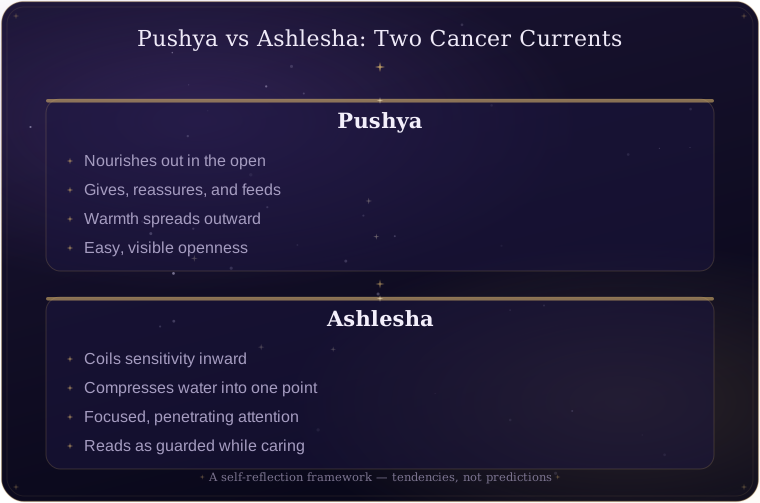
Ashlesha sits directly after Pushya in Cancer, and that contrast is the quickest way to see how it works. Pushya nourishes out in the open — it gives, reassures, and feeds. This placement does the opposite with the same Cancerian water: it coils that sensitivity inward and turns it into focused, penetrating attention. The way it functions is compression. Where Pushya spreads warmth outward, Ashlesha concentrates it into a single point of seeing. To get that depth of perception, you sacrifice some of Pushya's easy openness — which is exactly why these people can read as guarded even when they care deeply.
A second contrast sharpens it further: Mercury here versus Mercury in a breezy air sign. Air-sign Mercury skims across many topics and talks widely; in Cancer it runs through deep water instead. To gain that hypnotic, read-the-room precision, you trade range for depth — fewer subjects, but each one understood far past the surface. That trade is also where the shadow lives. The logic of the coil is plain: clinging is just sustained focused attention, and the serpent's "venom" only shows up when that attention gets weaponized — used to corner, expose, or manipulate instead of to understand. Kept healthy, the same focus becomes deep psychological seeing and the ability to hold what people tell you in confidence.
One nuance most popular pages skip: the tail end of this mansion sits at a gandanta point, the knotted junction where Cancer's water meets the fire of the next sign. Traditional Vedic astrology treats that junction as an especially raw, intense stretch — a place where both the clinging and the perception run hotter. It's a reminder that not every degree of this nakshatra reads the same; the early degrees and the final, gandanta degrees carry different pressure, and lumping them together is one reason generic descriptions feel slightly off to the people they're describing.
How to Read Ashlesha in Your Chart
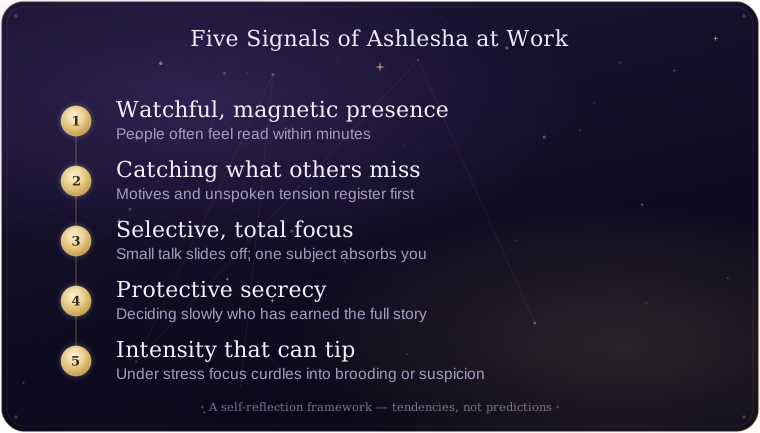
You don't need a precise birth time to recognize this energy at work. A handful of practical signals point to it:
- A watchful, magnetic presence. People often feel "read" by you within minutes, sometimes before you've said much at all.
- You catch what others miss. Motives, tells, and unspoken tension in a room register for you while everyone else keeps chatting.
- Selective, total focus. Small talk slides right off you, but one subject or one person can absorb you completely.
- Protective secrecy. You hold information close and decide slowly and deliberately who has earned the full story.
- Intensity that can tip. Under stress, the same focus curdles into brooding, suspicion, or holding on to people and grudges too long.
Common Misreadings
The same handful of misreadings is what sends people searching in the first place. Here is what the popular take gets wrong about ashlesha nakshatra, and what's actually going on underneath:
- Misread: it's the "manipulator" placement. The underlying talent is reading people accurately, and accuracy can protect just as easily as it can exploit. Manipulation is one possible misuse of the skill, not its factory setting.
- Misread: the serpent means bad luck or malice. The serpent is symbolism for stored, patient energy and penetrating insight, not a verdict stamped on someone's character. Treating an image as a verdict is how the whole sign gets slandered.
- Misread: these people are cold or detached. The attention here is intensely engaged; it simply points inward and downward instead of being performed for the room. What looks like distance is usually deep processing.
- Misread: the gift is secrecy for its own sake. The real function is carrying hidden or specialized knowledge responsibly and sensing the right moment to share it. Secrecy is the container, not the point.
Ashlesha at a Glance
| Property | How It Works | Energy Center | How to Observe |
|---|---|---|---|
| Coiled serpent symbol | Stores focus as compressed, patient energy | Ruled by Mercury, placed in Cancer | You wait and watch, then act with precise timing |
| Penetrating perception | Concentrates Cancerian water into a single point of seeing | Water element, emotional and intuitive | You sense moods and motives before they're spoken |
| Hidden-knowledge carrier | Holds and passes on specialized or private information | Mercury's link to language and exchange | You're trusted with secrets and drawn to research or counseling |
| Shadow of "venom" | Activates only when perception is weaponized | Cancer's defensiveness under threat | You notice focus curdling into suspicion or clinging when hurt |
Questions People Ask About Ashlesha
What rashi is ashlesha nakshatra in?
Ashlesha falls entirely within Cancer (Karka rashi), covering its final third from 16°40′ onward. That puts it in a Moon-ruled water sign, even though the nakshatra itself answers to Mercury.
Is Ashlesha a good or bad nakshatra?
Neither label holds up. Its focus and perception can protect and reassure or corner and manipulate — the outcome depends on how a person uses the attention, not on the placement itself.
What are the main characteristics of Ashlesha?
Sharp perception, emotional depth, persuasive communication, and a steady pull toward hidden or specialized knowledge. Under pressure, those same traits can tighten into secrecy, suspicion, or holding on far too long.
Which planet rules Ashlesha?
Mercury rules Ashlesha, which is why it leans toward language, analysis, and reading people closely. Sitting in Cancer, that Mercury works through emotion and intuition rather than cool, detached logic.
Reflection Prompts
- Think of a recent moment when you sensed what someone really felt before they said it. What did you do with that read?
- Recall a time your focus tipped into holding on too tightly. What were you afraid would happen if you let go?
- Name one piece of knowledge you guard closely. Who has actually earned the full version, and why?
Related Reading
- overview of the sign Cancer — the water sign Ashlesha sits inside, which colors its whole emotional tone.
- explainer on the Pushya nakshatra — the neighboring mansion in Cancer that makes Ashlesha's inward focus easier to see by contrast.
- guide to serpent and Naga symbolism in Vedic astrology — unpacks the imagery this placement is most often judged by.
Take Action
Ready to see where this actually lands for you? Generate your free birth chart and find exactly where the Moon, Mercury, and the nakshatras sit in your placements. You'll get a clear map of whether Ashlesha is active for you and how its focus is wired into the rest of your chart. More than a label, that's a way to recognize your own depth of perception — and to aim that watchful intensity on purpose instead of being unsettled by it.
Sources
- Parashara — the foundational sage whose lineage shaped the classical Vedic system of nakshatras.
- Dane Rudhyar — pioneered the psychological, person-centered way of reading a placement rather than treating it as fixed fate.