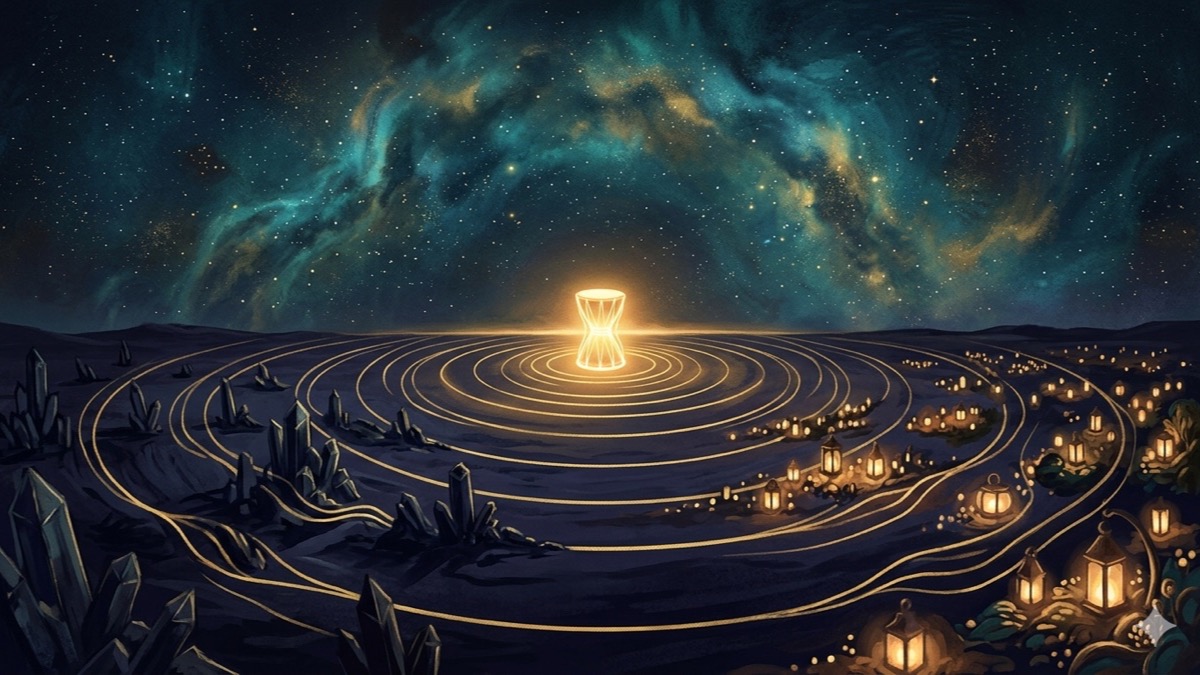
What is Dhanishta?
Dhanishta nakshatra is the 23rd lunar mansion in Vedic astrology, stretching from the late degrees of Capricorn into the early degrees of Aquarius, and its famous association with "wealth" points to mastery of cosmic rhythm and timing far more than to money. Most readers meet Dhanishta through its translation as "the wealthiest," then assume it promises material gain. The older meaning runs deeper: this is the star of the drum, of being in sync with the universe's beat. To enjoy the symbolism without the confusion, nakshatras series moon-sign pillar frames where this lunar mansion sits among the twenty-seven.
- Dhanishta is ruled by Mars, which lends it drive, discipline, and a competitive edge
- Its symbol is the Damaru, the hourglass drum of Shiva that keeps cosmic time
- Its presiding deities are the Ashta Vasus, the eight elemental gods of abundance
This is an interpretive framework for reading a birth chart, not a forecast of outcomes or financial advice.
Why It Matters for Self-Awareness
Most "Dhanishta nakshatra meaning" content stops at the flattering label and calls the star a guarantee of riches. That is exactly where readers get misled, because a symbol about timing and rhythm gets flattened into a promise about a bank balance. The discipline here is to separate the surface translation from the older symbolism: when a tradition names a star "the wealthiest," the question is what kind of wealth it meant, not how much cash it predicts. Held that way, Dhanishta becomes a small lesson in attunement — the ability to read cycles, hold a beat, and move with collective rhythm rather than against it.
The deeper read also explains why so many Dhanishta-influenced people gravitate toward timing-sensitive work. Musicians, athletes, market analysts, and community organizers all live by rhythm and the right moment, and the Mars rulership supplies the stamina to drill that timing until it is second nature. None of that requires a literal fortune. The reading that holds up is fluency with tempo and coordination, and that fluency is worth more than any single interpretation of "rich," in a chart or out of one. The Damaru drum makes the point in a single image: a drummer who cannot keep time is no drummer at all, however expensive the instrument, and the star rewards the steady hand over the full purse.
Dhanishta vs Adjacent Concepts: How It Works + Trade-offs
It helps to set the dhanishta nakshatra against two neighbors. Against the simple "wealth star" reading, the rhythm view explains how the symbolism actually works: the Damaru drum is Shiva's instrument for marking cosmic cycles, so the abundance promised is attunement to those cycles — knowing when to act, when to wait, and how to keep a group moving in time. To gain that clarity, you give up the easy fantasy of guaranteed money, but you trade it for something more useful: a model of prosperity built on timing rather than luck.
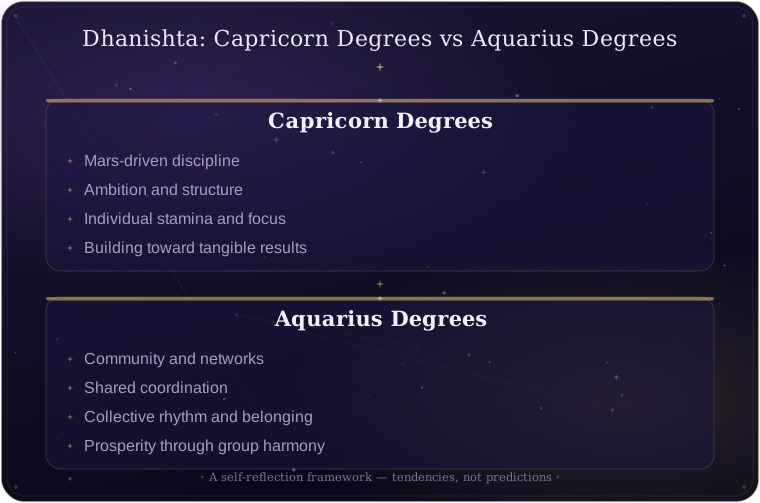
Against a single-planet reading, Dhanishta trades simplicity for nuance because it spans a sign boundary. The early part sits in Capricorn, where Mars-driven discipline pushes ambition and structure; the later part crosses into Aquarius, where the focus shifts toward community, networks, and shared coordination. The trade-off stays honest: the placement is not "all drive" or "all detachment" but a measurable blend that changes with the exact degree of the Moon, which is far more informative than a one-word verdict.
This is also where a grounded reading of astrology lives. The Ashta Vasus, the eight elemental gods who govern Dhanishta, are deities of collective abundance and elemental harmony, not personal hoarding. Read through them, the star's "wealth" is the prosperity of a well-coordinated whole — a group, an orchestra, a market in rhythm. The dhanishta nakshatra question, taken that way, lets you enjoy the symbolism of richness while crediting timing and harmony for it, and that separation is the whole point of reading the chart well.
How to Read Dhanishta in a Chart
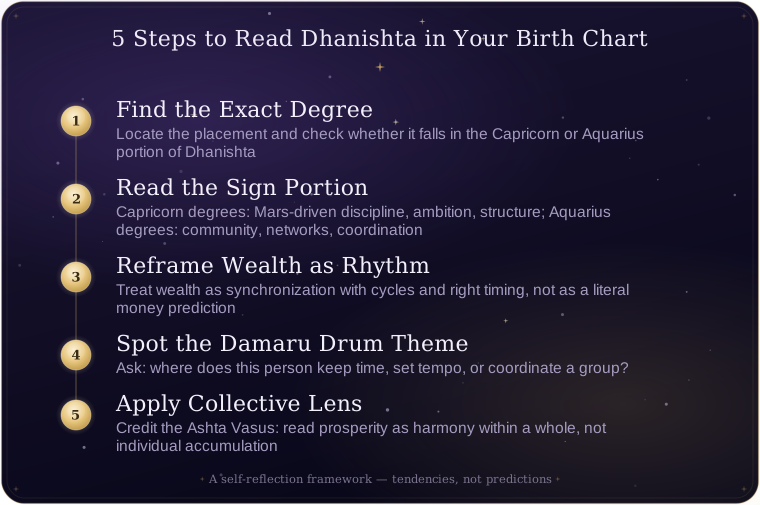
You can work with the dhanishta nakshatra yourself in a few honest steps, and the method holds whether the placement is your Moon, Ascendant, or another point.
- Find the exact degree of the placement to see whether it falls in the Capricorn portion or the Aquarius portion of Dhanishta.
- Read the Capricorn degrees for Mars-driven discipline, ambition, and structure; read the Aquarian degrees for community, networks, and coordination.
- Treat "wealth" as rhythm and timing first — synchronization with cycles — rather than as a literal prediction of money.
- Notice the Damaru drum theme: where in life does this person keep time, set tempo, or coordinate a group?
- Credit the Ashta Vasus for collective abundance, and read the star as harmony within a whole rather than individual accumulation.
Across all five steps, the same principle holds: the 23rd nakshatra rewards people who can feel a cycle and place their effort at the right beat in it. Mars supplies the energy, the Capricorn-Aquarius span sets the tone, and the Damaru drum names the skill. Read the chart for that capacity for timing first, and any reading of "wealth" will follow more honestly from it.
Common Misreadings
- Dhanishta guarantees you will be rich. The "wealthiest" name points to cosmic timing and rhythmic mastery; material gain is one possible expression, not a promise written into the star.
- The whole nakshatra behaves the same way. It does not; the Capricorn degrees lean Mars-disciplined and the Aquarian degrees lean communal, so the placement's exact position changes the reading.
- The ruling planet is Saturn because of Capricorn-Aquarius. No — Dhanishta is ruled by Mars in the nakshatra system, even though it crosses two Saturn-ruled signs; that distinction is the most common slip.
- Wealth here means personal hoarding. The Ashta Vasus govern collective abundance and elemental harmony, so the star's prosperity is shared and coordinated, not stockpiled.
Dhanishta at a Glance
| Property | What It Is | Where It Sits | How It Reads |
|---|---|---|---|
| Number | The 23rd nakshatra | Late Capricorn into early Aquarius | A bridge between discipline and community |
| Ruling planet | Mars | Across two Saturn-ruled signs | Drive, stamina, and competitive timing |
| Symbol | The Damaru drum of Shiva | Keeper of cosmic rhythm | Tempo, music, and synchronization with cycles |
| Deities | The Ashta Vasus, eight elemental gods | Govern collective abundance | Prosperity as harmony within a whole |
Common Questions About Dhanishta
What does Dhanishta mean in Vedic astrology?
It is the 23rd lunar mansion, often translated as "the wealthiest." The deeper meaning is mastery of rhythm and timing, symbolized by Shiva's Damaru drum. The dhanishta nakshatra is less about money than about being in sync with cosmic cycles, which is why its natives often thrive in timing-sensitive work like music, sport, and markets.
Which planet rules Dhanishta?
Mars rules Dhanishta. This holds even though the nakshatra spans Capricorn and Aquarius, both ruled by Saturn — the sign rulership and the nakshatra rulership are separate systems. Mars supplies the drive, stamina, and competitive edge that show up across the placement.
Why is Dhanishta called the star of wealth?
Because its presiding deities, the Ashta Vasus, are eight elemental gods of abundance, and because the Damaru drum links it to cosmic timing. The "wealth" is attunement to rhythm and collective harmony, not a forecast of riches, which is why the name is best read as prosperity through coordination.
What is the difference between the Capricorn and Aquarius parts?
The Capricorn degrees emphasize Mars-driven discipline, ambition, and structure, while the Aquarian degrees shift toward community, networks, and shared coordination. The exact degree of the placement decides which flavor dominates, so a precise birth chart matters here.
Reflection Prompts
- Where in your life do you keep time for others — set the tempo, coordinate a group, or hold the beat when things speed up?
- When you hear "wealth," what comes first: money, or being in sync with the right moment? What does that reveal about what you value?
- Think of a time good timing mattered more than effort or luck — what would it change to treat timing as a skill you can practice?
Related Reading
- Capricorn and Aquarius sign meanings — the two signs Dhanishta bridges
- The nakshatra series pillar (linked above) frames all twenty-seven lunar mansions in one place
Take Action
Generate your free birth chart to find where your Moon falls and whether the dhanishta nakshatra touches your placements. You get a clear view of your own degrees and a reminder that "wealth" in this star is about rhythm, and, more usefully, a habit of asking what your timing and coordination do for you before crediting fortune for a pattern that has a much steadier source.
Sources
- B. V. Raman — established the classical degree boundaries and Mars rulership used in nakshatra reading, the framework this piece follows
- Dennis Harness — known for documenting the Ashta Vasus and the Damaru symbolism that ground Dhanishta's rhythm-over-riches meaning