
What is the Affect-Labeling Practice?
The Affect-Labeling Practice is the habit of putting a precise word to a feeling as you write it down, so an emotion journal becomes an act of naming rather than a list of moods you simply record. Emotion journaling kept this way asks you to translate a vague inner state into language — "I feel sidelined," not just "bad day" — and that small translation is what separates reflection from a tally.
- It treats writing as a way to label what you feel, not only to vent or rate it
- It builds an emotion tracking log over time, so patterns become visible across weeks
- It works as a self-regulation diary you return to, not a one-off exercise
A pillar page on journaling prompts for self-reflection gives broader context for how this naming habit fits inside a wider reflective practice. This is an everyday self-awareness habit, not a clinical interpretation or medical advice.
Why It Matters for Self-Awareness
Most people who start a feelings journal stop after a few entries because the practice feels like bookkeeping — a number, a mood word, a quick line, and nothing changes. The reason is that recording a feeling and naming a feeling are different acts. Logging tells you a state occurred. Naming asks you to locate it precisely, and that precision is where self-awareness actually grows.
When you write "anxious" you have a category; when you write "anxious that I will be judged in tomorrow's review" you have a specific object, a context, and the beginning of a pattern. The first is a mood log entry. The second is affect labeling, and the difference in usefulness is large. A vague label leaves the feeling diffuse and sticky. A precise one gives it edges, and edges are what let you set a feeling down rather than carry it all day.
This is the quiet skill a feelings journal can build: the ability to read your own inner weather in words specific enough to act on. James Pennebaker, who studied expressive writing, found that people who narrate experiences in concrete, varied language tend to integrate them more fully than people who circle the same blunt words. The habit is not about writing more — it is about writing the feeling accurately enough that you recognize it the next time it arrives.
the Affect-Labeling Practice vs Adjacent Concepts: How It Works + Trade-offs
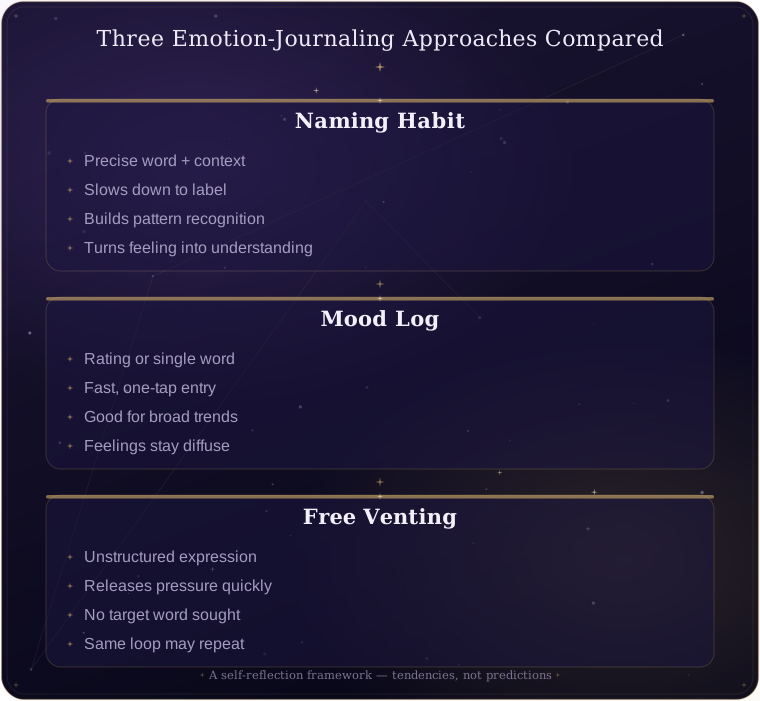
Three tools show up in the same searches: a naming-focused emotion journal, a quick mood journal, and free-form venting. They work differently and trade off against each other.
- The naming habit vs. a mood log. A mood log is fast — a rating, an emoji, a single word — and that speed is its strength for spotting broad trends over months. But it stops at recording. The Affect-Labeling Practice slows the entry down to find the exact word and its context, which is what turns a feeling from a data point into something you understand. To gain that depth, you sacrifice the one-tap convenience of a mood log.
- The naming habit vs. free-form venting. Venting on the page releases pressure and can feel good in the moment. But unstructured venting often rehearses a feeling without resolving it — the same loop, louder. Structured emotion journaling directs the writing toward naming and pattern, which moves a feeling from raw expression toward recognition. To get that movement, you give up some of the cathartic flood that pure venting provides.
The trade-off is directional. A mood log and venting both prioritize ease and release; the naming habit prioritizes precision and pattern recognition. Which one fits depends on whether today's goal is a quick check-in or a deeper read of what a feeling really points to — they answer different questions, and a good practice can hold both modes on different days.
How to Read the Affect-Labeling Practice in Yourself
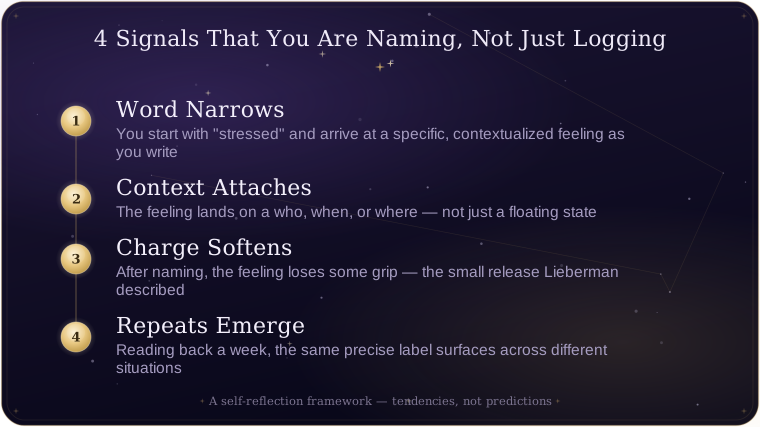
The practice produces movement when you apply it to concrete, recent moments rather than abstract tendencies. Four signals tell you a journal entry is naming a feeling rather than just logging one.
- The word gets more specific as you write. You start with "stressed" and arrive at "stretched thin and resentful about it." That narrowing is affect labeling working.
- A context attaches itself. The feeling stops floating and lands on a who, when, or where — the review, the unanswered text, the Sunday evening.
- The charge softens slightly after naming. Many people notice a feeling loses a little grip once it has an accurate word — what Matthew Lieberman described as putting feelings into words. That small release is the point of a self-regulation diary.
- Repeats become visible. Reading back a week of entries, the same precise label appears across different situations, revealing a pattern a mood rating would have flattened.
Common Misreadings
Four misreadings pull people away from a useful feelings journal and back into mechanical logging.
- More entries means deeper practice. Volume is not the metric. One entry where you find the exact word for a feeling does more than seven entries of "fine" and "tired." The length of the log is not a proxy for the depth of the naming.
- Writing about a feeling is the same as naming it. Describing a whole day around a feeling is not the same as labeling the feeling itself. The work is in the noun and the modifier — "left out," "quietly proud," "braced for criticism" — not in the surrounding story.
- A feelings journal should make you feel better immediately. Naming a hard feeling can sharpen it before it settles, because you are looking at it directly rather than around it. That is ordinary, not a sign the practice is failing.
- You need a feelings vocabulary you do not have. You do not need clinical terms. Everyday language works — "edgy," "let down," "relieved" — as long as it is specific to the moment rather than a generic mood word.
Emotion Journal Formats at a Glance
| Property | How It Works | Naming Focus | How to Observe |
|---|---|---|---|
| Quick mood log | Rates or tags a state in seconds | Minimal — a single word or score | Fast trend lines, but feelings stay diffuse |
| Two-part entry | Separates what happened from how it felt | High — names the feeling apart from the event | Deeper integration; the feeling gets its own precise label |
| Free-form venting | Writes the feeling out at length | Low — expression without a target word | Release in the moment, but the same loop often repeats |
| Pattern review | Reads back entries to spot recurrences | Cumulative — surfaces repeated labels | A self-regulation diary that reveals triggers over weeks |
Common Questions About the Affect-Labeling Practice
What is the difference between an emotion journal and a mood tracker?
A mood tracker records a state quickly — a rating or a tag. An emotion journal built on affect labeling asks you to name the feeling precisely and attach its context, so the entry becomes something you can read and learn from rather than just a data point. This is a personal self-reflection practice, not a clinical interpretation or medical advice.
How often should I write in a feelings journal?
Consistency matters more than length. A few specific entries each week, where you actually find the right word for a feeling, build more pattern recognition than a long entry once a month. Many people anchor it to a fixed moment — after work, before bed — so the habit has a reliable home.
Can writing about feelings make them worse?
Naming a hard feeling can briefly sharpen it, because you are facing it directly. For most people that is followed by a small settling. If writing consistently increases distress without any sense of relief or recognition, working alongside a licensed mental health professional is worth considering.
Do I need special prompts to start?
No. The simplest mood journal uses two questions: what happened, and what did I feel — named as exactly as I can. Prompts can help on flat days, but the core practice is just precise naming attached to a real moment.
Reflection Prompts
- Recall a feeling from this week you labeled quickly as "bad" or "fine" — what more specific word fits it now, and what context attaches to that word?
- Notice a feeling that keeps returning across different situations — what single precise label do all those moments share?
- Think of a recent entry where naming the feeling changed how it sat with you — what did the exact word free up that a vague one did not?
Related Reading
- pillar page on journaling prompts for self-reflection — the broader practice an emotion journal belongs to
Take Action
Generate your free birth chart to pair your emotion journal with a map of your own emotional tendencies. Your chart sketches the placements often linked to how you process feeling — where you guard, where you release — and that picture gives your naming practice a starting frame. The pairing is for self-awareness and reflection, not prediction: the journal still does the real work of putting an accurate word to what you feel.
Sources
- James Pennebaker — researched expressive writing and how naming experiences in specific, varied language supports emotional integration
- Matthew Lieberman — studied affect labeling, the act of putting feelings into words, as a form of everyday emotional self-regulation