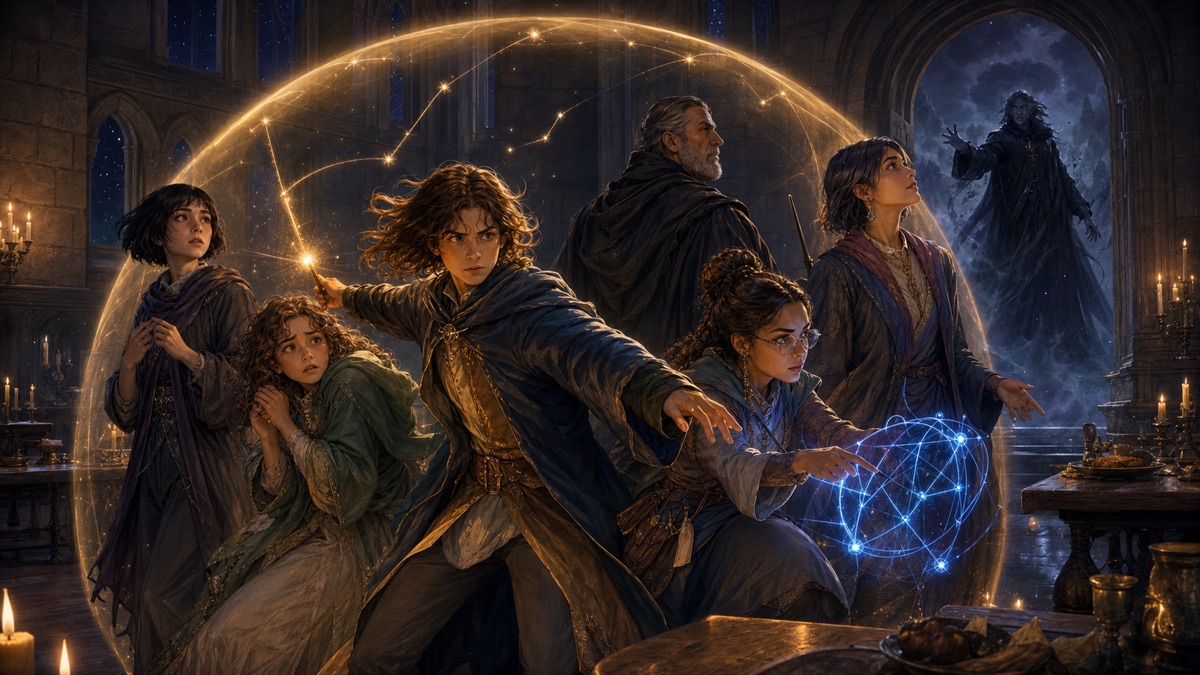
What Is Harry Potter Characters Zodiac Signs?
Harry Potter characters zodiac signs is a practice of pairing each major character in J.K. Rowling's series with a Western zodiac archetype based on story behavior, canon birthdays, and recurring narrative role.
- Uses story-behavior cues as the primary evidence, not full birth-chart construction
- Treats each sign assignment as a symbolic interpretive lens rather than a deterministic personality verdict
- Distinct from actor birth-chart analysis, which covers the real people who played these roles in the films
This sits alongside the broader guide to zodiac sign archetypes, which maps every sign's symbolic register in its traditional form. The practice works because each zodiac sign carries a compressed archetype—a recognizable pattern of motivation, blind spot, and growth arc. When a character's canon birthday is available, as Harry Potter's July 31 birthday confirmed across the novels, it anchors the reading in the text rather than projection. Where birthdays are absent or ambiguous, story behavior becomes the only honest basis for an assignment.
Why It Matters for Self-Awareness
Harry Potter characters zodiac signs clarify patterns that are harder to name in a direct mirror. Mapping a character to a zodiac sign places two already-familiar systems side by side: what readers know about the character from the story, and what they know about the sign from its archetype tradition. The overlap becomes a working definition of the archetype—concrete enough to recognize in real life, not just on the page.
Understanding Harry Potter characters zodiac signs matters because the same symbolic patterns appear everywhere once you have names for them. The Hermione who reaches for more preparation whenever she feels uncertain is recognizable to anyone who has used thoroughness to manage anxiety rather than solve a problem. Neville Longbottom's arc—from a Leo who seems to have none of the sign's characteristic confidence to one who embodies it under the most extreme possible pressure—offers a counter-reading of Leo that most surface-level descriptions never address. That counter-reading is useful precisely because real Leo expressions don't always match the stereotype of the loudly self-assured leader.
The externalized view matters here for a specific reason: it removes the defensiveness that comes with direct self-assessment. Watching Ron Weasley's self-doubt play out across seven books is less threatening than examining your own relationship with being overshadowed. The story creates enough distance that the pattern becomes visible without triggering the self-protection that usually gets in the way of honest self-examination.
Why Fictional Distance Helps
According to a 2017 Pew Research Center survey, about 29% of U.S. adults said they believed in astrology. The Harry Potter series reached that same generation as children, which means character archetypes from the books and zodiac-based self-understanding developed in parallel for many readers. Using the two frameworks together is a natural extension—and one that rewards close attention to story behavior rather than surface personality matching.
Character Zodiac Readings vs. Actor Birth Charts: Where the Line Falls
The most persistent confusion in character archetype content is treating character readings and actor readings as interchangeable. A performer's birth data describes a real person; Harry Potter's July 31 birthday gives this article a separate character-side datum. These readings don't reinforce each other—they answer different questions about different people. The Leo zodiac sign meaning archetype looks very different when applied to a fictional hero's story arc than to a real person's natal placement. Pulling actor data into character analysis doesn't add nuance; it introduces a category error that makes the archetype harder to read clearly.
Harry Potter characters zodiac signs as an interpretive framework stops at the character's page in the story. The trade-off is real and worth naming directly: to get clean symbolic alignment—a reading that tells you something precise about how an archetype functions in a narrative—you give up biographical texture. An actor's chart requires a real person's birth data and reflects their actual life experience; a character's sign assignment reflects the story's logic and the narrative role that character fills. Questions about a performer’s natal placements belong in a different article.
The same boundary separates single-sign character mapping from full birth-chart construction. A natal chart analysis of Harry Potter would require fabricating a rising sign, house placements, and transits that the books simply don't supply. Staying at the archetype level—this character's dominant patterns fit this sign's symbolic register—means staying honest about what the text can actually support. The gain is interpretive clarity; the cost is the additional granularity a real chart would provide.
How to Read Harry Potter Characters in a Zodiac Framework
Harry Potter characters zodiac signs hold up best when they account for the full arc of the story, not just one memorable scene. These are the observable signals that make an archetype assignment credible:
- Recurring motivation under pressure. The most reliable archetype signal is what a character reaches for when something is at stake. Harry's instinct is to step in front of others—the Leo self-sacrifice pattern. Hermione's first move is more information and better preparation—Virgo's corrective orientation toward uncertainty.
- Characteristic blind spot. The shadow pattern is as diagnostic as the strength. Ron Weasley's Pisces empathy makes him absorb the emotional states of everyone around him; his self-doubt surfaces most visibly when standing next to people whose gifts seem larger than his own. Draco's Gemini adaptability becomes a performance of values he's been handed rather than chosen, and the gap between his public face and what his private scenes reveal is the sign's signature split.
- Relationship style and loyalty pattern. Sirius Black's Scorpio signature is clearest in how he handles betrayal—his loyalty is absolute until it isn't, and what comes after the break bears no resemblance to what came before. Luna Lovegood's Aquarius quality is visible in the consistency of her detachment; she doesn't need the group to confirm what she observes, and she doesn't adjust her observations to make them more comfortable for the people around her.
- Growth arc consistency across the series. A sign assignment should fit the character's starting point and their ending. Neville's Leo reading works because it describes his full development, not just his final chapter—Leo is a fixed sign, and his courage builds slowly and non-linearly before it becomes unmistakable at the right moment.
- Canon birthday as anchor or productive challenge. Where birthdays exist in canon, they either confirm the story-behavior read or create a tension worth examining. Where no birthday exists, story behavior is the only legitimate basis for an assignment.
Common Misreadings
When reading Harry Potter characters zodiac signs, a small set of errors comes up consistently. Here's where each tends to go wrong:
- Conflating Hogwarts house and zodiac sign. Gryffindor is not a fire-sign filter. Hermione is a Virgo and a Gryffindor—those two facts coexist without contradiction. The Sorting Hat selects on qualities the books describe as courage, loyalty, ambition, and wit. These don't map to astrological elements.
- Substituting actor charts for character archetypes. A performer's natal placements and Hermione Granger's Virgo reading are different reference points. Using the first to explain the second is a category error that muddies both readings without clarifying either.
- Assigning based on a single trait rather than the full pattern. Calling Voldemort a Scorpio because he reads as dark and controlling misses the more precise Capricorn assignment. His arc is about institutional domination, the systematic elimination of everything outside his reach, and a pathological refusal to accept mortality. The Capricorn shadow is about ambition without empathy and control as a substitute for safety. A Scorpio archetype transforms through the encounter with mortality; Voldemort attempts to eliminate it from the equation entirely—which is the Capricorn response to the one limit that institutional power cannot reach.
- Demanding determinism from an interpretive framework. Saying Hermione "is a Virgo" means the Virgo archetype fits her patterns more precisely than any other sign does. It does not mean fictional characters carry functioning natal charts. The framework is symbolic and interpretive, not predictive.
Character Sign Map at a Glance
| Character | Zodiac Sign | Story Archetype | How to Observe |
|---|---|---|---|
| Harry Potter | Leo | The self-sacrificing hero | Steps in front of danger for others; leads by instinct rather than planning |
| Hermione Granger | Virgo | The meticulous problem-solver | First response to uncertainty is more preparation; correctness functions as a form of safety |
| Ron Weasley | Pisces | The loyal but self-doubting companion | Absorbs the emotional states of everyone around him; self-doubt peaks when overshadowed |
| Draco Malfoy | Gemini | The identity-split performer | Public cruelty masks private fear; values are performed rather than internally held |
| Tom Riddle / Voldemort | Capricorn | The ambition-without-empathy shadow | Every action is institutional and control-driven; mortality is the one thing he cannot neutralize |
| Neville Longbottom | Leo | The slow-developing fixed courage | Quiet across most of the series; unmistakable in the final confrontation |
| Luna Lovegood | Aquarius | The detached truth-teller | Speaks without needing the group's confirmation; her outsider position is self-chosen |
| Sirius Black | Scorpio | The total-loyalty extremist | Betrayal reshapes him entirely; intensity is protective and destructive in equal measure |
| Severus Snape | Capricorn | The disciplined keeper of private loyalty | Control is his primary mode; devotion is never public-facing until the final reveal |
Common Questions About Harry Potter Characters Zodiac Signs
What zodiac sign is Harry Potter?
Harry Potter's canon birthday is July 31, placing him in Leo. His story-behavior read confirms the archetype across all seven books: he repeatedly steps in front of danger for others, leads by instinct rather than strategy, and his defining quality is not raw power but the willingness to give it up for the people around him.
Is Hermione Granger actually a Virgo?
Hermione's September 19 birthday lands in Virgo, and her patterns map closely to the archetype from the first chapter to the last. Her first response to any unknown is more research; her relationship to being right functions as anxiety management as much as intellectual drive. The assignment holds under close reading.
Why do some sources assign Draco Malfoy to Scorpio rather than Gemini?
The Scorpio read draws on Draco's intensity and family loyalty. The Gemini read rests on the gap between his public performance and the private reality visible in his scenes with Snape and Narcissa. His June 5 canon birthday confirms Gemini, and his arc—the inability to commit fully to either side of the conflict—fits Gemini's mutable quality more precisely than Scorpio's fixed intensity.
Does Voldemort's sign match his full arc?
Tom Riddle's December 31 birthday places him at the edge of Capricorn. His arc is entirely about institutional control, the elimination of anything outside his reach, and the refusal to accept the one form of loss he cannot prevent. Those are Capricorn shadow patterns, and they map more precisely than the intensity-based Scorpio reading that appears in some fan content.
Reflection Prompts
- Think of a scene where a Harry Potter character's zodiac shadow—the blind spot inside their archetype—showed up most clearly, and notice what that moment made you recognize about a recurring pattern in your own behavior.
- Recall a time when you used Hermione's Virgo strategy—more preparation, more research—as a way to manage fear rather than actually solve the problem you were facing.
- Consider which Harry Potter character you find most difficult to sympathize with, and whether their zodiac archetype pattern is one you recognize in yourself but resist acknowledging.
Related Reading
- Severus Snape zodiac sign — the one major character canon gives a full birthday, so his Capricorn Sun is a calculation rather than a fan assignment
- Dumbledore zodiac sign — the contrasting case: canon fixes only a birth year, so no Sun sign can be settled
- pillar page on how to read a birth chart — for readers who want to move from character archetype mapping into actual natal chart analysis
- guide to zodiac sign archetypes and their shadow patterns — the broader symbolic framework these character readings draw from
Take Action
Generate Your Free Birth Chart and run the same archetype lens used in this guide on your own planetary placements. You will find which sign's patterns—strength and shadow both—show up most prominently in your chart. Understanding those patterns gives you the same interpretive distance the Harry Potter characters offer: a clear enough picture to recognize the pattern before you're already inside it.
Sources
- J.K. Rowling — Harry Potter series and published supplementary material; canon birthdays and story-behavior cues that anchor the character references on this page
- Pew Research Center — 2017 survey on New Age beliefs (reported October 2018); the 29% U.S.-adult belief-in-astrology figure cited in the self-awareness section