
What is journal prompts?
Journal prompts are focused questions designed to direct reflection toward a specific theme or pattern. They function as focusing tools — narrowing the open page into a defined inquiry rather than leaving self-reflection entirely open-ended.
- Appear across personal growth, mindfulness, and shadow work contexts as entry points for structured self-reflection
- Range from loosely topic-organized lists (grouped by emotion, life stage, or relationship type) to diagnostically framed questions that target a specific psychological function
- Differ significantly in what they produce: topic-organized prompts tend to generate emotionally fluent narrative; structurally diagnostic prompts are more likely to surface recurring behavioral patterns
The broader landscape of structured self-inquiry tools — where journal prompts sit alongside practices like guided visualization and astrological self-reflection — is covered in pillar page on self-reflection tools and journaling practices.
Why It Matters for Self-Awareness
Most journaling resources offer the same structure: a long list of prompts organized by topic. "Prompts for anxiety." "Prompts for grief." "Prompts for self-worth." The organizational logic looks helpful, but it produces a specific problem that most journalers encounter within a few months of regular practice.
When journal prompts are grouped by topic rather than by the psychological function they serve, they train a particular kind of writing: emotionally fluent but pattern-blind. A writer working through a "prompts for confidence" section will write about confidence — how it feels, when it shows up, what it looks like in different situations. What that section rarely produces is the entry that reveals why a specific confidence pattern keeps repeating across unrelated areas of life, or what behavioral sequence actually precedes the feeling of low self-worth.
The friction is structural, not motivational. People generate surface-level entries week after week not because they lack self-awareness, but because the prompts they're using are organized for emotional topic coverage rather than for surfacing how a person actually functions across situations. A journaler can fill notebooks with emotionally honest, well-written entries and still have no clearer view of their own recurring patterns than when they started — if the questions were organized by theme rather than by function. Understanding this distinction makes any existing prompt list more useful, even without switching resources.
journal prompts vs Adjacent Concepts: How It Works + Trade-offs
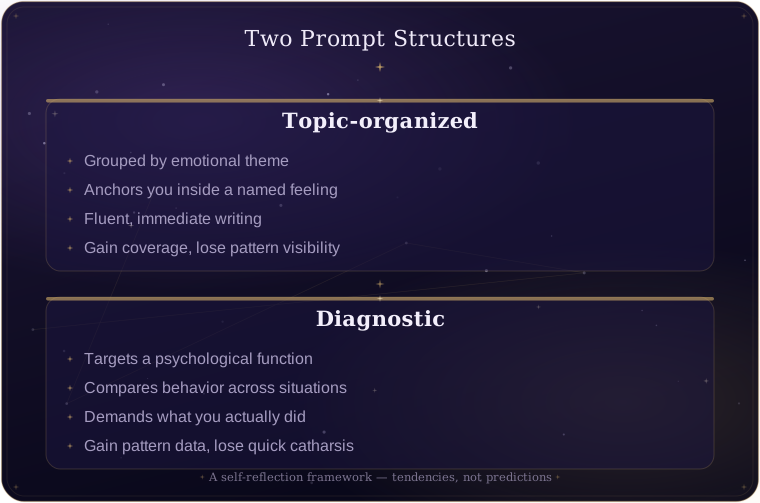
Two structural models dominate what's available online, and they produce different kinds of results.
- Topic-organized prompts. These group questions by emotional theme or life area: anxiety, grief, self-love, relationships, seasons, or transitions. How they work: they anchor the writer inside a named feeling and invite description and exploration of that domain. The trade-off is direct — to get broad emotional coverage across many themes, you give up the cross-situational comparison that reveals why a specific pattern exists. Emotional fluency is the gain; pattern visibility is the cost.
- Diagnostic prompts. These target a specific psychological function rather than a theme, anchor inquiry across multiple situations rather than a single event, and require behavioral evidence — what you actually did — rather than emotional report. How they work: by forcing the writer to compare behavior across unrelated contexts, they make patterns visible that theme-based prompts cannot surface. The trade-off cuts the other way — to get genuine pattern recognition, you give up the immediate emotional catharsis that topic prompts deliver quickly. You write less, but you see more.
Shadow work prompts, when well-constructed, follow the diagnostic model — which is exactly why they tend to feel harder than general prompt lists. They don't ask how the avoided material feels; they ask what you actually did when it showed up in a specific situation. That behavioral specificity is what separates a prompt that surfaces something genuinely new from one that produces a more elaborate version of what the writer already knew about themselves. A detailed guide to building this kind of prompting practice is covered in guide to shadow work journaling and what it surfaces.
The three structural rules that distinguish diagnostic journal prompts from narrative ones hold across all topic areas: they name a function rather than a feeling, they span multiple situations rather than one event, and they demand behavioral evidence rather than interpretation. All three must hold for a prompt to produce pattern-level insight rather than emotionally honest narrative.
How to Read journal prompts in Yourself
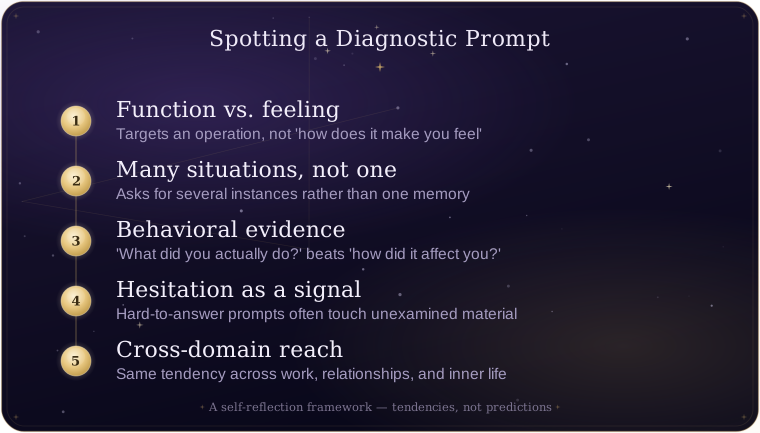
Distinguishing diagnostic prompts from narrative ones in any given list takes a single pass of structured attention. Look for these signals:
- Function vs. feeling. Does the prompt target a psychological operation ("When did you last change your position on something that mattered to you?") or a feeling-state ("How does uncertainty make you feel?")? Function-first framing points toward diagnostic structure.
- Multiple situations vs. one event. Diagnostic prompts ask for several instances, not one memory. "Think of three times you agreed when you meant to say no" requires cross-situational recall. "Write about a time you felt pressured" anchors in a single memory and tends toward narrative.
- Behavioral evidence vs. emotional report. "What did you actually do?" is diagnostic. "How did it affect you?" is narrative. The first requires naming a specific action; the second invites elaboration on a feeling. Both are valid questions — only the first consistently produces new pattern data.
- Hesitation as a signal. Prompts that produce immediate, fluent writing often sit inside territory you've already articulated to yourself. Questions that feel unexpectedly hard to answer concretely — where you find yourself substituting interpretation for a specific instance — are more likely touching unexamined material.
- Cross-domain applicability. The most structurally sound diagnostic prompts surface the same behavioral tendency across work, relationships, and internal life at once. A question that only makes sense in one domain has limited diagnostic reach.
Common Misreadings
The way journal prompts are discussed and packaged online produces consistent misconceptions that keep journalers working at the narrative level:
- "More prompts means more insight." Volume and depth don't scale together. Fifty narrative prompts organized by theme produce fifty narrative entries. One well-framed diagnostic question — "Recall the last three times you avoided a conversation you knew you needed to have. What did you actually do instead?" — can surface more usable pattern data than a full month of theme-organized writing. The potential of journal prompts for self discovery doesn't scale with volume; it scales with the structural quality of the question.
- "Theme organization means psychological depth." Working through a category labeled "confidence" or "grief" feels like structured progress. In practice, topic categories provide emotional breadth, not diagnostic depth. You can complete every prompt in a self-worth section and still have no clearer picture of the specific situations where your sense of worth reliably drops — because the prompts were designed for coverage, not detection.
- "Prompts about anxiety help you understand the pattern." Prompts built around anxiety are often designed for emotional expression and release. A question asking "What worries are you carrying today?" invites description of a current emotional state. "In which situations do you consistently prepare for the worst, even when the stakes are demonstrably low?" is structurally more useful — it requires behavioral comparison across situations rather than description of the present moment. Expression and pattern detection serve different purposes, and conflating them leads to months of expressive writing that leaves the underlying pattern unchanged.
- "Hesitation means the prompt is wrong for you." Blank-page discomfort in response to a well-formed prompt usually means the prompt is working. Diagnostic questions asking for specific behavioral instances feel harder than narrative prompts because they require naming what you did, not what you felt or intended. That friction is informational, not a sign the question doesn't fit.
Prompt Structure at a Glance
| Property | How It Works | Energy Center | How to Observe |
|---|---|---|---|
| Topic-organized | Groups inquiry by emotional theme; invites description of a named feeling or life domain | Emotional expression | Fluent, immediate writing; high word count with limited new pattern data |
| Diagnostic | Anchors inquiry across multiple situations; requires behavioral evidence over emotional report | Pattern recognition | Hesitation before writing; difficulty naming specific instances often signals proximity to unexamined material |
| Shadow work | Inverts habitual self-view to surface avoided or disowned material by targeting the gap between self-image and actual behavior | Unconscious avoidance | Strong resistance or quick deflection toward abstraction both indicate material worth staying with |
| Self-discovery | Spans life domains (work, relationships, inner life) to surface behavioral consistency across contexts | Cross-domain observation | Patterns appearing across more than one domain are the usable signal; single-domain answers suggest narrative framing |
Journaling Prompt FAQ
What makes journal prompts diagnostic rather than just reflective?
A diagnostic prompt targets a psychological function, spans multiple situations, and requires behavioral evidence rather than emotional description. The structural marker is "what did you actually do?" — it demands a named action rather than an interpretation, which is what forces the cross-situational comparison where patterns become visible.
How many prompts should you work with in one session?
One diagnostic question per session is typically more productive than a list. When prompts stack, writers tend to handle each as a separate entry rather than following a single thread to its real edge. The behavioral specificity that makes a prompt diagnostic disappears when attention is spread across ten questions at once — you answer shallowly rather than concretely.
What's the difference between self-directed reflection prompts and prompts used in professional mental health settings?
Both use structured questions, but the contexts differ significantly. Self-directed reflection prompts are personal tools used within a journaling practice. Prompts used in professional mental health settings are part of a guided process with a trained professional. The structural overlap can be real — but the processing context, and the presence of professional support, are not the same thing.
Is the length of a response a reliable sign that a session went well?
Length is not the goal. A short entry naming three specific behavioral instances is more diagnostically useful than a long entry elaborating on the feeling around a single situation. Compression toward specificity — the ability to name exactly what you did, across more than one context — is the signal that a prompt is being used well.
Reflection Prompts
- Think of the last three times you avoided a conversation you knew you needed to have — what did you actually do instead, and was the avoidance pattern the same each time?
- Recall a recent moment when your reaction felt stronger than the situation seemed to call for — what did you do in the first ten seconds, and what reason did you give yourself at the time?
- Name one belief about yourself you've returned to in your writing for years — what specific behavior, visible in at least two different areas of your life, keeps that belief in place?
Related Reading
- guide to shadow work journaling and what it surfaces — covers how shadow work prompts specifically target avoided material, extending the diagnostic approach into unconscious patterns
- overview of self-reflection tools and journaling approaches — the broader landscape of structured introspection methods that prompt-based journaling belongs to
- comparison of journaling styles and psychological uses — useful for understanding where diagnostic prompting fits relative to free writing, stream-of-consciousness, and gratitude journaling
This is not a clinical interpretation or mental health advice.
Take Action
Generate your free birth chart to explore how structured self-reflection connects to your natal placements. Your chart maps the recurring patterns in your psychological and relational life — the same patterns that diagnostic prompting is designed to surface. When you can see those patterns on paper, well-framed journal prompts can do more work than an entire themed list.
Sources
- Pennebaker, J. W., & Smyth, J. M. (2016). Opening Up by Writing It Down. Guilford Press.
- Progoff, I. (1975). At a Journal Workshop. Dialogue House Library.
- Cameron, J. (1992). The Artist's Way. TarcherPerigee.