
What is Revati?
The revati nakshatra is the twenty-seventh and final lunar mansion in Vedic astrology, spanning the closing degrees of Pisces, ruled by Mercury, and presided over by Pushan, the divine shepherd who guides safe passage between endings and beginnings. It sits at the very edge of the zodiacal wheel, where one full cycle completes and the next quietly begins. Most readers reach for it expecting a heavy, final-curtain energy, yet what they find is something lighter and stranger: a place of crossing over rather than shutting down. To map where it falls in your own chart, the nakshatras cluster pillar lays out how all twenty-seven mansions interlock.
- It occupies 16°40' to 30° Pisces, the last segment of the last sign
- Its ruling planet is Mercury, not the Saturn many students expect
- Its deity, Pushan, escorts travelers and souls through transitions
This is an interpretive framework for reading symbolism, not a forecast of events or a fixed verdict on anyone's character.
Why It Matters for Self-Awareness
People who study the lunar mansions often brace for the last one to feel like an ending. The intuition is reasonable: the final stretch of the final sign sounds like it should carry weight, finality, maybe even a Saturnian sense of judgment. The revati nakshatra quietly overturns that expectation, and noticing why is where the real learning starts. The mansion is governed by Mercury, the planet of speech, connection, and movement, which means the close of the cycle is read not as a wall but as a doorway.
That single fact reframes how you might read your own thresholds. When a chapter ends in life, the instinct is to treat it as loss or culmination. Revati offers a different posture: the ending as a handoff, a guided crossing rather than a stop. Held that way, the revati nakshatra becomes less a prediction about destiny and more a lens for how you move through change, what you carry forward, and how gently you let things conclude.
The placement also rewards attention to those around you. Pushan was honored as a protector of herds and a guide for anyone setting out on a road, so the mansion's deeper theme is care extended outward. Read this way, a Revati emphasis in a chart can describe someone who naturally tends the people in transition near them, holding space at thresholds rather than rushing past them. That orientation toward gentle stewardship, more than any single trait, is what the final lunar mansion tends to surface in self-reflection.
Revati vs Adjacent Concepts: How It Works + Trade-offs
It helps to set the revati nakshatra against its neighbors on the wheel. Against Ashwini, the first nakshatra, Revati is the mirror image: where Ashwini bursts open with raw initiating energy, Revati closes with the calm of completion, and the two share a horizon because the end of the cycle touches the start of the next. The trade-off is temperamental. Ashwini's gift is the spark of beginnings; Revati's is the grace of finishing well, and you cannot fully have both at once in the same gesture.
Against Uttara Bhadrapada, the mansion just before it, Revati trades depth for breadth of passage. Uttara Bhadrapada carries a still, contained wisdom; Revati takes that settled understanding and puts it in motion, ferrying it across the threshold. Pushan, the shepherd-deity, is the key to the difference: he does not hold ground, he guides movement, escorting flocks, travelers, and souls safely from one state to another. That orientation toward transit rather than arrival is what distinguishes Revati from the more anchored mansions around it.
The Mercury rulership is the deepest of these contrasts. Where you might expect the zodiac's final degree to be ruled by a slow, weighty planet, Mercury imports communicative intelligence into Pisces's oceanic compassion. The result is a nakshatra that bridges worlds rather than dissolving into them, pairing the ocean's empathy with the messenger's clarity. That blend is the whole signature, and missing it is the most common way readers misjudge the close of the cycle. It is worth sitting with how unusual the pairing is: the most boundless sign of the zodiac handed to the most articulate of planets, so that compassion gains a voice and a sense of direction instead of drifting. Read carefully, that combination explains why the mansion is associated with safe travel, eloquent guidance, and the quiet competence of someone who knows the way across.
How to Read Revati in a Chart
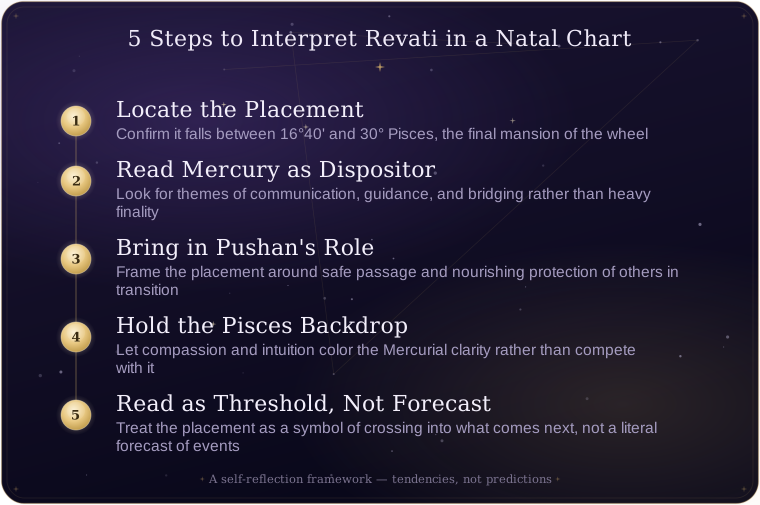
You can interpret the revati nakshatra placement with a few grounded steps, and the same approach works whether you are reading a natal Moon, an ascendant, or a planet that lands in those degrees.
- Locate the placement between 16°40' and 30° Pisces, confirming it sits in the final mansion of the wheel.
- Read Mercury as the dispositor, looking for themes of communication, guidance, and bridging rather than heavy finality.
- Bring in Pushan's role as shepherd and escort, framing the placement around safe passage and nourishing protection of others.
- Hold the Pisces backdrop, so compassion and intuition color the Mercurial clarity rather than competing with it.
- Treat the placement as a symbol of crossing thresholds, not as a literal forecast about any single life event.
Common Misreadings
- The final nakshatra must feel heavy and Saturnian. The close of the cycle is Mercury-ruled, so it reads as a guided crossing, not a weighty verdict, and that lightness is the point.
- Ending means dissolution or loss. Pushan escorts safe passage, so Revati frames conclusions as handoffs into the next beginning rather than as things simply lost.
- Pisces placement makes it purely dreamy. Mercury's rulership adds clarity and connection, so the oceanic compassion comes paired with a messenger's precision.
- The last degree is only an end. The same degree that completes the zodiac touches the start of the next cycle, encoding rebirth alongside completion.
Revati at a Glance
| Property | What It Means | Where It Sits | How to Read It |
|---|---|---|---|
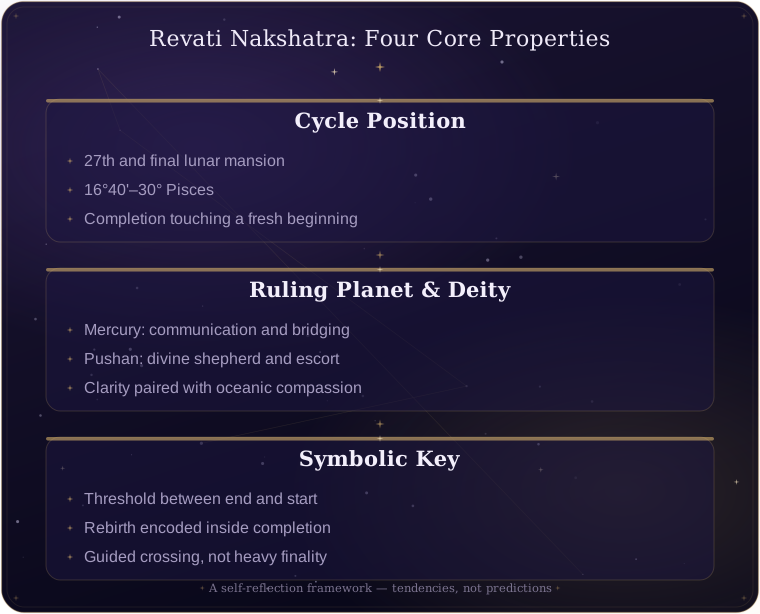
| Cycle position | 27th and final lunar mansion | 16°40'–30° Pisces, the wheel's last degrees | Completion that touches a fresh beginning |
| Ruling planet | Mercury brings communication and bridging | Imported into Pisces's compassion | Clarity and connection, not heavy finality |
| Presiding deity | Pushan, the shepherd-guide | Escort through transitions and passage | Safe crossing, nourishment, protection |
| Symbolic key | Threshold between end and start | Equinox-adjacent point of the year | Rebirth encoded inside completion |
Common Questions About Revati
Why is the final nakshatra ruled by Mercury and not Saturn?
Many students expect the last mansion to carry Saturn's gravity, but the revati nakshatra is governed by Mercury. That rulership turns the close of the cycle into a communicative, bridging energy rather than a heavy ending, which is why it reads as a guided passage instead of a final judgment.
Who is the deity of Revati and what does that signify?
Its presiding deity is Pushan, the divine shepherd and protector of travelers. He escorts flocks, journeyers, and souls safely through transitions, so the mansion is read around nourishment, guidance, and safe passage rather than around culmination or finality.
Where exactly does Revati fall in the zodiac?
It spans 16°40' to 30° Pisces, the closing segment of the final sign, completing the cycle of twenty-seven lunar mansions at the very last degree of the wheel.
Does the last nakshatra mean only endings?
No. Because its final degree sits where one cycle completes and the next begins, it encodes rebirth alongside completion. The mansion reads as a threshold, a crossing into what comes next, not simply as a stop.
Reflection Prompts
- Recall an ending you treated as loss — how might it look if you read it as a handoff into something new instead?
- Think of a transition you are facing now; what would change if you trusted a guide to escort you across rather than bracing alone?
- Notice where you expect heaviness at the close of a chapter — what lightness might be available if completion were also a beginning?
Related Reading
- nakshatras cluster pillar — the hub that frames all twenty-seven lunar mansions and how they connect
- Ashwini, the first lunar mansion — the mirror at the start of the cycle that Revati's ending quietly touches
- Uttara Bhadrapada, the mansion just before it — the contained wisdom that Revati sets in motion across the threshold
Take Action
Generate your free birth chart to find your own Moon and ascendant, and see whether the closing degrees of Pisces carry any weight in your placements. You get a clear map of where you sit on the wheel and, more usefully, a fresh way to read the endings in your own story as guided crossings rather than full stops.
Sources
- Dennis Harness — author of The Nakshatras: The Lunar Mansions of Vedic Astrology, a standard reference on the twenty-seven mansions and their deities
- David Frawley — Vedic scholar whose writing frames the lunar mansions as a language of symbol and cosmic cycle rather than fixed prediction