
What is solar return?
Solar return is an annual astrological chart cast for the exact moment each year when the Sun returns to the precise zodiac position it held at your birth. The chart resets every birthday and stays active until the next one, coloring twelve months with themes already written into your broader pillar guide to reading your birth chart. Two people born on the same day still get different annual charts once their birth times or birthplaces differ, which keeps the technique personal rather than generic. Astrologers in the cyclic tradition treat it as one timing tool among several, never a standalone verdict on the year. Read well, it works as a temporary yearly overlay on your existing natal chart rather than a fresh forecast that replaces it.
- Activates natal potential for one year instead of inventing new circumstances
- Always read in relation to the birth chart, never as a standalone prediction
- Built from the Sun's exact yearly return, so its timing is precise to the minute
Why It Matters for Self-Awareness
Understanding a solar return matters because most beginners read it backward. They pull up the annual chart, spot a stacked house or a tense aspect, and treat it as a fixed prediction — as if the birthday chart could deliver circumstances the birth chart never promised. The friction shows up constantly in study groups: tutorials walk through how to cast and read the annual chart but rarely explain that it sits underneath natal authority, so newcomers end up forecasting events their natal chart gives no basis for.
That single gap creates two recurring problems. First, the annual chart starts to feel more powerful than the birth chart, and people brace for a "big year" on the strength of one dramatic placement. Second, any year without hard aspects reads as "nothing happening," when the real signal is often a quiet activation of a pattern already written into the spoke explainer on natal chart promises. Read in proper order — birth chart first, annual layer second — the yearly chart tells you which inherent themes get the spotlight, while how they play out stays open to how you respond. That reframing is the whole point: self-awareness comes from seeing which part of you is being highlighted this year, not from bracing for a scripted event.
A common case makes the trap concrete. Someone opens this year's chart, sees no eye-catching aspects, and concludes the next twelve months will be flat and forgettable. Read against the birth chart, the same quiet snapshot often tells a different story: a gently emphasized natal Moon or a softly placed chart ruler can mark a year of steady inner consolidation that matters far more than a flashier setup would. The lesson runs in both directions — a busy annual chart is not automatically a big year, and a calm one is not an empty one.
solar return vs Adjacent Concepts: How It Works + Trade-offs
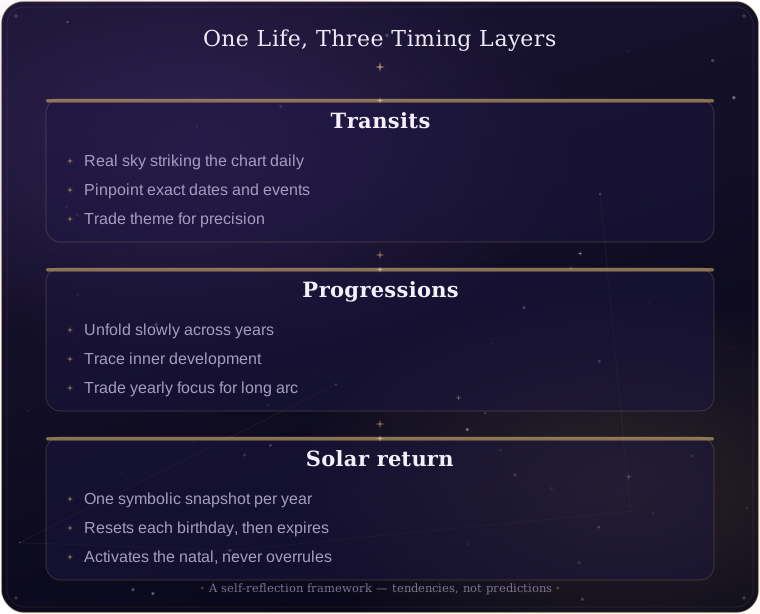
The annual chart is easy to confuse with the other timing tools it sits beside, and reading them as interchangeable is where most interpretation goes wrong. Each one answers a different question, and each comparison carries a trade-off worth naming out loud:
- Versus transits. Transits track the real sky striking your birth chart day by day, so they pinpoint exact dates and events. The annual chart instead freezes one symbolic snapshot for the whole year. To get the year's overarching theme in a single image, you sacrifice the precise timing that transits give you.
- Versus progressions. Secondary progressions unfold slowly, symbolizing inner development across years. The yearly chart works faster, resetting each birthday as a fresh twelve-month overlay. Choosing the annual snapshot gets you a clean yearly container, but you lose the long psychological arc that progressions trace.
- Versus the natal chart. The birth chart is the permanent promise; the return is a temporary activation of one part of that promise. To gain a year-specific focus you give up nothing lasting — the natal chart keeps final authority, and the annual layer simply expires on your next birthday.
Across all three, the same rule holds, and it is the rule the cyclic, person-centered tradition Dane Rudhyar helped shape keeps front and center: a yearly chart activates the birth chart, it never overrules it. A return Mars in the tenth house, for instance, does not hand you a promotion. It spotlights ambition your natal chart already describes, and what you build with that year of emphasis stays yours to direct.
This hierarchy also settles the question that stalls most beginners — which technique "wins" when two of them disagree. They are not competing. Transits, progressions, and the yearly chart are layered readings of the same life, and when several of them point at the same natal theme at once, that convergence is the real signal. One lonely placement in the annual chart, with nothing natal standing behind it, rarely amounts to much.
How to Read Your Annual Chart in Your Timing
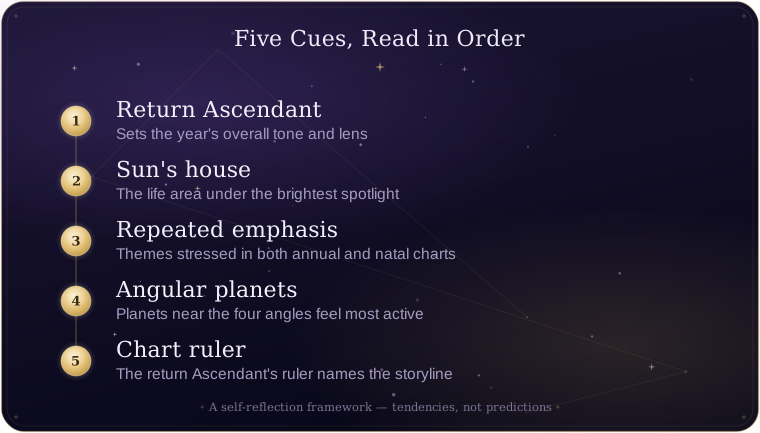
Reading a solar return well starts with locating what the year emphasizes, then checking every signal against the birth chart. These cues, read in order, keep the annual layer in its proper place:
- The Ascendant sign. The rising sign of the return sets the year's overall tone and the lens you meet experiences through.
- The Sun's house. Whatever house the Sun occupies shows the life area getting the brightest spotlight for the twelve months.
- Repeated emphasis. A planet or sign stressed in both the annual chart and your natal chart marks a theme that genuinely matters this year.
- Angular planets. Planets near the year's four angles tend to feel most active — note them, then trace each back to its natal role.
- The chart ruler. Find the planet ruling the return Ascendant and see which house it sits in; that placement often names the year's storyline.
Predictive astrologers such as Robert Hand stress this back-checking habit: a placement in the annual chart means little until you see what it activates natally. Picture a return Venus landing in the seventh house. On its own it reads like "a relationship year," but if your natal Venus is quiet and barely aspected, the more honest reading is a one-year invitation to practice connection — not a romance guaranteed to arrive on schedule.
The same discipline applies to the hard aspects that scare people. A return Saturn squaring the Sun can look ominous in isolation, yet if your natal Saturn already aspects the Sun, the year simply turns up the volume on a lifelong negotiation with structure and limits — a familiar lesson revisited, not a fresh punishment dropped from the sky.
Common Misreadings
Most shallow guides repeat the same handful of mistakes about the solar return, and each one traces back to forgetting its subordinate role:
- "It predicts fixed events." The annual chart highlights themes already latent in the birth chart. It does not hand you outcomes the natal promise never supported, no matter how striking the placement looks.
- "A dramatic year needs a dramatic chart." Quiet annual charts often activate deep natal patterns. The absence of hard aspects is not the absence of meaning — sometimes the most defining years look unremarkable on paper.
- "The return overrides the birth chart." It never does. The yearly layer is temporary and expires on the next birthday, while the natal chart keeps authority the entire time.
- "Read it in isolation." A placement means something only once you trace it back to the natal house and planet it activates. Read alone, the annual chart invents a story the birth chart never told.
Notice the thread running through all four: every mistake treats the annual chart as an independent oracle. Keep it tethered to the birth chart and the misreadings mostly dissolve on their own.
Reading the Annual Return Chart at a Glance
| Property | How It Works | Natal Anchor | How to Observe |
|---|---|---|---|
| Resets annually | Recast each birthday when the Sun reaches its natal degree | The natal Sun's exact sign and degree | Note the year runs birthday to birthday, not January to December |
| Temporary overlay | Activates existing potential for twelve months, then expires | The whole birth chart it rests on top of | Compare each placement to its natal counterpart |
| Year's focus area | The return Sun's house shows where the spotlight falls | The natal house holding that same theme | Locate the Sun's house in the annual chart |
| Yearly tone | The return Ascendant colors how the year is met | The natal rising sign it temporarily overlays | Check the rising sign of the birthday chart |
Questions People Ask About Reading the Annual Chart
How is the annual return chart different from a yearly horoscope?
A yearly horoscope is generic to your Sun sign, while the return chart is cast for your exact birth moment and place. That precision ties it directly to your own natal placements rather than a broad, sign-wide forecast shared by millions.
Does the location I'm in on my birthday change the chart?
Yes. Many astrologers cast the chart for wherever you are at the moment of return, which shifts the Ascendant and the house placements. Others prefer your birthplace, and the two schools read the resulting angles quite differently.
Can the annual chart show something my birth chart doesn't?
Not really. The yearly layer can only activate themes the birth chart already contains, so it spotlights existing potential rather than introducing promises that were never there.
How long does the return chart stay in effect?
It runs from one birthday to the next, roughly twelve months. The themes tend to build toward the middle of the year and soften as the next return approaches.
Reflection Prompts
- Think of a recent birthday year that felt distinct — what single theme defined it, and where had that pattern already shown up before?
- Recall a year you expected to be huge but lived quietly — what natal pattern was being activated underneath the calm surface?
- Name one natal trait you keep meeting; which recent twelve-month stretch put it under the brightest spotlight?
Related Reading
- guide to reading transits against your natal chart — the day-by-day timing tool that pairs with the yearly snapshot.
- explainer on secondary progressions — the slower inner-development method worth comparing against the annual reset.
- overview of major astrological return cycles — how the yearly return sits alongside the slower Saturn and Jupiter returns.
Take Action
Generate your free birth chart to see which natal promises this year's return is set to spotlight. You'll get a clear map of the birth potential sitting underneath every annual overlay — and the next time a placement worries you, you'll read it as a temporary highlight rather than a fixed verdict on the year.
Sources
- Dane Rudhyar — shaped the cyclic, person-centered approach that reads yearly charts as living activations of the birth chart
- Robert Hand — a leading modern voice in predictive astrology who stresses checking every timing signal against the natal baseline