
What is Uttara Bhadrapada?
Uttara Bhadrapada nakshatra is the twenty-sixth of the twenty-seven lunar mansions in Vedic astrology, and it is a Saturn-ruled mansion seated entirely within Pisces whose core function is restrained, contemplative strength — the quiet of still water over deep currents rather than visible force. It sits among the pillar page on all 27 nakshatras in Vedic astrology, where each mansion's ruling planet, presiding deity, and symbol set its interpretive range, and Uttara Bhadrapada's range is defined by depth held under composure.
- Ruled by Shani (Saturn), the graha associated with discipline, patience, and structure that endures
- Presided over by Ahirbudhnya, the serpent of the deep ocean floor in Vedic tradition, who governs hidden knowledge and the still depths beneath the surface
- Located in the sign of Pisces (Meena in Sanskrit), the final water sign, where dissolution and accumulated wisdom meet
Read traditionally, this nakshatra encodes a specific paradox: power that grows precisely because it is withheld. The placement is interpretive, not predictive — it describes a tendency a chart may carry, never a fixed fate.
Why It Matters for Self-Awareness
Most write-ups on Uttara Bhadrapada flatten it into a list of pleasant traits — wise, calm, spiritual — and stop there. That summary misses how the placement actually works, and the miss matters for anyone trying to read it in their own chart. Calm here is not the absence of intensity; it is intensity held in reserve. Saturn does not produce serenity by removing depth. It produces it by containing depth, the way a deep ocean appears motionless at the surface while immense pressure builds below.
The self-awareness question this reframes is a common one. People with strong Uttara Bhadrapada influence often hear that they are too withdrawn, too slow to act, too unwilling to push, yet held against the placement's actual logic, that feedback inverts: the restraint is the strength. Ahirbudhnya, the deep-sea serpent, does not strike — it knows, and it waits. The more useful inner question becomes not "why am I so reserved?" but "what am I holding in reserve, and what conditions release it well?" Treating the still water as a feature rather than a flaw changes how a person relates to their own depth.
There is a further layer worth holding. Uttara Bhadrapada is the penultimate nakshatra, second from the end of the entire lunar cycle. In classical framing, a placement this late carries the integrated learning of the mansions before it — wisdom arrived at rather than wisdom assumed. For self-awareness work, that positioning suggests the placement's gifts mature with time and rarely announce themselves early. The depth is real; it simply does not advertise.
Uttara Bhadrapada vs Adjacent Concepts: How It Works + Trade-offs
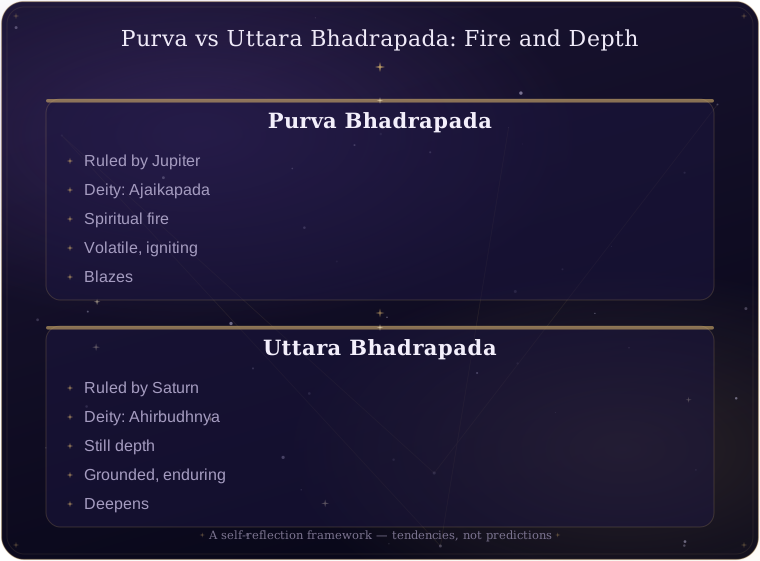
The clearest way to read Uttara Bhadrapada nakshatra is against its near twin, Purva Bhadrapada, the twenty-fifth mansion that immediately precedes it. The two share the "Bhadrapada" root and sit adjacent in the sequence, which is exactly why students confuse them — and the confusion produces real misreadings, because their inner mechanics diverge sharply. Purva Bhadrapada is ruled by Jupiter and presided over by Ajaikapada, the one-footed serpent of spiritual fire, carrying a volatile, igniting quality. Uttara Bhadrapada is ruled by Saturn and presided over by Ahirbudhnya, the serpent of the calm deep. To gain Uttara Bhadrapada's grounded steadiness, you trade away the cathartic fire of its predecessor: this mansion does not blaze, it deepens.
Set against Pisces' more familiar Western reading, the contrast sharpens further. Western Pisces tends toward dissolution, boundlessness, the merging of edges — and Uttara Bhadrapada occupies Pisces, so the watery field is shared. But Saturn's co-presence imposes structure on that water. Where unstructured Pisces energy can drift, Saturn gives it a container, a discipline, a floor. The trade-off is concrete: you give up some of water's free-flowing spontaneity in exchange for spiritual depth that can actually be built upon and sustained. This is not Western astrology by another name — the Vedic frame credits the discipline of a specific graha, Shani, for the difference, and that attribution is the whole point of reading the two systems distinctly.
A third contrast most surface treatments skip: practitioners sometimes group Uttara Bhadrapada with gentler water placements because of its calm reputation. That grouping erases Saturn entirely. The steadiness here is not soft — it is the weight of Shani applied to Pisces' depth, which is why the placement reads as quietly immovable rather than merely pleasant. Holding both Saturn and Ahirbudhnya in frame at once — as the classical attributions require — is what separates an accurate reading of Uttara Bhadrapada from one that mistakes its restraint for passivity.
How to Read Uttara Bhadrapada in Yourself
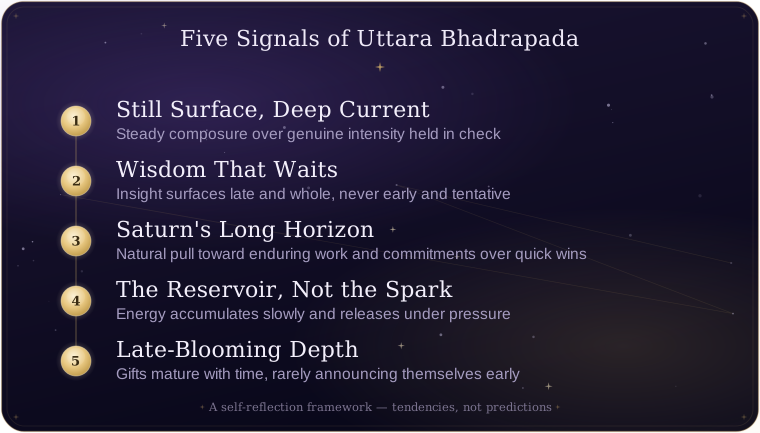
Uttara Bhadrapada's signature shows up in the texture of how depth is held rather than how it is displayed. Look for these observable signals, each a tendency the placement inclines toward rather than a guarantee.
- Still surface, deep current. A steady, unhurried outward composure that sits over genuine intensity. Others may read the calm as detachment, while the inner experience is one of considerable depth held deliberately in check.
- Wisdom that waits. A reluctance to offer conclusions before they are fully formed. Insight tends to surface late and whole, in the manner of Ahirbudhnya's deep knowledge, rather than early and tentative.
- Saturn's long horizon. A natural orientation toward what endures — long projects, slow craft, commitments measured in years. Quick wins hold less pull than work that compounds over time.
- The reservoir, not the spark. Energy that accumulates rather than flashes. Where a fire placement ignites, this one fills slowly and releases under pressure, often surprising those who mistook the calm for emptiness.
- Late-blooming depth. A sense that the placement's gifts arrive with maturity. Many describe their strongest contributions emerging well after the early-life phase when faster placements peak — consistent with a penultimate mansion that integrates what came before.
Common Misreadings
Most misreadings of Uttara Bhadrapada come from reading one part of the placement while ignoring another. The three most common:
- "Calm means low energy." This mistakes Saturn's containment for absence. The still water of Ahirbudhnya's deep is not empty; it is pressurized. Reading the surface alone produces a passive interpretation that cannot account for the placement's documented capacity for sustained, weighty effort once committed.
- "It's the same as Purva Bhadrapada." The shared name and adjacent degrees invite this, but the rulers differ — Jupiter's fire in Purva, Saturn's depth in Uttara — and the deities differ likewise. Applying Purva's volatile, igniting profile to Uttara produces a trait list the placement does not actually carry.
- "Pisces here behaves like Western Pisces." Uttara Bhadrapada sits in Pisces, so the watery field is genuine, but Saturn's structuring presence changes the expression. Reading it as boundless, drifting Pisces misses the discipline that gives this mansion its grounded, buildable depth — the distinction Vedic tradition is careful to name.
Uttara Bhadrapada at a Glance
| Property | How It Works | Energy Center | How to Observe |
|---|---|---|---|
| Sequence position | Twenty-sixth of twenty-seven mansions; penultimate, carrying integrated learning | Late-cycle wisdom | Note that its gifts tend to mature with time rather than arrive early |
| Ruling planet | Saturn (Shani) supplies discipline, patience, and enduring structure | Saturnian restraint | Track where steady, long-horizon effort shows up without need for visible reward |
| Presiding deity | Ahirbudhnya, serpent of the deep ocean, governs hidden knowledge and still depths | Oceanic depth | Notice insight that surfaces late and whole rather than early and partial |
| Sign placement | Seated in Pisces (Meena), the final water sign, where wisdom and dissolution meet | Structured water | Read depth held within a container rather than depth that drifts |
| Core function | Restrained strength — power that grows because it is withheld | Still water over deep current | Observe composure that conceals rather than lacks intensity |
Common Questions About Uttara Bhadrapada
What does Uttara Bhadrapada mean?
The name belongs to the twenty-sixth nakshatra and translates, loosely, to the "latter" or "second" of the Bhadrapada pair, distinguishing it from Purva ("former") Bhadrapada that precedes it. In practice the Uttara Bhadrapada meaning centers on its core symbolism: the calm deep, governed by Ahirbudhnya, where wisdom is held in stillness rather than expressed in motion.
Which planet rules Uttara Bhadrapada?
Saturn, called Shani in Sanskrit, is the ruling graha. Saturn's domain — discipline, patience, structure that lasts — shapes how the placement's Piscean depth expresses: contained, deliberate, and built for endurance rather than spontaneity. This Saturnian rulership is the single most important factor distinguishing it from the Jupiter-ruled mansion before it.
Who is the deity of Uttara Bhadrapada?
The presiding deity is Ahirbudhnya, described in Vedic tradition as the serpent of the deep ocean floor. The Uttara Bhadrapada deity governs hidden knowledge and the still depths beneath the surface, which is why the placement is so consistently associated with composure that conceals considerable interior depth.
Is Uttara Bhadrapada favorable in a birth chart?
Vedic astrology does not assign a mansion a fixed positive or negative value outside of context. Uttara Bhadrapada's restrained strength can read as steadying wisdom and durable commitment, or as reserve that others mistake for withdrawal — the same quality, experienced differently depending on house placement, Saturn's condition in the chart, and life circumstance.
Reflection Prompts
- Recall a time your outward calm hid genuine intensity underneath — what were you holding in reserve, and what would have released it well?
- Think of an insight that took you a long time to voice because it wasn't fully formed yet — how did waiting change its quality when it finally surfaced?
- Consider a moment someone read your steadiness as low energy or detachment — what depth were you carrying that they couldn't see from the surface?
Related Reading
- Purva Bhadrapada nakshatra overview — the preceding mansion that shares the Bhadrapada root but carries Jupiter's spiritual fire rather than Saturn's still depth; the single most useful contrast for reading Uttara Bhadrapada accurately
- Nakshatra (Wikipedia)
Take Action
Generate your free birth chart to see where Uttara Bhadrapada sits in your own placements.
Your chart shows precisely which planets, if any, fall within this mansion's range in Pisces and how Saturn's discipline activates across specific houses. That map turns the still-water symbolism into something concrete — a picture of where your own depth tends to gather, what conditions draw it out, and how the placement's restrained strength may be working quietly in your life.
Generate your free birth chart
Sources
- Parashara — author of the foundational Vedic astrology framework through which nakshatra lordships, deity attributions, and the traditional symbolic system are interpreted
- Varahamihira — classical Jyotish authority whose writings on the lunar mansions inform the traditional reading of nakshatra deities and signification