
What is The 3rd House?
The 3rd House is the slice of the birth chart that shows how you take in, sort, and pass along everyday information. It governs the small, constant mental habits that run under your decisions — how you ask questions, name what you notice, gather facts, and talk with the people closest to you. Traditional astrology also ties this house to siblings, neighbors, short trips, and early schooling, the kind of close detail the broader pillar guide to the twelve astrological houses places in a full-chart context. Beneath all of it sits one theme: how your mind works at close range, in the ordinary back-and-forth of a normal day. Read at that level, 3rd house astrology maps your everyday thinking and communication style.
- Describes daily thinking habits, not big-picture belief or philosophy
- Naturally linked to Mercury and the sign Gemini in traditional astrology
- Often flattened into a "siblings and short trips" house and nothing more
Why It Matters for Self-Awareness
Understanding 3rd house astrology matters because most people look in the wrong place. They expect a house about brothers, sisters, and quick errands, then skim past the part that actually shapes their choices: the default thinking style they run all day without noticing. The friction is quiet but real — because the territory feels so ordinary, its influence goes unexamined even as it sets the terms for everything else. Consider how differently two people handle the same email: one fires back in thirty seconds with a clarifying question, the other sits with it for an hour and drafts three versions. Neither is responding to the "important" parts of the chart in that moment; both are running a 3rd house habit, usually with no sense that they are doing it.
In my years moving between psychological frameworks and evolutionary astrology — including community-counseling work and thousands of hours reading charts — the 3rd house is the placement clients most often underrate. They arrive wanting to talk about love, money, or a career crossroads, and overlook the everyday mental habits feeding every one of those decisions. The way you frame a problem, the questions you reach for first, the speed at which you talk yourself into or out of a choice: these patterns move before any "bigger" part of the chart gets a word in. A reader convinced she "thinks things through carefully" may find that she actually decides fast and then spends days assembling reasons — a 3rd house pattern she had never named.
This is also where the house connects to the spoke page on Mercury in the birth chart, since Mercury is its natural ruler and colors how the whole system processes information. Seeing the pattern is what makes it usable, and the payoff is concrete rather than abstract. A thinking habit you can name is one you can question, slow down, or trust on purpose, rather than one that runs you from underneath. That shift — from an automatic reflex to an observed choice — is the practical reason this part of the chart repays steady attention.
The 3rd House vs Adjacent Concepts: How It Works + Trade-offs
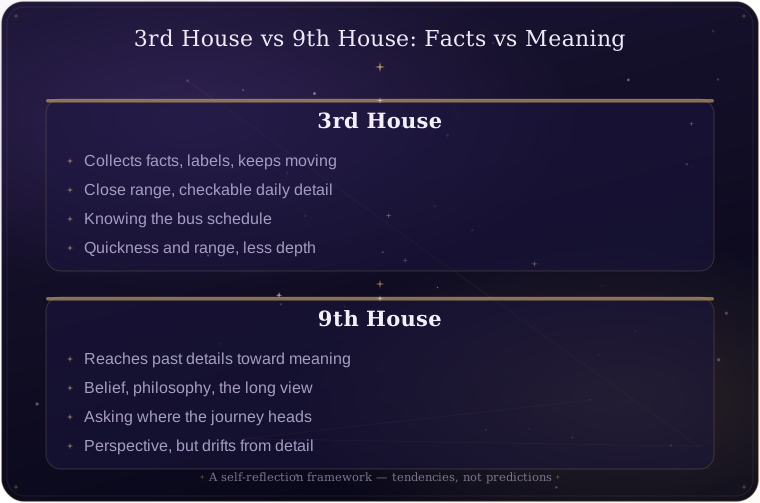
3rd house astrology is easiest to read against its opposite, the 9th house. The 3rd works by collecting: it gathers facts, labels them, and keeps moving, staying close to what can be seen, checked, and talked about over coffee. The 9th house runs the other way, reaching past the details toward meaning, belief, and the long view — the difference between knowing the bus schedule and asking where the journey is ultimately headed. Howard Sasportas framed this axis cleanly: if the 3rd house collects information, the 9th house asks what the information is for. That reading of the houses, which he and Liz Greene helped bring into the mainstream, treats the two ends as partners rather than rivals.
The trade-off is worth stating plainly, because it explains a frustration many readers recognize. To get the 3rd house's quickness and range, you often sacrifice depth: a mind that knows a little about everything can struggle to sit with one subject long enough to master it. Lean the other way, toward the 9th house, and the exchange reverses — you gain meaning and perspective but can drift away from the concrete, checkable detail that keeps thinking honest. Picture the person who can hold forth on ten topics at dinner yet never finishes the book on any of them; that is the 3rd house overextended, range bought at the price of depth. Neither setting is "better"; they are two different instruments, and most charts play a personal blend of the two.
The 3rd house also differs from the planet Mercury itself, and blurring the two is a common mistake. Mercury is the moving part — the way information actually travels through your mind — while the 3rd house is the field that information moves through. You can have a sharp Mercury and a quiet 3rd house, or a crowded 3rd house steadied by a careful Mercury, and the combination changes the whole picture. To favor a fast, fact-led thinking style buys you agility and quick recall, but the cost is the patience that turns scattered facts into understanding you can stand behind. Naming which trade you tend to make is the first real step toward choosing it on purpose instead of by default.
How to Read The 3rd House in Your Chart
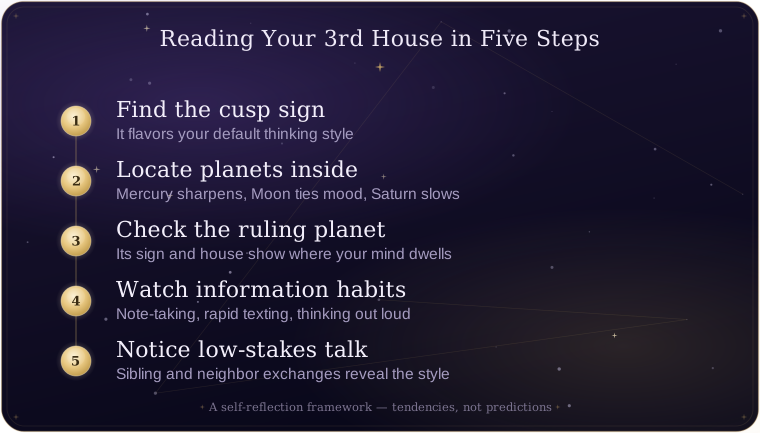
You can read 3rd house astrology in a chart through a handful of concrete markers rather than one sweeping verdict. Look at these in order, and a clear picture of your everyday thinking style usually comes together:
- Find the sign on the cusp. It flavors your default thinking style — quick and verbal, cautious and methodical, or restless and endlessly curious.
- Locate any planets inside it. Mercury sharpens curiosity, the Moon ties thinking to mood, and Saturn slows and structures how you process.
- Check where the ruling planet sits. Mercury is the natural significator of the 3rd house, but your chart's actual 3rd-house ruler is the planet ruling the sign on that house's cusp — so it is not always Mercury. Track that ruler's sign and house to see where your everyday mind spends most of its attention.
- Watch your real information habits. Constant note-taking, rapid texting, or talking ideas out loud are this house working in plain sight.
- Notice how you speak with siblings and neighbors. These close, low-stakes exchanges tend to reveal your thinking style most plainly.
Common Misreadings
A few stubborn misreadings keep people from using this house well:
- "It's only the siblings house." Siblings are one familiar expression of this house, not its core. The deeper subject is your everyday thinking and the information habits that quietly shape how you weigh and reach decisions.
- "A busy 3rd house means you're smart." It points to mental activity, speed, and range — not depth, wisdom, or raw intelligence. Being quick and well-informed is not the same as understanding something thoroughly.
- "Short trips and errands are the whole story." Those everyday keywords are the surface, not the substance. What the house really tracks is how you gather, label, and pass along whatever you happen to notice.
- "It doesn't touch the big decisions." In practice, 3rd house astrology shapes the framing and the first questions a major choice is built on, long before the so-called serious houses ever weigh in.
The 3rd House at a Glance
| Property | How It Works | Natural Ruler & Sign | How to Observe |
|---|---|---|---|
| Everyday thinking | Sorts and labels information at close range | Mercury (ruler) | You narrate, question, and categorize without being asked |
| Communication style | Sends ideas outward quickly in speech and writing | Mercury (ruler) / Gemini (sign) | You text, talk, or jot notes steadily through the day |
| Learning mode | Picks things up in short, curious bursts | Mercury (ruler) / Air | You skim widely and learn best by asking and doing |
| Close relationships | Sets the tone of exchanges with siblings and neighbors | Gemini (sign) | Your easiest, lowest-stakes conversations show the pattern |
Questions People Ask About the 3rd House
What does the 3rd house mean in astrology?
The 3rd house describes your everyday thinking and communication style — how you gather, sort, and share information at close range. Siblings, neighbors, and short trips all belong to it, but they sit on top of that deeper, more fundamental pattern of how your mind handles detail.
Is the 3rd house only about siblings?
No. Siblings are one common expression of the house, while its real subject is the daily mental habits and steady flow of information that shape how you frame problems and make decisions.
Which planet rules the 3rd house?
Mercury is the natural ruler, paired with the sign Gemini, because both are tied to thinking, language, and the movement of information. Where Mercury sits by sign and house then adds personal detail to how this part of your chart works.
How do I know if my 3rd house is strong?
A 3rd house reads as emphasized when planets sit inside it or when its ruling planet is especially prominent. In 3rd house astrology that usually shows up as a mind that is busy, verbal, and quick to gather and pass along whatever it picks up.
Reflection Prompts
- Think of a recent decision — how did the questions you asked first shape the answer you ended up with?
- Recall a conversation with a sibling or close friend this week: what did it reveal about your natural thinking style?
- Notice the last time you skimmed instead of going deep — what pulled your attention off the subject?
Related Reading
- explainer on the 9th house and its meaning — the polarity point that turns the 3rd house's scattered facts into broader meaning.
- guide to the sign Gemini — the sign most associated with this house's quick, curious thinking style.
- House (astrology) (Wikipedia) — background on the house system this article sits within.
Take Action
Map your own 3rd house this week: find its sign, note any planets inside it, and track how you gather and share information from morning to night. That gives you a plain-language picture of how your mind actually handles detail — not a fixed label, but a working description you can question and refine. Read the full Astrological Houses guide to place the 3rd house in context to see how this everyday-thinking house fits the larger chart, and the habit you once overlooked starts to read as one of the most decision-shaping parts of who you are.
Sources
- Howard Sasportas — developed the psychological reading of the houses this article draws on, treating the 3rd house as the mind's basic operating style.
- Liz Greene — helped bring depth-psychological astrology into the mainstream, shaping how placements are read as living patterns rather than fixed fates.