
What is The 9th House?
The 9th House is the sector of a birth chart that governs how you reach beyond your immediate surroundings toward meaning, belief, and a bigger picture of life. Sitting within the wider pillar guide to the twelve astrological houses, 9th house astrology reads in modern psychological work as the chart's domain of belief, higher learning, and the search for meaning. Where the 3rd House collects facts and handles the daily exchange of information, the 9th House asks what those facts add up to — and it does so through philosophy, faith, long-distance travel, higher education, and the questions you keep returning to about why any of it matters.
- Governs belief systems, higher learning, distant horizons, and the search for meaning
- Linked by tradition to Sagittarius and its ruler, Jupiter
- Often experienced as the restless pull toward something larger than daily routine
Why It Matters for Self-Awareness
Understanding 9th house astrology matters because this is the part of the chart where many aspiring readers get quietly stuck, and the friction is specific rather than vague. People can describe their Sun, Moon, and rising with real fluency, then go blank when asked what they actually believe — not what they were taught, but what they have tested and kept. The 9th House holds exactly that material: the working philosophy you live by, the worldview you defend without noticing, the curiosity that keeps pulling you toward subjects that promise to explain the whole rather than the part. It tends to stay underexamined because belief feels too obvious to question, the way you rarely notice the lens you are looking through.
Across nearly fifteen years spent helping people read the belief, meaning-making, and travel-and-higher-study currents in their charts, the placements they wrestle with most in session are 9th-house ones when several planets cluster there at once. The difficulty is rarely a lack of meaning in their lives; it is the interpretive confidence to hold a multi-planet picture without collapsing it into a single tidy verdict. This way of reading the house follows the lineage Howard Sasportas and Liz Greene helped establish, which treats the 9th less as a forecast of luck and more as the chart's site of meaning-making and growth. That orientation toward the bigger frame is also why the house works so closely with the sibling guide to the 3rd house and the everyday mind, its polarity point, where the raw information later gets shaped into a worldview.
The 9th House vs Adjacent Concepts: How It Works + Trade-offs
9th house astrology becomes clearer when you set the house beside the ones it is most often confused with, because each comparison exposes a different trade-off in how the chart moves between detail and meaning:
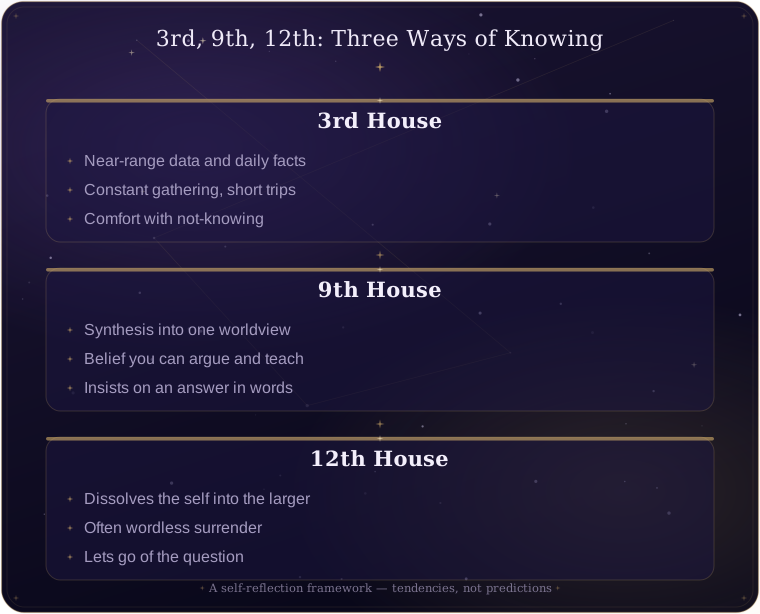
- The 9th versus the 3rd House. The 3rd house works through near-range data — siblings, short trips, the constant gathering of facts — while the 9th works through synthesis, where scattered facts get pulled into a single worldview. To gain the 9th's sense of meaning, you give up the 3rd's comfort with not-knowing; the way it functions, the search for the big answer can make the small, unresolved detail feel intolerable. This is why a 9th-emphasized reader can hold a sweeping philosophy yet lose patience with the patient, granular learning the 3rd house thrives on.
- The 9th versus the 12th House. The 12th house dissolves the self into something larger and often wordless, whereas the 9th reaches toward the larger through belief you can actually articulate and argue. Choosing the 9th's explicit faith over the 12th's quiet surrender gets you a worldview you can teach and share, but you sacrifice some of the 12th's tolerance for mystery that refuses to be named. The 12th lets go of the question; the 9th insists on an answer it can put into words.
- The 9th versus the 10th House. The 10th house builds outward reputation and concrete standing in the world, while the 9th builds the inner conviction that gives that standing a direction. To lean on the 9th rather than the 10th is to prize meaning over achievement — you gain a clear sense of why, but you can lose ground on the visible markers of how far you have come. In practice the 10th asks what you have accomplished; the 9th asks whether it pointed anywhere worth going.
How to Read The 9th House in Your Chart
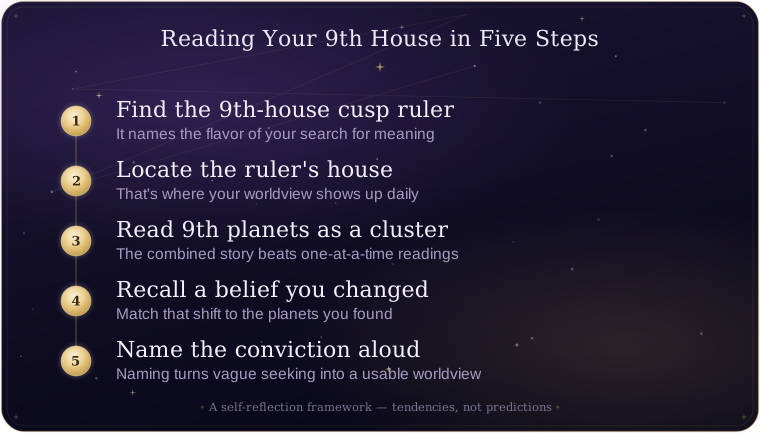
Reading 9th house astrology in your own chart works best as a single observe-then-apply sequence rather than a trait checklist, because belief rarely announces itself as one neat symbol. Instead of staring at the house and waiting for a verdict, you trace it through the parts of the chart you can already see:
- Find the sign on your 9th-house cusp and note its planetary ruler — this names the flavor of your search for meaning.
- Locate the house that ruler actually occupies; that visible house is where your worldview tends to show up in daily life.
- Note any planets sitting inside the 9th itself, then read them as a cluster rather than one at a time.
- Recall a belief you changed your mind about, and match the shift to the planets you found in step three.
- Name the conviction you arrived at out loud — that act of naming is what turns vague seeking into a worldview you can use.
Run this sequence once and the house stops being an abstract field of "philosophy and travel"; it becomes a specific pattern you can point to in how you actually form, defend, and revise what you believe.
Common Misreadings
Most confusion about 9th house astrology comes from a few popular shortcuts that flatten a meaning-rich house into a single keyword. Each of the most common misreadings is worth correcting on its own terms:
- "It's just the travel house." Long-distance travel is one vivid expression, not the whole territory; the underlying theme is reaching beyond the familiar for meaning, which can happen just as fully through study, faith, or a worldview that travels nowhere physically.
- "It's the luckiest house because of Jupiter." Traditional rulership by Jupiter colors the house with growth and optimism, but it describes a tendency toward expansion and faith, not a guarantee of fortune; an unexamined 9th can just as easily over-believe as over-arrive.
- "It only matters if you're religious." The house governs any organizing belief system, secular or spiritual — the philosophy you live by counts here whether or not it carries a religious label.
- "Planets here mean you should be a teacher." Teaching and publishing are common outlets, yet the deeper reading concerns how you metabolize experience into meaning; that synthesis can show up in research, mentoring, or simply a steady habit of asking why.
The 9th House at a Glance
| Life Area | How It Works | Natural Ruler | How to Observe |
|---|---|---|---|
| Belief and philosophy | Scattered experience gets pulled into a working worldview | Sagittarius / Jupiter | Notice which convictions you defend before you think to question them |
| Higher learning | Knowledge is pursued for meaning, not just utility | Sagittarius / Jupiter | Track the subjects you study long after any exam is over |
| Distant horizons | The unfamiliar is sought as a source of growth | Jupiter (traditional) | Watch what shifts in you after travel or contact with another culture |
| Meaning-making | Raw events get translated into a sense of purpose | Sagittarius / Jupiter | Listen for how you explain why hard experiences happened to you |
Common Questions About The 9th House
What does the 9th house represent in a birth chart?
It represents belief, higher education, long-distance travel, philosophy, and the search for meaning — everything tied to reaching beyond your immediate world for a larger picture. Because it sits opposite the 3rd house of everyday facts, it describes how you turn raw information into a worldview you actually live by.
What does it mean to have a lot of planets in the 9th house?
A loaded 9th house points to a mind organized around meaning, learning, and belief rather than routine detail. The task is reading the planets as a single configuration, since their combined story matters more than any one placement read in isolation.
Is the 9th house really the house of luck?
Its traditional ruler Jupiter lends a tone of growth and optimism, but 9th house astrology describes a leaning toward expansion and faith, not a promise of good fortune. Read as tendency rather than guarantee, it shows where you are inclined to believe, grow, and reach.
How is the 9th house different from the 3rd house?
The 3rd house gathers near-range facts and handles daily communication, while the 9th synthesizes those facts into philosophy and long-range meaning. Together they form the chart's axis between knowing the parts and understanding the whole.
Reflection Prompts
- Think of a belief you changed your mind about recently — what experience finally moved you?
- Recall a moment when travel or an unfamiliar idea shifted how you see your own life.
- Name one conviction you defend automatically; when did you last actually test it?
Related Reading
- explainer on the 10th house and public standing — useful for seeing how inner conviction in the 9th turns into outward direction and reputation.
- the 6th house of daily work, health, and routine — where the 9th house's big beliefs get grounded in the everyday practice that actually carries them.
- House (astrology) (Wikipedia) — background on the house system this sector belongs to.
Take Action
Once you have traced your 9th-house ruler and read its planets as a cluster, set that picture back inside the larger map by reading the full Astrological Houses guide to place this house within the whole chart. That single view shows how the 9th House connects to the eleven houses around it, and seeing the connection is often the moment a vague pull toward "meaning" sharpens into a worldview you can recognize and live with on purpose.
Sources
- Howard Sasportas — developed the framework that reads the houses, including the 9th, as fields of psychological development and meaning-making
- Liz Greene — helped establish the psychological reading of the 9th house as the inner search for meaning rather than a forecast of luck