
What is the Best-Sign Theory?
The best-player zodiac question is the search for a single zodiac sign that produces the best soccer players, and the honest answer is that birth-date clustering is real but astrological causation is not. People look up the best soccer players' zodiac sign expecting one winning sign, yet the patterns in elite squads come from the calendar, not the stars. Read as a data question rather than a horoscope, World Cup 2026 astrology themes pillar is the place to enjoy the symbolism while keeping the numbers straight.
- Elite players do cluster by birth month, a well-documented effect
- That clustering tracks each country's youth selection cutoff, not a star sign
- The honest read names the Relative Age Effect, not a "lucky" zodiac sign
This is an educational, data-first reading — not a prediction of results or a betting guide.
Why It Matters for Self-Awareness
Most "best soccer players zodiac sign" content picks a flattering sign and stops. That is where readers get misled, because a real birth-month pattern gets dressed up as astrology when it has a plainer cause. The discipline here is to separate correlation from a horoscope: if a dataset of top players leans toward certain months, the question is what the calendar did, not what the planets decided. Held that way, the best soccer players zodiac sign question becomes a small lesson in reading data honestly — a skill worth more than any flattering sign, on or off the pitch.
The pattern itself is not in doubt; decades of sports-science research find that elite players are born disproportionately in the early months of their selection year. What the data does not support is the leap from "these players share a birth window" to "this zodiac sign breeds champions." Those are two very different claims, and a best soccer players zodiac sign list quietly swaps the second for the first. Keeping them apart is what lets you read the numbers and still enjoy a horoscope without confusing one for the other.
the Best-Sign Theory vs Adjacent Concepts: How It Works + Trade-offs
It helps to set the best-sign theory against two neighbors. Against a pure horoscope, the data view explains how it works: youth academies group children by age bands with a cutoff date, so a child born just after the cutoff is months older, bigger, and more often selected — the Relative Age Effect. To gain that explanatory clarity, you sacrifice the fun of a destined sign — this is a calendar effect, not an astrological one.
Against a results prediction, the dataset trades certainty for honesty. It can show that the best soccer players' zodiac sign pattern shifts when a country moves its cutoff, which is exactly what you would not expect if the stars were responsible. The trade-off stays honest: naming a measurable bias in selection is not the same as crowning a sign, and it is far more useful for understanding why some birthdays show up more often.
This is also where the honest reading of astrology lives. Liz Greene treated the chart as a language of symbol rather than a statistical claim, and Robert Hand framed it as meaning rather than a predictive machine, so neither would expect a horoscope to explain a selection bias. The best soccer players' zodiac sign question, taken that way, lets you enjoy the symbolism of a sign while crediting the calendar for the data, and that separation is the whole point of reading either one well.
How to Read the Best-Sign Theory in the Data
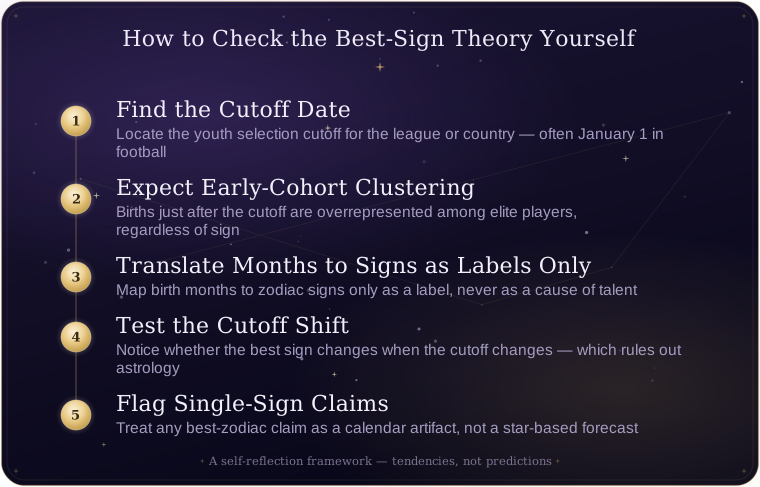
You can check the best-sign theory yourself with a few honest steps, and the exercise works on any sport or any list that claims a lucky sign produces winners.
- Find the youth selection cutoff for the league or country in question — often January 1 in football.
- Expect births just after the cutoff to be overrepresented among elite players, regardless of sign.
- Translate those months into zodiac signs only as a label, never as a cause, and watch how the so-called best soccer players zodiac sign simply tracks the calendar.
- Notice that the "best" sign changes when the cutoff changes, which rules astrology out.
- Treat any single-sign claim about the best soccer players' zodiac sign as a calendar artifact, not a forecast.
Common Misreadings
- One zodiac sign makes better players. The clustering is the Relative Age Effect; the sign is a label on a birth month, not a cause of talent, and the same months would look 'lucky' under any system that read them.
- The data predicts the World Cup. A birth-month bias in selection says nothing about who wins; outcomes rest on the players, not their signs.
- Astrology and birth-month data agree. They do not; the pattern moves with the cutoff date, which a star-based cause could never explain.
- You read a player's sign differently from your own. The honest method is identical — check the calendar cause first, then enjoy the label — for anyone.
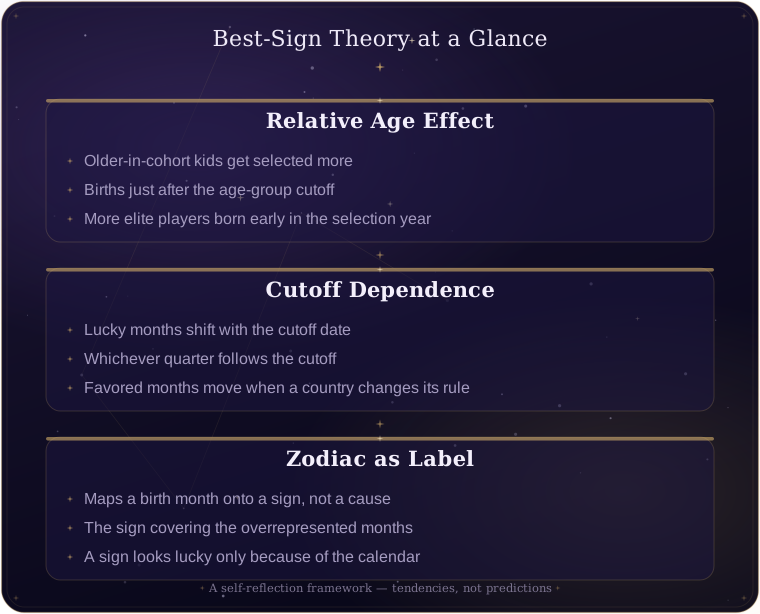
the Best-Sign Theory at a Glance
| Property | How It Works | Birth-Month Window | How to Observe |
|---|---|---|---|
| Relative Age Effect | Older-in-cohort kids get selected more | Births just after the age-group cutoff | More elite players born early in the selection year |
| Cutoff dependence | The "lucky" months shift with the cutoff | Whichever quarter follows the cutoff date | The favored months move when a country changes its rule |
| Zodiac as label | Maps a birth month onto a sign, not a cause | The sign covering the overrepresented months | A sign looks "lucky" only because of the calendar |
| No astrological signal | No sign causes talent in the data | Any sign, once the cutoff is controlled for | The pattern vanishes when you correct for age bands |
Common Questions About the Best-Sign Theory
Is there really a best zodiac sign for soccer?
No reliable one. Elite players cluster by birth month because of the Relative Age Effect, and the matching zodiac sign is just a label on those months rather than a cause of skill. Any list that crowns a single sign as the best soccer players zodiac sign is reading a calendar pattern as if it were a star pattern.
Why do some signs seem overrepresented?
Because youth selection uses an age-group cutoff, and children born just after it are older, bigger, and more often chosen, then given better coaching that compounds the early edge. The overrepresented months map onto whichever signs happen to follow the cutoff, which is why the favored sign differs between a January-cutoff country and a school-year-cutoff one.
Does this mean astrology is involved?
No. The pattern shifts whenever a country changes its cutoff date, which a star-based explanation cannot account for. It is a calendar effect, not a star-based one, and that shift is the cleanest test you can run on any claim of a lucky sign.
Can I still enjoy the zodiac angle?
Yes — as symbolism, not statistics. Read the sign for fun and personality, but credit the Relative Age Effect for the real birth-month pattern. The honest version of a best soccer players zodiac sign piece simply keeps the symbol and the statistic in separate boxes.
Reflection Prompts
- Recall a time you mistook a coincidence for a cause — what did noticing the difference change about how you decided?
- Think of a pattern you once explained by personality; could a plainer factor explain it better?
- Notice when you want a flattering story to be true — what does checking the data, rather than the horoscope, free up for you?
Related Reading
- World Cup 2026 astrology themes pillar — the hub that frames the tournament's wider astrology
- zodiac signs as World Cup 2026 teams — the playful companion to this data-first piece
- what the Relative Age Effect is — the calendar cause behind the birth-month pattern
- transit_events cluster on 2026 planetary transits — the real-sky backdrop to the tournament
Take Action
Generate your free birth chart to read your own Sun for fun, while keeping the best soccer players' zodiac sign question in honest perspective. You get a clear view of your own sign and a reminder that a label is not a cause, and, more usefully, a habit of asking what the calendar or the cutoff did before crediting the stars for a pattern that has a much plainer source.
Sources
- Liz Greene — grounded the reading of astrology as symbol rather than a statistical claim, the stance this data-first piece takes
- Robert Hand — known for treating astrology as a language of meaning rather than a predictive machine