What are Astrological Transits?
Astrological transits are the angles formed when present-moment planets move into relationship with the fixed points of your birth chart. Put plainly, a transit is a present-sky planet meeting a fixed point in your birth chart.
- A family of timed events, not a single fixed prediction
- Each one has a beginning, a peak, and an end you can actually track
- Read by planet, angle, and the chart point it touches, never in isolation
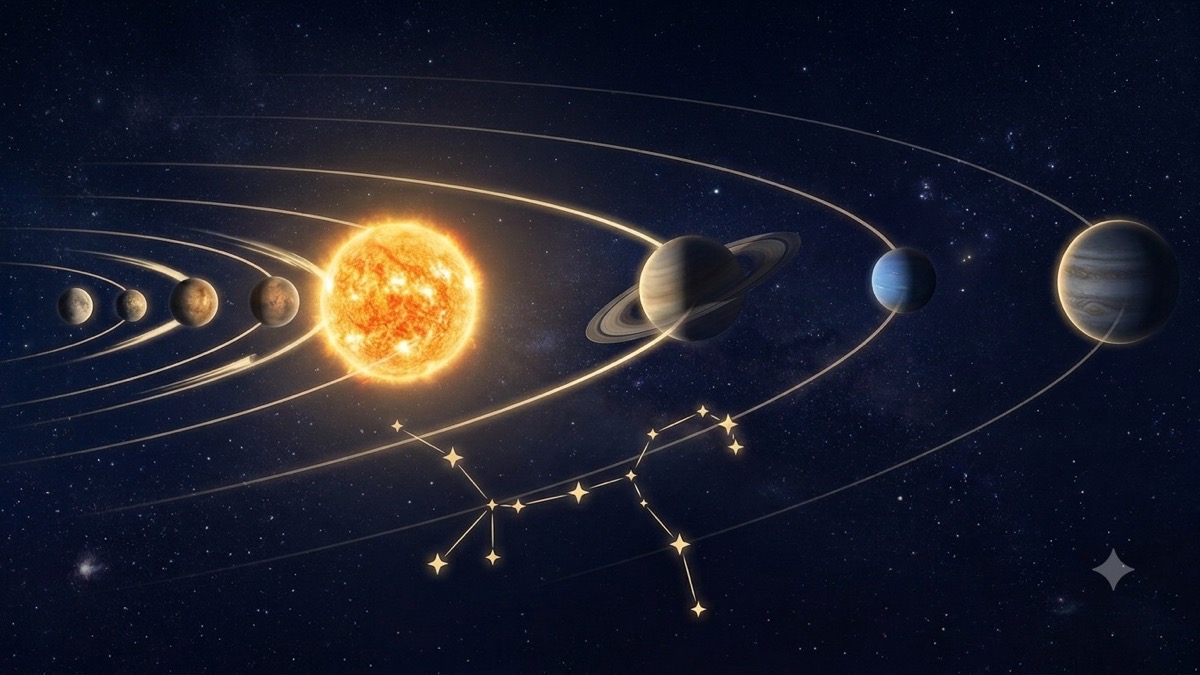
This is a system rather than one thing. The moving members are the planets themselves — roughly nine bodies, from the fast Moon to slow, distant Pluto — and each forms its own contact as it crosses the birth chart anatomy explainer. Names follow a simple pattern: the transiting planet, the angle it makes, and the natal point it touches, as in "transiting Saturn square natal Sun." Once you know that pattern, most of the jargon in horoscopes and apps stops looking mysterious and starts reading like a sentence you can follow.
Why It Matters for Self-Awareness
Most people meet these planetary movements in a daily horoscope, where they arrive stripped of context: a vague warning that Mercury is "causing chaos" or that a big shift is coming. That framing creates two opposite mistakes. Some readers treat each contact as a fixed prediction and brace for doom; others decide the whole thing is noise and tune it out. Both reactions skip the part that makes a transit usable — the fact that it is a specific, timed angle between one moving planet and one fixed point in your own chart, with a shape you can follow from start to finish.
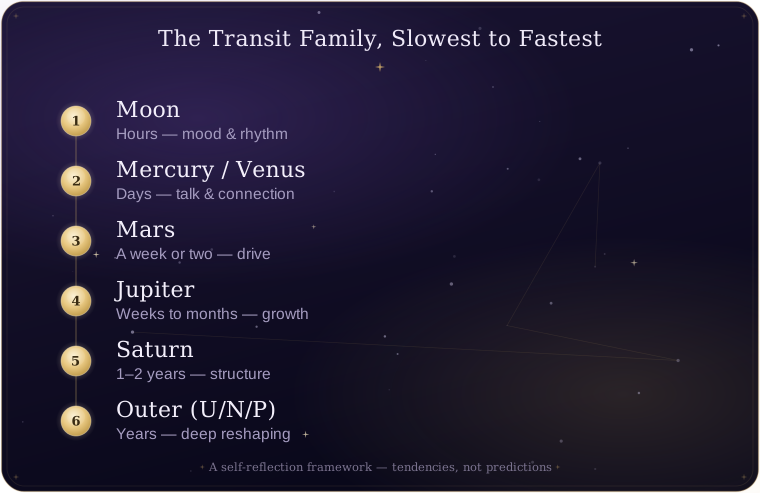
Understanding the family before any single member matters because the planets do not all behave the same way. A Moon contact lasts hours; a Pluto contact can run for two or three years. If you do not know which kind you are looking at, you cannot tell a passing mood from a long structural shift, and that is exactly where daily-horoscope thinking goes wrong. It flattens a nine-speed system into one undifferentiated forecast. Seeing the whole range first gives you a sense of scale — you learn to ask "how slow is this planet, and how long will this last?" before you ask "what does it mean?"
There is also a self-knowledge payoff. The same contact lands differently depending on where it falls in your chart, which is why two people can share the same sky and have completely different weeks. Reading these movements as a family teaches you to locate an event in your own life area rather than borrowing a generic prediction written for millions. That shift — from "what is the universe doing to everyone" to "which angle is active in my chart, and in which house" — is the difference between astrology as anxiety and astrology as a tool for noticing patterns. To see which life area any given contact lights up, it helps to know the astrology houses overview first.
The Astrological Transits at a Glance
| Transiting Planet | Core Theme | Typical Duration | Common Misread |
|---|---|---|---|
| Moon | Mood, daily rhythm, emotional weather | A few hours | Reading a fleeting feeling as a lasting trend |
| Mercury | Conversations, errands, short trips, thinking | A day or two | Blaming "retrograde" for every small inconvenience |
| Venus | Attraction, money, taste, small pleasures | A few days | Expecting a passing charm to be a life partner |
| Mars | Drive, conflict, decisive action, irritation | A week or two | Treating ordinary frustration as a full crisis |
| Jupiter | Growth, opportunity, optimism, excess | Weeks to months | Assuming luck arrives without any effort |
| Saturn | Limits, responsibility, maturation, tests | One to two years | Hearing only punishment, missing the mastery |
| Uranus | Disruption, freedom, sudden change | One to two years | Forcing change before it is ready |
| Neptune | Dissolving, idealizing, inspiration, fog | Two to three years | Mistaking confusion for clarity |
| Pluto | Death-and-rebirth, power, deep change | Two to three years | Expecting literal catastrophe instead of inner change |
The pattern that organizes this whole table is speed: the slower a planet moves, the longer its contact lasts and the deeper it tends to cut. Robert Hand built much of modern predictive astrology around exactly that hierarchy, which is why duration belongs in the same row as theme.
The Nine Transits: Quick Guide
Here is each member at hub depth — enough to recognize these transits, with the full reading saved for each deep dive. Across all of them the same rule holds: faster planets bring events, slower planets bring processes.
- Moon moves fastest, so it reads like emotional weather — a few hours of heightened feeling tied to whatever natal point it touches. Use it to time small things, like when to rest or when to reach out, rather than to make permanent decisions. The common misread is treating a passing low mood as proof of a lasting problem, when the Moon has already moved on by tomorrow. For the full picture, see the Moon transit explainer.
- Mercury lasts a day or two and stirs the realm of thinking, messages, errands, and short conversations — a useful window for signing documents, sorting details, or finally having the talk you have been putting off. The misread is blaming every dropped call or traffic jam on "Mercury retrograde"; most days are simply ordinary, retrograde or not. Read the Mercury transit deep dive for the detail.
- Venus runs a few days and warms matters of attraction, money, taste, and small pleasures. People often feel more magnetic, social plans fill up, and spending gets easier. The misread is mistaking a brief Venusian sweetness for a destined relationship; a lovely few days is not a forecast of forever. See the Venus transit explainer.
- Mars unfolds over a week or two and raises drive, courage, irritation, and the urge to act. It can sharpen focus or shorten your temper, depending on the angle and the point it strikes. The misread is reading ordinary frustration as a full crisis — Mars heat usually passes once the planet moves on. The Mars transit explainer covers the details.
- Jupiter lasts weeks to months and tends to expand whatever it touches — opportunity, confidence, travel, or plain excess. It is the closest astrology comes to a tailwind, but growth still asks for participation. The misread is assuming luck will arrive on its own; Jupiter opens a door, it does not walk you through it. The Jupiter transit deep dive shows how, and for a worked example of a single Jupiter transit shaping a shared moment, see how Jupiter in Cancer colors the World Cup 2026 window as collective energy rather than a winner forecast.
- Saturn can run one to two years and brings limits, responsibility, and the slow work of maturing in one area of life. It often feels like pressure, but the point is structure that holds up over time. The misread is hearing only punishment and missing the mastery Saturn rewards once the work is done. For a fully worked example, follow Saturn in Pisces worked example.
- Uranus spans a year or more and brings disruption, sudden insight, and a pull toward freedom in whatever area it crosses. Change can feel abrupt and liberating at the same time. The misread is forcing a breakup or quitting on impulse before the shift has fully formed — Uranus rewards readiness, not panic. The Uranus transit explainer explains the difference.
- Neptune moves slowly, often lasting two to three years, and softens edges — dissolving old certainties, raising inspiration, and sometimes spreading confusion. It is excellent for art and devotion, harder for contracts and clear decisions. The misread is mistaking fog for clarity and acting on an idealized picture of a person or plan. The Neptune transit deep dive covers how.
- Pluto is the rarest and longest, sometimes running two to three years, and works on the most guarded parts of your life. The theme is death and rebirth — not literal loss, but the ending of an identity or pattern that has outlived its use. The misread is bracing for outer catastrophe instead of expecting deep inner change. The Pluto transit explainer goes further.
How Shade and Combination Shift Readings
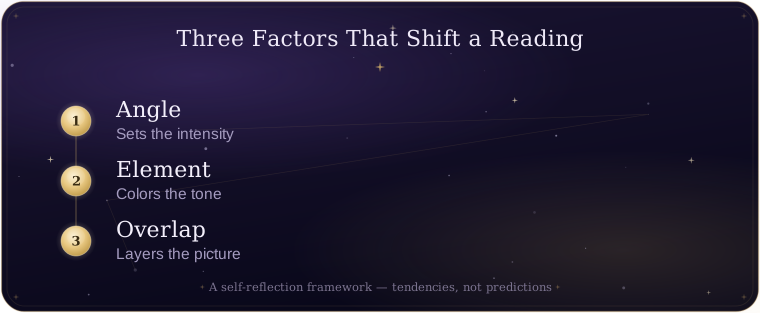
Single transits rarely act alone, and reading one as an isolated event is the fastest way to misjudge it. What changes the meaning is angle, element, and overlap — the way several moving planets layer over each other and over your chart at once. Three factors do most of the work.
- The angle changes the intensity. The aspect a transiting planet makes decides how strongly you feel it. A soft trine can pass almost unnoticed, while a square aspect explainer creates the friction that makes a contact demand action. To get the clarity that comes from a hard angle, you sacrifice the ease of a soft one — the square is felt precisely because it does not let you ignore it.
- Element blends the tone. A transiting planet takes on the flavor of the sign it moves through, and that sign's element shapes how the theme expresses. The same Mars contact reads as blunt force in fire, slow pressure in earth, restless talk in air, and an emotional surge in water. The four-element framework overview explains how those blends work.
- Overlap compounds the picture. When several contacts land at once, they layer rather than cancel. A hopeful Jupiter contact running under a heavy Saturn one produces a year that feels like growth and grind at the same time, and reading only one of them gives a flat, wrong forecast.
Two quick examples show how this plays out. First, transiting Saturn square your natal Moon is not the same as Saturn gently sextile that Moon: the square brings a felt test of security and belonging, while the sextile offers a quiet chance to mature with far less strain. Second, a fast Mars contact lighting up a slow Pluto one can act like a match dropped on a long fuse — Mars supplies the trigger and the heat, Pluto supplies the depth and the lasting change. In both cases the reading lives in the combination, not in any single planet's standard meaning. The real skill is learning to read these stacked contacts as chords rather than single notes, and to keep asking which one is loudest right now and which is only background.
Common Misreads + Framework Limits
Most mistakes with transits happen at the level of the whole family, not any single planet. Four show up again and again.
- Treating a contact as a discrete prediction. A transit is interpretive vocabulary, not a fixed event guaranteed to arrive on schedule. Read it as a window of likely themes, not a sentence handed down from above.
- Forcing one lineage to be the single truth. Traditional and psychological astrologers often read the same contact differently, and when they disagree the honest move is to hold both rather than crown one correct. Dane Rudhyar's view that planets are symbols rather than causes sits beside older predictive methods, and both can earn their place.
- Promoting the framework into an identity. "I'm in my Saturn return" can quietly become an excuse or a personality. The chart describes timing and theme; it is not a label that explains everything you do or absolves you of choice.
- Expecting it to replace real ground truth. Astrology can name a pattern, but it cannot diagnose an illness, repair a relationship, or substitute for the clinical and practical help a hard season may genuinely call for.
There is also a subtler limit worth naming, one most beginner guides skip. Liz Greene's argument that fate is largely what you do to yourself without knowing it reframes a contact as a meeting with your own unconscious patterns rather than an outside force pressing on your chart. That nuance matters because it changes what you do with the information: instead of waiting for something to happen to you, you watch for the pattern it tends to surface and work with it on purpose. At its best, this framework is a mirror and a clock — not a verdict, and not a replacement for your own judgment.
Common Questions About These Cycles
How are transits different from my daily horoscope?
A daily horoscope blends many active angles into one generic forecast for an entire sun sign, while a single contact is one specific moving planet hitting one fixed point in your own chart. Reading the sky against your actual chart is far more precise than any sun-sign column.
How do I know which contact matters most right now?
Start with the slowest planets, since Saturn, Uranus, Neptune, and Pluto contacts last longest and shape the biggest themes. Then check which natal points they touch and at what angle, because a hard aspect to a personal planet outranks a soft one to an empty degree.
Does a transit make things happen to me?
In modern psychological astrology, a planet is read as a symbol of a process already moving in your life, not a cause forcing events from outside. The contact marks timing and theme; what you do with it stays yours.
How long does a contact last?
It depends entirely on the planet's speed: a Moon contact lasts hours, a Mars contact a week or two, and a Pluto contact two to three years. Knowing the duration tells you whether you are seeing a passing mood or a genuine turning point.
Reflection Prompts
- Think of a recent week that felt unusually charged, and ask which slow planet might have been crossing a key point in your chart.
- Recall a time you blamed the stars for something — was it a real, timed angle, or a vague daily-horoscope worry?
- Notice which life area keeps showing up when big shifts hit, and consider which house a current contact may be lighting up.
Related Reading
To read transits more deeply, follow these threads:
- The natal chart transits guide for working through your chart contact by contact
- The 2026 astrology calendar for every retrograde, eclipse, ingress, and moon phase of the year, each dated from the ephemeris
- The how to read a birth chart walkthrough, the foundation every reading rests on
- The astrology aspects overview for measuring the angles
- A comparison with Vedic astrology timing for an outside view
Take Action
Pick one slow-moving planet in the current sky and find where it falls in your own chart, then watch how its transits unfold against your fixed points. Start with the full guide to reading a birth chart, then track which planets are currently crossing it. Do this for a few weeks and the sky stops feeling like fate happening to you and starts feeling like a clock you can finally read.
Sources
- Robert Hand — shaped modern predictive astrology around the idea that a planet's speed sets the depth and duration of its contact
- Dane Rudhyar — advanced the person-centered view that planets are symbols of inner processes rather than external causes
- Liz Greene — brought a Jungian, psychological reading to the chart, framing fate as unconscious pattern made visible