
What is black moon lilith?
Black moon lilith is the Moon's calculated apogee — the farthest point in the Moon's elliptical orbit around Earth, used in astrology as a symbolic lens for desire patterns that were exiled or suppressed by social conditioning. It is not a physical body; it is a mathematical point, which places it alongside overview of astrological points and secondary chart bodies as a secondary interpretive tool rather than something you can locate in the physical sky.
- Marks the position where the Moon is geometrically farthest from Earth, calculated either as a smoothed long-term average (mean) or as real-time orbital geometry (true)
- Commonly confused with Asteroid Lilith (1181), a physical rock in the asteroid belt with an entirely separate orbit and a different chart placement
- The mean and true versions can fall in different signs for the same birth date, which is why chart apps often disagree on this placement
Why It Matters for Self-Awareness
Understanding black moon lilith matters because most of the confusion readers run into has nothing to do with interpretation — it is rooted in which calculation method the chart software is using. When two platforms give different signs for the same birth time, the instinctive reaction is to distrust the reading or assume a user error. The real source is almost always a mean-versus-true discrepancy built silently into the software.
This matters practically. Someone with mean Lilith in Scorpio and true Lilith in Sagittarius will find that Scorpio-based interpretations describe a suppression pattern that never quite fits, while Sagittarius-based descriptions land with unexpected accuracy. The productive move is to find out which version the source is using before deciding whether a reading applies — not to read both signs and hope one resonates.
Beyond the calculation issue, the point describes a specific kind of pattern: areas where an authentic desire or identity quality got labeled excessive, dangerous, or socially inconvenient early on. Working within the person-centered tradition Dane Rudhyar helped formalize for Western astrology, contemporary practitioners use this placement as a pointer toward where habitual self-editing tends to be most consistent — not a shadow to fight against, but a map of where authentic expression was conditionally suppressed. Most popular write-ups reduce this to a shadow label without explaining why the suppression happened, which leaves readers with a diagnosis rather than a usable frame.
black moon lilith vs Adjacent Concepts: How It Works + Trade-offs
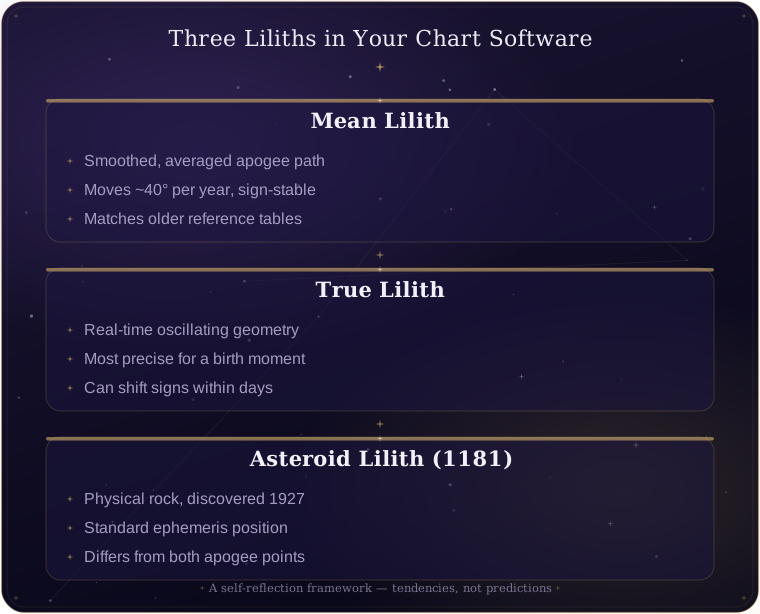
Three distinct black moon lilith calculation types appear in modern chart software, and conflating them produces mismatched placements. Each one works differently and carries a specific trade-off:
- Mean position (averaged apogee). Uses a smoothed, averaged version of the Moon's apogee path. This version moves steadily at roughly 40 degrees per year and rarely jumps sign boundaries within a short birth window. To get sign-level stability and consistent readings across older reference tables, you sacrifice the precision of tracking the actual geometric peak of each orbit.
- True position (oscillating apogee). Tracks the real-time moment when the Moon is geometrically farthest from Earth. It gives the most accurate positional snapshot for a specific birth moment. To get that real-time precision, you sacrifice sign stability: the true point can shift signs within days near oscillation peaks, meaning the same person born a few days apart may show a different sign.
- Asteroid Lilith (1181). A physical rock in the asteroid belt, discovered in 1927, tracked through standard ephemeris tables. Research into asteroid mythology has connected this body to the same Mesopotamian and Kabbalistic heritage as the apogee-based points explored in Lilith mythology and symbolism in ancient traditions. To get a body with a single, consistent position across all software, you sacrifice the psychological resonance the apogee versions carry in exiled-desire frameworks.
The practical split: mean position works better for comparing placements across groups or using older printed ephemerides; true position suits readers who want precision tied to the actual orbital geometry of their specific birth moment.
How to Read black moon lilith in Yourself
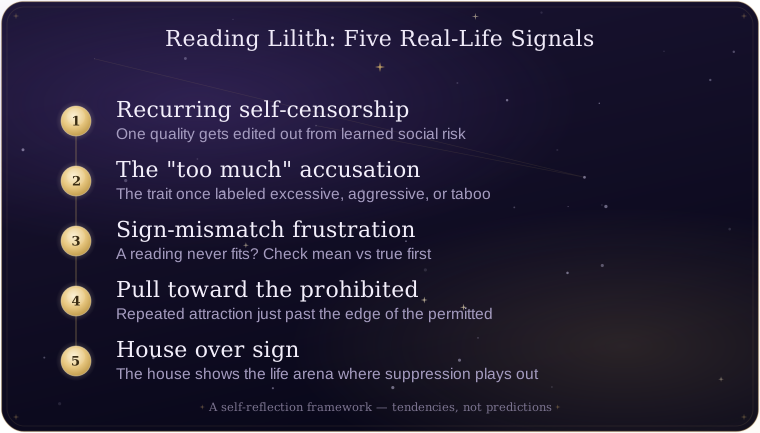
Reading black moon lilith in a birth chart starts with confirming which version the software is calculating — mean and true can differ by multiple signs for the same birth data. Once that is settled, look for these signals in real life:
- Recurring self-censorship in one area. Consistent editing of a specific quality or desire — not from genuine preference, but from a learned sense that expressing it carries social risk.
- The "too much" accusation. The placement often describes the quality that was labeled excessive, aggressive, or taboo in formative environments — what you learned to suppress rather than risk losing approval.
- Sign-mismatch frustration. If a placement has never felt accurate despite extensive reading, check whether the interpretation was built on mean or true position. A different calculation method often explains the entire misfit.
- Compulsive pull toward the prohibited. Repeated attraction to something just outside the edge of what feels permitted to want, with no clear origin for the pull.
- House placement over sign flavor. The house tells you the life arena — career, relationships, creative expression — where the suppression pattern shows up most concretely day to day.
Common Misreadings
Four misreadings about black moon lilith circulate consistently in popular write-ups. Here is where each one goes wrong:
- "Lilith is my dark side." This reduces the point to a shadow label. The more precise frame is that it marks where desire or identity was pushed out by external pressure — the suppression is the story, not an inherent pathology in the person who carries the placement.
- "My Lilith sign is [sign] — I just checked." Without specifying mean versus true, this claim can be off by one to three signs. Cafe Astrology defaults to mean; multiple other platforms default to true. The source matters before the sign does.
- "Lilith runs on a nine-year cycle, same as the nodes." The cycle is approximately nine years, but it does not synchronize with nodal returns. Treating them as aligned produces timing errors in predictive or transit-based work.
- "There is only one Lilith point." Modern software typically includes at least three: mean apogee, true apogee, and asteroid 1181. White Moon Selena — the lunar perigee — is often added as a counter-pole. Readings that treat one as the definitive point are working from an incomplete picture.
Black Moon Lilith at a Glance
| Property | How It Works | Sign Stability | How to Observe |
|---|---|---|---|
| Mean Lilith (apogee average) | Smoothed average of the Moon's apogee path | ~40° per year, slow and stable | Check whether two apps agree on sign — if they do, likely using mean |
| True Lilith (oscillating apogee) | Real-time apogee geometry, tracks actual oscillation | Can shift sign within days near oscillation peaks | Recalculate the same birth data one week earlier or later; if sign shifts, you are reading true |
| Asteroid Lilith (1181) | Physical rock in the main asteroid belt | Standard elliptical orbit, consistent | Find sign in an asteroid ephemeris; will differ from both apogee versions |
| White Moon Selena | Lunar perigee, counter-pole to the apogee | Moves at a comparable rate to mean Lilith | Read alongside the apogee versions as the integrative counter-point in the orbital pair |
Common Questions About Black Moon Lilith
What is the difference between true and mean Lilith positions?
Mean Lilith averages the Moon's apogee into a smooth, slow-moving position; true Lilith follows the real oscillating geometry of the orbit. The two can differ by multiple signs for the same birth data, which is why different astrology apps give different placements without any user error on your part.
Why does my Black Moon Lilith sign change depending on which website I use?
Most chart calculators default silently to either mean or true apogee and do not label which one they used. Cafe Astrology's tools yield mean positions; several other platforms default to true. Checking the app's documentation resolves the discrepancy immediately.
Is Lilith a planet or an asteroid?
The mean and true versions are calculated mathematical points derived from the Moon's orbital geometry — they have no physical body. Asteroid Lilith (1181) is a physical rock, but it occupies a different chart position than either apogee version.
How often does this point change signs?
Mean Lilith changes signs roughly every nine months as it moves through the zodiac. True Lilith oscillates and can shift signs within days near apogee peaks, then reverse. For stable sign-level interpretation across a birth window, mean Lilith is the more reliable reference.
Reflection Prompts
- Think of a specific moment when someone told you that a quality of yours was "too much" — what was the quality, and did you agree with that judgment at the time?
- Recall one desire or identity trait you have consistently edited out of how you present yourself publicly — when did that editing start, and whose voice does it carry?
- Notice one area where you feel pulled toward something you frame as off-limits — is that prohibition genuinely yours, or did you inherit it from an environment that no longer applies?
Related Reading
- guide to the lunar nodes and nine-year nodal cycle — the nodal cycle is frequently confused with Lilith's orbital period; this page clarifies how the two timelines differ
- White Moon Selena explainer — the counter-pole to the apogee Lilith, tracking the Moon's perigee position in the chart
- Lilith in the signs and houses guide — sign-by-sign and house-by-house breakdown of how the suppression pattern tends to show up in different life arenas
Take Action
Generate your free birth chart to find your exact black moon lilith placement — and check which calculation method your chart is using. Knowing whether you are working with mean or true tells you which interpretive sources apply and where the contradictions in past readings actually came from.
Sources
- Dane Rudhyar — pioneered the psychological, person-centered reading of astrological cycles and chart points in Western astrology
---
This is not a clinical interpretation or mental health advice.