
What is North Node vs South Node?
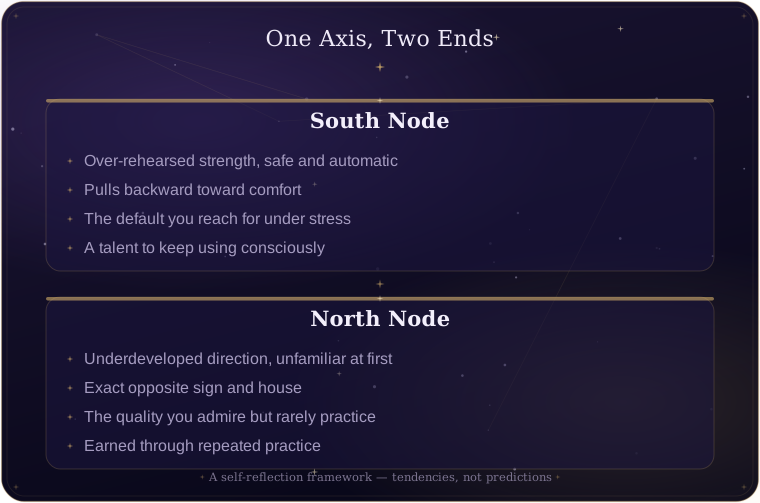
North Node vs South Node describes the two opposite points where the Moon's orbit crosses the Sun's apparent path, read in astrology as a single growth axis between a comfortable past pattern and an unfamiliar future direction. The South Node names what already comes easily, often to the point of overuse; the North Node points toward the qualities a person has not yet practiced and tends to find awkward. Together they form one axis, not two separate placements, which is why they are always read as a pair. This sits within the wider field of pillar page on the lunar nodes and the soul's path, which frames the nodes as direction rather than fixed fate.
- The South Node marks an over-rehearsed strength that feels safe and automatic
- The North Node marks an underdeveloped direction that feels unfamiliar and worth practicing
- Read as one axis, never as two isolated traits, because each side defines the other
Why It Matters for Self-Awareness
Understanding North Node vs South Node matters because students often struggle to trust nodal readings at all, since the historical traditions hand down contradictory definitions and leave the reader unsure which one to believe. Some lineages treat the nodes as essential karmic indicators; others have technically rejected them as abstract calculated points with no real influence. That gap is the friction most people carry into a search, and it shows up in a few recognizable ways:
- The contradiction problem. One source calls the nodes the chart's deepest karmic signal; another dismisses them as mathematical fictions, and the reader cannot tell who is right.
- The overcorrection trap. Hearing that the South Node must be "released," people try to amputate a genuine talent instead of rebalancing it.
- The fatalism worry. Searchers fear the nodes describe a fixed destiny rather than a direction they can actually work with day to day.
Across roughly two decades of charting the nodal axis and watching its evolutionary direction unfold in client after client, I have found the most common reason a reading lands is that it answers this trust problem first: it treats the contradiction itself as information rather than pretending the disagreement does not exist. The growth-centered approach that Howard Sasportas and Liz Greene helped establish is useful here precisely because it reads the axis as development rather than decree. A reader who already over-relies on a South Node strength does not need to be told the strength is wrong; they need to see where the same skill, used past its point of usefulness, quietly costs them. Framed that way, the axis stops being a verdict about character and becomes a working question about balance, which is far easier to trust than a flat declaration of fate.
North Node vs South Node vs Adjacent Concepts: How It Works + Trade-offs
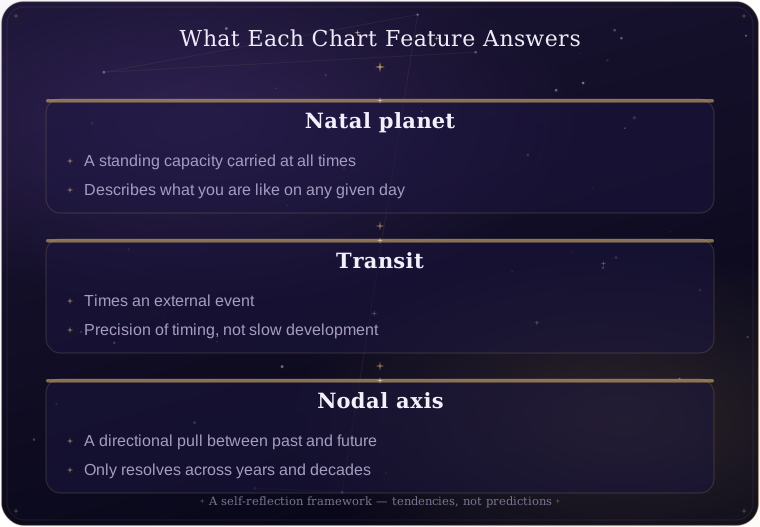
The North Node and South Node are often confused with adjacent chart features, so it helps to set the axis beside the placements it gets mistaken for and show how each one functions. The way it works is comparative: the nodes describe a directional pull between past and future, while signs, planets, and the related explainer on planetary transits to the natal nodes describe something more static or event-based. The trade-offs become clearer in contrast:
- Nodes vs a natal planet. A planet describes a standing capacity you carry at all times; the nodal axis describes movement away from one habit toward another. To read the nodes as a fixed trait, you sacrifice the directional meaning that makes them useful.
- Nodes vs the rising sign. The rising sign shapes how you meet the world on contact; the nodes shape where your development is heading. Lean on the rising sign for first impressions and you lose the longer arc the axis is tracking.
- Nodes vs a transit. A transit times an external event; the nodal axis describes an internal growth direction. To get the precision of timing, you trade away the slow-burning developmental theme the nodes hold across decades.
The practical takeaway from these contrasts is that the axis answers a different question than its neighbors. A planet or a sign tells you what you are like, while the nodes tell you which way your development leans over a long horizon. The clearest test is the timescale: a sign or planet describes something true of you on any given day, whereas the axis only resolves when you watch it play out across years and even decades. Keeping the axis in its own lane, set against these adjacent placements rather than blended into them, is what lets a nodal reading stay precise instead of collapsing into a generic personality sketch.
How to Read North Node vs South Node in Yourself
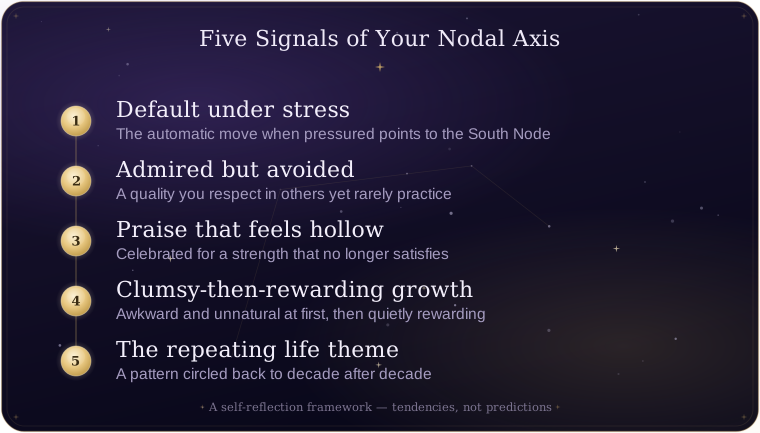
Reading the North Node and South Node in yourself starts with noticing the difference between what drains you when overused and what stretches you when attempted, since that contrast is where the axis becomes observable in ordinary life. You are not looking for a dramatic revelation; you are looking for the quiet, repeated tug between a familiar move and an unfamiliar one. Watch for these signals:
- The default you reach for under stress. The move you make automatically when pressured usually points to the South Node end of the axis.
- The skill you admire but avoid. A quality you respect in others yet rarely practice often sits near the North Node.
- The praise that feels hollow. Being celebrated for a strength that no longer satisfies you is a classic South Node overuse signal.
- The growth that feels clumsy. A direction that feels awkward and unnatural at first, then quietly rewarding, tends to mark the North Node.
- The repeating life theme. A pattern you keep circling back to, decade after decade, is the axis asking to be rebalanced.
None of these signals is meant to be read once and filed away. The point of observing first is that the same scene can read differently depending on the day: a strength that feels like overuse during a stressful month can feel like steady ground during a calm one. Returning to these cues over time, rather than locking in a single verdict, is what turns observation into a usable practice.
Common Misreadings
Most popular write-ups flatten the North Node and South Node into slogans, and those shortcuts are exactly what trip up the readers who come looking for clarity. The modern internet leans almost entirely on a tidy "soul purpose" story, which sounds reassuring but skips the historical skepticism and the technical debates that make a careful reading possible. Each misreading has a more accurate version underneath it:
- "Reject your South Node." Misread: the past is a flaw to discard. Actual: the South Node is a real talent to keep using consciously, not abandon.
- "The North Node is your destiny." Misread: a reward that arrives on its own once you find your placement. Actual: the meaning is earned through repeated practice, and someone can know their North Node for years while never developing it.
- "Nodes predict events." Misread: they forecast what happens to you. Actual: they describe a developmental pull, not a calendar of events.
- "Just chase the North Node." Misread: focus on the North Node alone and ignore the South Node. Actual: the South Node names the very resource you draw on to reach the North Node, so dropping it leaves the growth ungrounded.
North Node vs South Node at a Glance
| Property | How It Works | Chart Axis | How to Observe |
|---|---|---|---|
| South Node | An over-rehearsed pattern pulling backward toward comfort | Its natal sign and house, with that sign's ruler coloring the habit | Notice the skill you default to automatically under pressure |
| North Node | An underdeveloped pull toward unfamiliar growth | The exact opposite sign and house, ruled by the polar planet | Watch for the quality you admire but rarely practice |
| The full axis | A directional tension between past habit and future stretch | The sign-pair the axis spans, always 180 degrees apart | Track a life theme that keeps repeating across years |
| Reading method | Observe the contrast first, then apply meaning | Both poles of the axis read together, never one pole alone | Compare what drains you against what slowly rewards you |
Common Questions About North Node vs South Node
What does the difference between the North Node and South Node actually mean?
The South Node names an over-practiced strength from the past, and the North Node names an unfamiliar growth direction for the future. They sit at opposite ends of one axis, so neither is read in isolation.
Is the South Node bad and the North Node good?
Neither is good or bad. The South Node is a genuine talent that becomes a rut when overused, while the North Node is a direction that often feels awkward before it feels rewarding.
How do I find my North Node in my chart?
The nodes are calculated points, so an accurate birth time and a chart calculator give you both ends at once. Many readers begin with guide to finding the North Node sign and house before going deeper.
Do the North Node and South Node predict my future?
They describe a developmental pull rather than fixed events. The axis tends to surface as a recurring theme you can work with, not a future you are locked into.
Reflection Prompts
- Think of a recent moment you handled on autopilot. Which strength did you reach for without deciding to?
- Recall a time you admired someone's quality yet felt clumsy trying it yourself.
- Name one life theme that keeps returning, and ask what direction it might be pointing you toward.
Related Reading
- comparison of the North Node across all twelve signs — see how the growth direction shifts sign by sign
- guide to the South Node and releasing past patterns — go deeper on working consciously with the past pole
Take Action
Open your birth chart and locate your North Node by sign, then read one worked example to see the axis in motion. The Read the North Node in Scorpio guide to see this growth axis worked through one sign walks the same past-to-future tension through a single placement, so you finish with a concrete picture instead of an abstract rule. Naming your own growth edge this way turns the chart from a verdict into a question you get to keep answering.
Sources
- Howard Sasportas — developed the psychological, growth-centered reading of the chart that frames the nodes as developmental direction
- Liz Greene — shaped the depth-psychological tradition this axis-as-growth interpretation draws on