
What is the Blue-Node Convention?
The Blue-Node Convention is the simple fact that most birth-chart software draws the North Node as a blue symbol, so "blue node astrology" is not a hidden placement at all but the ordinary North Node shown in a particular color. People type the phrase after spotting an unfamiliar blue glyph on a chart, assume it must be its own point, and go looking for a meaning that was never there. The honest answer is plainer and more useful: the color is a display choice the program made, and the placement underneath it is the lunar node axis every chart already carries, the subject the pillar page on the lunar nodes and the soul's path treats in full.
- "Blue node" describes how a symbol looks on screen, not what it is in the chart
- The blue symbol almost always marks the North Node (Rahu in Vedic systems)
- The color varies by software, so it carries no fixed astrological meaning of its own
This is an educational, interpretive framework rather than a clinical reading or a forecast.
Why It Matters for Self-Awareness
The reason this small confusion matters is that it quietly teaches the wrong lesson about how to read a chart. A beginner who decides the blue symbol is a separate "blue node" starts hunting for its meaning in interpretations that never mention it, then feels lost when nothing fits. The friction is real and recognizable: someone sees a blue glyph in one program, a differently colored one in another, and concludes the chart itself has changed when only the palette has. Naming the convention for what it is replaces that uncertainty with a steadier habit — read the symbol, not the swatch.
There is a second, quieter benefit to getting this right. Once you know that "blue node astrology" is really the North Node in disguise, you can redirect your curiosity toward the thing that actually carries meaning: the nodal axis and the direction it points. The color told you nothing, but the placement tells you a great deal about the contrast between a familiar past pattern and an unpracticed future one. Mistaking the display for the data is a small error, yet correcting it early is what keeps a reading honest, and that discipline tends to carry over to every other glyph on the wheel.
the Blue-Node Convention vs Adjacent Concepts: How It Works + Trade-offs
It helps to set the Blue-Node Convention beside the real placement it points to, because the two are easy to blur. The way the convention works is purely visual: a program assigns the North Node a blue color and the South Node a contrasting one, so the eye learns to read "blue" as a label. The trade-off is that this shorthand is convenient inside one piece of software and misleading the moment you leave it — the meaning lives in the node, never in the hue.
Against the North Node itself, the contrast is sharper still. The North Node is a calculated point where the Moon's orbit crosses the ecliptic, and it means the same thing whether your software paints it blue, red, or black. Liz Greene read the chart as a language of symbol rather than a literal catalog, and Robert Hand framed astrology as meaning rather than a fixed machine, so neither would grant a color any standing of its own. To treat the blue symbol as a distinct factor, you would have to sacrifice that whole interpretive logic and credit a software setting with significance it cannot carry.
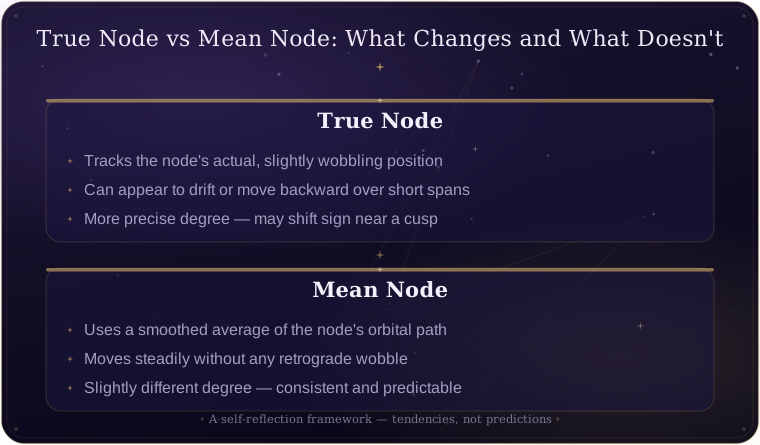
A subtler trade-off sits inside the placement, between the True Node and the Mean Node. Both are versions of the same North Node, and software may show either in blue. The True Node tracks the node's actual, slightly wobbling position, which drifts and even appears to move backward over short spans; the Mean Node uses a smoothed average that moves steadily. Choosing one over the other changes the node's degree by a small amount, occasionally enough to shift its sign near a cusp — a genuine interpretive choice, unlike the color, which changes nothing at all.
How to Read the Blue-Node Convention in Your Own Chart
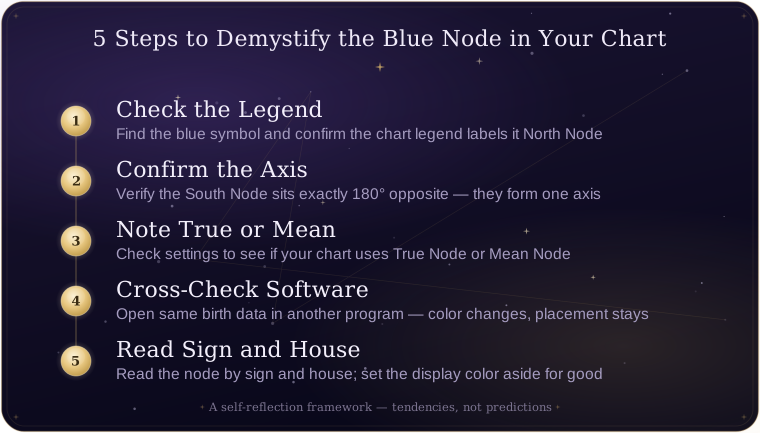
You can settle the blue-node question in your own chart with a few honest steps, and the same method works no matter which program drew it.
- Find the symbol you think of as the "blue node" and check the chart's legend or glyph key, which almost always labels it as the North Node.
- Confirm the South Node sits exactly opposite, since the two are one axis 180 degrees apart, not two unrelated points.
- Note whether your software is set to True Node or Mean Node, usually shown in the settings, so you know which version of the degree you are reading.
- Open the same birth data in a second program and watch the color change while the placement stays put — proof the blue was never the meaning.
- Read the node by its sign and house, as covered in the guide to finding the North Node sign and house, and set the color aside for good.
Common Misreadings
- The blue node is its own point. It is the North Node shown in a software color; there is no separate body or calculation hiding behind the blue symbol.
- Blue means something specific in astrology. The hue is a display setting that differs across Astro-Seek, TimePassages, and other tools, so it carries no shared meaning.
- True Node and Mean Node are different nodes. They are two ways of locating the same North Node; the difference is a small degree shift, not a different placement.
- Rahu is unrelated to the blue node. Rahu is the Vedic name for the very same North Node the software colors blue; one tradition, one axis, two vocabularies.
the Blue-Node Convention at a Glance
| Property | How It Works | What It Actually Is | How to Observe |
|---|---|---|---|
| Blue symbol | Software paints the North Node blue as a display choice | The ordinary North Node, not a new point | Check the chart legend; the glyph is labeled North Node |
| Color variance | Each program picks its own palette | A cosmetic setting with no fixed meaning | Open the same chart elsewhere and watch the color change |
| North Node identity | The blue glyph marks the ascending lunar node | Rahu in Vedic systems, same axis as the South Node | Confirm the South Node sits 180 degrees opposite |
| True vs Mean Node | Software computes the node's exact or averaged position | Two versions of the same node, a small degree apart | Read the settings to see which mode your chart uses |
Common Questions About the Blue-Node Convention
Is "blue node" a real astrological placement?
No. It is the North Node displayed in a blue color by your chart software. The phrase "blue node astrology" describes how a symbol looks on screen, not a distinct point in the chart, so the meaning you want is simply the North Node's meaning.
Why is the node blue in my chart but a different color elsewhere?
Because color coding is software-specific. One program may render the North Node blue and the South Node orange, while another reverses or replaces those colors entirely. The placement is identical across all of them; only the palette differs.
Is the blue node the same as Rahu?
Yes, in effect. Rahu is the Sanskrit name for the North Node in Vedic astrology, the same ascending lunar node Western software often colors blue. The interpretive frameworks differ, but the underlying axis is one and the same.
Should I use the True Node or the Mean Node?
Either is defensible; they are both the North Node, located by slightly different math. The True Node follows the node's real, wobbling motion, and the Mean Node uses a smoothed average. The degree gap is small, so pick one, stay consistent, and read the node by sign and house.
Reflection Prompts
- Recall a time a label or a display made you assume something was more complicated than it was — what changed when you looked underneath it?
- When you first saw the blue symbol, what meaning did you start to invent for it, and where did that guess come from?
- Notice how it feels to trade a mysterious "blue node" for the plainer North Node — does the loss of mystery cost you anything, or free you to read what is actually there?
Related Reading
- comparison of the North Node across all twelve signs — read the placement the blue symbol actually marks, sign by sign
- explainer on Rahu and Ketu in Vedic astrology — see how the same axis is named and read in another tradition
Take Action
Generate your free birth chart to find your own North Node by sign and house, and notice which color your software happens to give it. You finish with the placement that carries the meaning, a clear sense that the blue was only ever a display choice, and the steadier habit of reading the glyph rather than the swatch.
Sources
- Liz Greene — grounded the reading of astrology as a language of symbol rather than a literal catalog, the stance this correction takes
- Robert Hand — known for framing astrology as meaning rather than a fixed machine, which is why a software color carries no standing of its own