What are Chakra Crystals?
Chakra crystals are stones paired with the seven energy centers of the body, where the idea of crystals for each chakra means matching a stone to a center by its energy state, not its color alone. Each center sits along the spine and gets one or two go-to stones, building on the framework Anodea Judith established, and the pairing sits inside the larger pillar page on the full chakra system that maps how the seven centers relate.
- Pairs one or two reliable stones to each of the seven energy centers
- Treats a stone's job as supporting a center that feels under- or over-active
- Reads color as a starting clue, not the whole answer
Why It Matters for Self-Awareness
crystals for each chakra matters because most people shop the wrong way. They scan a color chart, grab a green stone for the heart center because green looks "heart-ish," and assume the match is done. The friction underneath is real: a stone helps when it meets the actual energy state of a center, and color alone never tells you whether a center is quiet and drained or loud and overworked. So the green stone for an over-active heart center that already gives too much can miss the point entirely, and the citrine someone buys to feel more confident can leave an already-restless solar plexus center even louder.
Picking crystals for each chakra by feel instead of by chart turns the practice into self-observation. Take a few familiar moments. You notice your throat center going quiet in a tense meeting and reach for a calming stone when the truer need is something steadying. You feel your root center buzzing on a sleepless night after a long commute, and the chart tells you "red for root" while your body is actually asking to settle, not to be revved up further. The same color can sit at opposite ends of a center's needs depending on the week. That small shift, from "what color goes here" to "what is this center doing right now," is where the real awareness comes from. The stone becomes a prompt to check in, a way to keep your attention on one center long enough to notice its state, not a decoration that promises a result on its own.
Chakra Crystals vs Adjacent Concepts: How It Works + Trade-offs
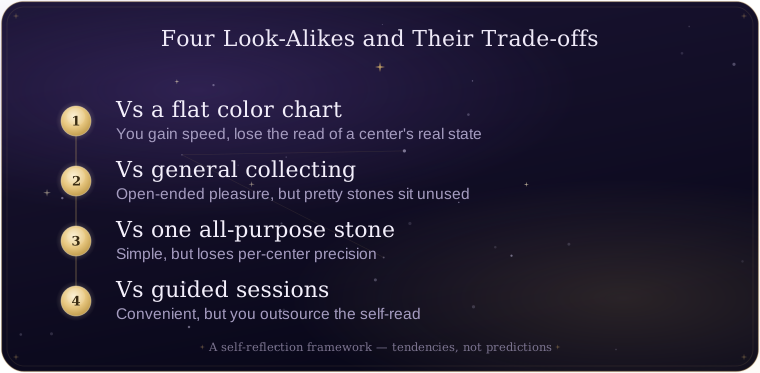
People mix up three things that look similar, so it helps to put crystals for each chakra next to its neighbors and show how each one works plus what you give up choosing it.
- Chakra crystals vs a flat color chart. A color chart sorts stones by hue and stops there; chakra crystal work sorts them by which center needs support and in what state, so the same blue stone can be a fit one week and a mismatch the next. To get the speed of a color chart, you sacrifice the accuracy of reading a center's actual energy, which is the whole point of the pairing.
- Chakra crystals vs general crystal collecting. Collectors gather stones for beauty, rarity, or how they look on a shelf, with no center in mind. To get the open-ended pleasure of a collection, you lose the targeted use that comes from tying each stone to one job, and a drawer of pretty stones tends to sit unused because nothing tells you when to reach for which.
- Chakra crystals vs single all-purpose stones. Some traditions lean on one master stone, often clear quartz, for everything. To get the simplicity of one stone, you sacrifice the per-center precision that a full set offers; a root center that runs cold and a third-eye center that runs hot rarely want the same support, and a single stone can only point in one direction at a time.
- Chakra crystals vs guided crystal sessions. A session hands the choosing to someone else, which feels easy. To get that convenience, you give up the self-reading skill that makes the practice yours, since the value of the pairing is learning to notice your own centers, not outsourcing the read.
How to Read Chakra Crystals in Yourself
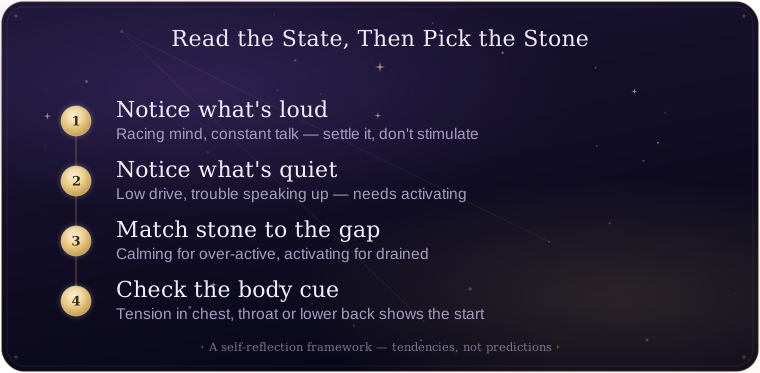
The honest way to pick crystals for each chakra is to read your own state first, then choose the stone that answers it. Here is what to watch for:
- Notice which center feels loud. A racing mind or constant talking can point to an over-active throat or third-eye center asking to be settled, not stimulated.
- Notice which center feels quiet. Low drive, feeling ungrounded after a long commute, or trouble speaking up usually flags an under-active root or throat center.
- Match the stone to the gap. Pick a calming stone for an over-active center and an activating one for a drained center, rather than defaulting to color.
- Check the body cue. Tension that gathers in the chest, throat, or lower back is a plain signal of where to start, no special sensitivity required.
Common Misreadings
A few myths keep readers stuck, and clearing them is the fastest fix for crystals for each chakra.
- "Green stone, heart center, done." Color is a clue, not the rule. A center that is already over-giving may want grounding support, not more of the same.
- "More crystals work better." A full grid of stones rarely beats one stone matched to the center that actually needs attention right now.
- "The stone does the work for me." The pairing is a focus tool for your own attention; the awareness comes from you noticing the center, not from the stone acting on its own.
- "One stone fits a center forever." A center shifts between under- and over-active across a week, so the stone that fit on Monday may not fit on Friday.
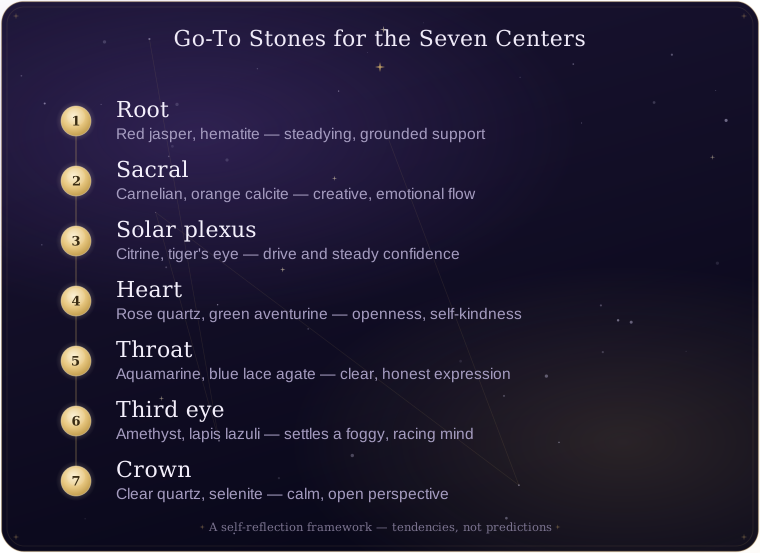
Chakra Crystals at a Glance
| Energy Center | Common Crystals | How It Works | How to Observe |
|---|---|---|---|
| Root | Red jasper, hematite | Lends a steadying, grounded quality | Notice restlessness or feeling unsafe after stress |
| Sacral | Carnelian, orange calcite | Supports creative and emotional flow | Watch for flat or stuck feelings around pleasure |
| Solar plexus | Citrine, tiger's eye | Reinforces drive and steady confidence | Spot hesitation or pushiness in decisions |
| Heart | Rose quartz, green aventurine | Eases openness and self-kindness | See whether you give too much or close off |
| Throat | Aquamarine, blue lace agate | Encourages clear, honest expression | Catch the urge to go silent or over-explain |
| Third eye | Amethyst, lapis lazuli | Settles an overactive or foggy mind | Notice racing thoughts or trouble focusing |
| Crown | Clear quartz, selenite | Supports a calm, open sense of perspective | Observe feeling scattered or disconnected |
Questions People Ask About Chakra Crystals
How do I choose chakra crystals if I'm a beginner?
Start with the one center that feels most off today and pick a single stone for it. You learn the practice faster by working one center at a time than by buying a full set at once.
Do chakra crystals have to match the chakra color?
Color is a helpful first clue, but it is not the deciding factor. A center that runs over-active often wants a grounding stone rather than a same-color one, so read the energy state before the hue.
Can one crystal work for more than one chakra?
Yes. Clear quartz is treated as flexible across centers because traditions describe it as taking on the focus you give it, which makes it a common starting stone for several energy centers.
How do I actually use a crystal once I've matched it?
Hold it or rest it near the matching center while you sit quietly and notice that area. The stone works as a cue to keep your attention on the center, not as something that changes the body on its own.
Reflection Prompts
- Think of a recent moment when speaking up felt hard, and notice which center went quiet.
- Recall a stressful week and name the one energy center that felt loudest.
- Picture choosing crystals for each chakra by feel, and ask which center you'd start with.
Related Reading
- guide to the seven chakra colors and meanings — see how color theory connects to each energy center before you shop by hue.
Take Action
Take the free Chakra Test to find which energy center is most under- or over-active right now, so you can pair your first stone with the center that needs it instead of guessing from a color chart: Take the Chakra Test. You walk away with a clear starting point, and over time that habit of reading your own state turns crystal work into a steady practice of self-awareness rather than a shopping list.
Sources
- Anodea Judith — systematized the modern seven-center chakra framework this crystal mapping draws on