
What is the Descendant?
The Descendant is the point on the western horizon directly opposite your rising sign, and it sits on the cusp of your seventh house of one-to-one relationships. In descendant astrology, this angle reads as the sign and qualities you most often project onto close partners. The sign here describes the traits you tend to look for, react to, or feel pulled toward in someone else, often because you have not fully claimed those traits in yourself. You can find it in the broader vocabulary of glossary pillar page on astrology terms, which maps how each chart point fits together.
- Sits exactly opposite the Ascendant, marking the seventh-house cusp
- Describes the relationship qualities you tend to meet through other people
- Often points to disowned traits you reclaim by recognizing them in partners
Why It Matters for Self-Awareness
Most quick write-ups stop at one idea: the Descendant shows your "ideal partner." That framing feels reassuring, but it leaves the real work untouched. Descendant astrology is more useful when you read it as a description of your own pattern rather than a shopping list for a future date. The traits on this angle are usually parts of yourself you have set aside, and they keep reappearing in the people you choose. Building on the relationship-as-mirror tradition Liz Greene helped shape, the person across from you is partly a creation of your own unconscious, and what you admire or resent in them often points back inward. This connects to the wider axis of self-image that the explainer on the Ascendant rising sign covers, since the two angles sit on the same line and define each other.
The practical payoff shows up in everyday moments. Think of the friend who keeps dating the same confident, slightly bossy person and then complains they are "too controlling," or the colleague who is drawn again and again to dreamy, hard-to-pin-down partners and ends up feeling unseen. In both cases the Descendant sign tends to name the very trait the person has trouble owning in themselves: the quiet one who never claims their own authority, the practical one who has filed away their own imagination. Reading the Descendant this way turns a vague hope about partners into a concrete prompt: what am I waiting for someone else to carry? Dane Rudhyar framed the chart angles as tools for becoming a fuller version of yourself, and in that spirit descendant astrology is less a forecast than a question you keep asking as your relationships change.
Descendant vs Adjacent Concepts: How It Works + Trade-offs
Descendant astrology gets clearer when you set the angle beside its neighbors and look at how each one works. The contrasts below show what each point gives you and what it costs to lean on it.
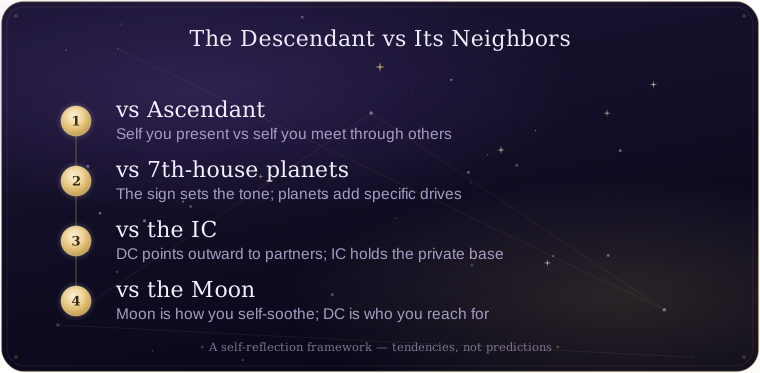
- Descendant vs Ascendant. The Ascendant shows the self you present; the Descendant shows the self you meet through others. To read your relationship pattern through the Descendant, you give up the comfort of treating partner problems as purely "their fault" and accept that the trait you keep meeting may be your own.
- Descendant vs the seventh-house planets. The Descendant sign sets the overall tone, while planets inside the seventh house describe specific drives you experience through people. Reading only the sign gets you a clean summary, but you lose the detail those planets add; for example, a Mars in the seventh house can color a calm-looking Descendant sign with real friction.
- Descendant vs the IC. The Descendant points outward to partnership, while the chart's private base of home and roots is marked by the IC. Focusing on the Descendant gets you insight into how you relate, but it says little about the inner ground you retreat to when the relationship is over.
- Descendant vs the Moon. The Moon describes how you feel and self-soothe, while the Descendant describes who you reach for to meet a need you have not yet met yourself. Leaning on the Descendant alone gets you the relationship pattern, but you can miss the quieter emotional habits the Moon reveals. In practice, descendant astrology reads best when each of these neighbors fills in a gap the angle leaves open.
How to Read the Descendant in Yourself
Descendant astrology becomes practical once you watch for it in real situations rather than treating it as a label. Look for these signals.
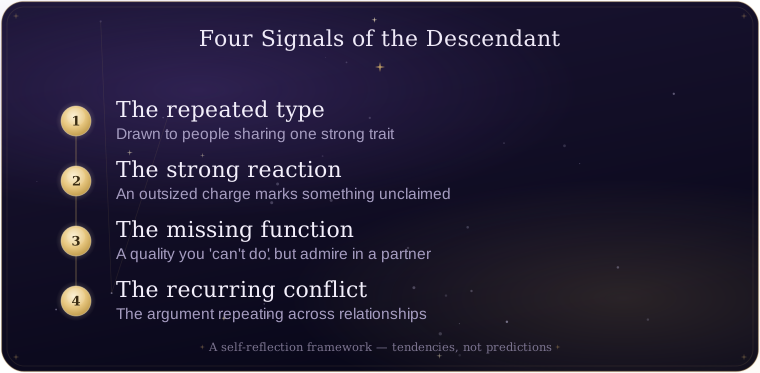
- The repeated type. Notice if you keep being drawn to people who share one strong trait, then ask where that trait lives, or hides, in you.
- The strong reaction. Watch for partners whose behavior triggers an outsized response; that charge often marks something you have not claimed.
- The missing function. Spot a quality you say you "can't do" but admire in a partner, such as directness or ease.
- The recurring conflict. Track the argument you have in relationship after relationship; the theme usually traces back to your seventh-house cusp.
Common Misreadings
Most surface-level takes on the Descendant repeat the same few errors, and each one keeps readers stuck on the friction that brought them here.
- "It's just my ideal partner." The Descendant describes a pattern you live out, not a wish list to fill; the deeper task is recognizing those traits as your own.
- "It means I'm doomed to attract the wrong people." Descendant astrology shows tendencies, not a fixed fate; once a trait is seen and claimed, the pull tends to ease.
- "It's the same as my Venus sign." Venus shows what you value and enjoy; the Descendant shows what you project onto a one-to-one partner, which is a different reading.
- "I should just find someone who matches the sign." Choosing a partner to fit the Descendant sign skips the point entirely. The angle is most useful as a prompt to develop the trait in yourself, so that you relate from a fuller place rather than handing the job to whoever you date next.
Descendant at a Glance
| Property | How It Works | Chart Position | How to Observe |
|---|---|---|---|
| Relationship style | Sets the tone you seek and meet in partners | Seventh-house cusp, opposite the Ascendant | Note the recurring "type" you are drawn to |
| Projected traits | Surfaces qualities you have not yet claimed | Sign on the Descendant | List traits you admire but say you lack |
| Partner conflicts | Mirrors disowned drives back through others | Seventh house and its planets | Track the argument that repeats across relationships |
| Self-integration | Eases the pull once a trait is owned | Read alongside the Ascendant axis | Watch whether a strong reaction softens over time |
Common Questions People Ask About the Descendant
What does the Descendant mean in descendant astrology?
It is the seventh-house cusp opposite your rising sign, read as the traits you tend to project onto close partners. The sign there describes the relationship qualities you keep meeting in other people.
How do I find my Descendant sign?
Your Descendant is always the sign exactly opposite your Ascendant. If you know your rising sign, the sign six places away on the wheel is your Descendant.
Is the Descendant the same as the seventh house?
No. The Descendant is the exact cusp point, while the seventh house is the whole area of one-to-one relationships that begins at that cusp. The cusp sets the tone; the house holds the full territory.
Does my Descendant describe my "perfect match"?
Not exactly. It describes a pattern you tend to repeat, often built from traits you have not claimed in yourself, rather than a guaranteed ideal partner.
Reflection Prompts
- Think of a recent partner or close friend: what one trait drew you in most strongly?
- Recall a conflict that keeps repeating across your relationships, and name the theme behind it.
- Notice a quality you admire in others but say you "can't do," and ask where it already shows up in you.
Related Reading
- guide to the twelve astrological houses — places the seventh house in the full wheel so the Descendant has context.
- Descendant (astrology) (Wikipedia) — the technical background behind the angle.
Take Action
Cast your full birth chart and locate your Descendant sign and seventh-house cusp using the steps in the full guide to reading a birth chart. You will come away with the exact sign on your relationship axis and a short list of the traits it points to, and once you see them as your own rather than someone else's job to carry, your patterns in love start to read less like bad luck and more like a map you can work with.
Sources
- Liz Greene — developed the psychological, projection-centered reading of the seventh house and relationship astrology that this article draws on.
- Dane Rudhyar — established the person-centered approach to the chart angles that frames the Descendant as a tool for self-understanding.