
What is Astrology Terms?
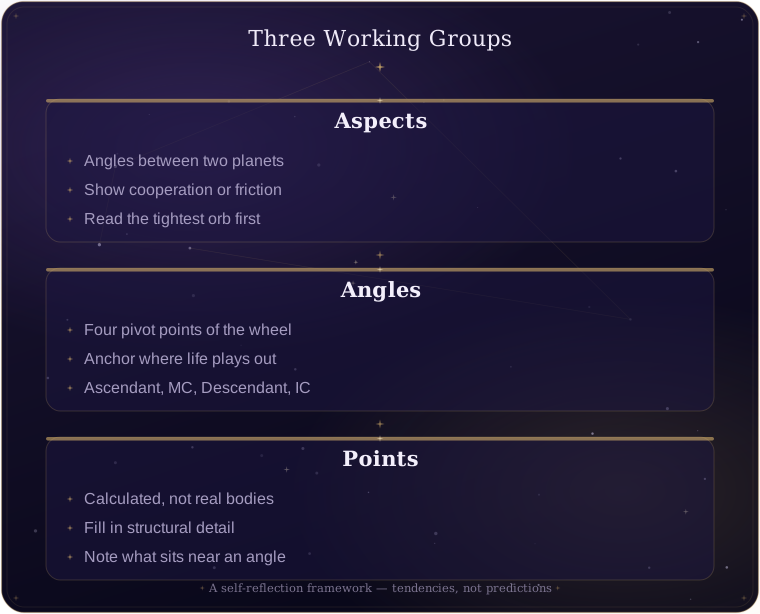
Astrology terms are the shared vocabulary that names the parts of a birth chart and the relationships between them. The words fall into three working groups: aspects (the angles between two planets), angles (the four pivot points of the chart wheel), and points (calculated spots that are not planets at all). Most beginners learn these one card at a time and never see that they describe a single connected map. Each term answers a different question about the same chart, and the whole vocabulary only starts to make sense once you read it as a set rather than a list.
- Aspects measure the geometric distance between two planets and predict how they cooperate or clash
- Angles mark the four corners of the wheel that anchor where life plays out
- Points are calculated positions, not bodies, that fill in the chart's structure
Why It Matters for Self-Awareness
Learning astrology terms in isolation is the trap that sends people back to search, which is why this glossary links each one out to the broader guide to reading a complete birth chart where the words work together. You can memorize that a square is "tense" and a trine is "easy," then open your own chart and have no idea how those labels connect to the angles and points sitting right next to them. The terms feel like flashcards, not a system.
The fix is the same one that keeps appearing in careful chart work: read every word as one half of a relationship, never as a fixed trait. Dane Rudhyar spent his career arguing for exactly this person-centered angle, and it pays off immediately here: a trine is not a friendly shape on its own; it is a tie between two specific planets in two specific houses, and the meaning changes with the cast. When you treat the vocabulary as connections instead of standalone definitions, your own chart stops reading like a glossary and starts reading like a portrait. Stephen Arroyo's work pushed this further by showing that chart factors interact rather than standing alone, which is the difference between knowing the words and reading the page, and it is also why a flat alphabetical list of definitions so rarely sticks. The grouping into aspects, angles, and points is what turns scattered labels into a structure you can carry from one chart to the next.
Astrology Terms vs Adjacent Concepts: How It Works + Trade-offs
Astrology terms get confused with two neighbors: the raw astronomy they come from, and the personality keywords people quote online. Sorting them out shows how each layer works and what you give up when you stop at one of them.
- Terms vs astronomy. The astronomy gives you exact degrees; the named words translate those degrees into relationships you can interpret. To get the precision of raw coordinates, you sacrifice readability, which the named vocabulary restores.
- Terms vs keywords. A keyword like "ambitious" is a conclusion; a word like square is the structure that produced it. To get the speed of a keyword, you sacrifice the reasoning, so you cannot adapt it when the chart shifts.
- Aspects vs angles. Aspects describe how two planets relate across the wheel; angles describe the fixed frame of the wheel itself. To read motion you lean on aspects; to read context you lean on angles, and a chart needs both.
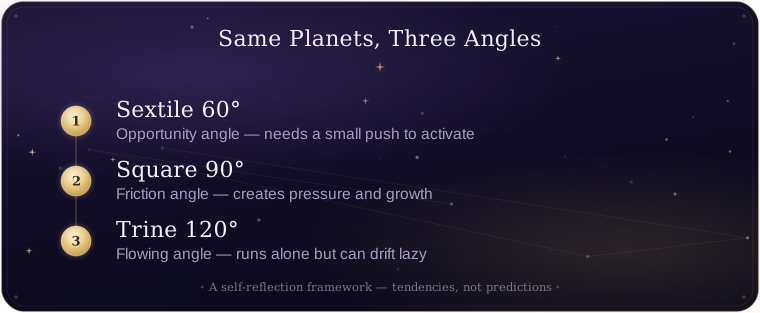
A worked example shows how it works in practice. Two planets sitting 60 degrees apart form the explainer on the sextile aspect, an opportunity angle that asks for a small push to activate. Move them to 120 degrees and you have the explainer on the trine aspect, a flowing angle that runs on its own but can drift into laziness. Push them to 90 degrees and you reach the explainer on the square aspect, a friction angle that creates pressure and growth. Same two planets, three different shapes, three different stories, all decided by the angle between them.
How to Read These Terms in Your Chart
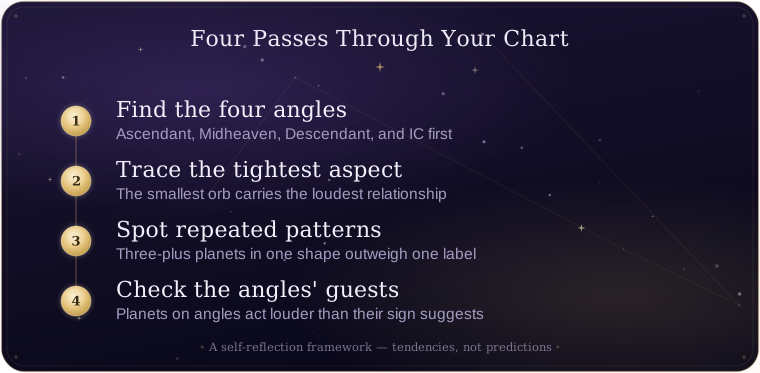
Once your wheel is in front of you, resist the urge to look up every word at once. Move through these four passes in sequence instead, treating each one as a single question to answer before the next.
- Find the four angles first. Locate the Ascendant, Midheaven, Descendant, and IC; the explainer on the descendant angle marks your one-to-one relationships and the explainer on the IC angle, the Imum Coeli marks your private roots and home base.
- Trace the tightest aspect. The aspect sitting closest to its exact angle, the smallest orb, carries the loudest relationship; a trine within a degree of 120 outranks a sloppy one off by six, so name that near-exact pairing before any other.
- Spot a repeated pattern. If three or more planets keep forming the same shape, that pattern often outweighs a single dramatic label.
- Check what touches an angle. A planet sitting on an angle tends to act louder than its sign alone would suggest, so note which words cluster near those four corners.
Common Misreadings
The reason most people stay stuck is that the popular write-ups flatten astrology terms into good-or-bad scores. As Robert Hand's interpretive work makes clear, the same shape can read very differently depending on the planets involved, so a few corrections clear the fog.
- "Hard aspects are bad." A square or opposition reads as tension, not damage; this group describes pressure that often drives the most growth.
- "Trines are always good." A trine flows easily, which can mean a talent you never develop because it never demanded effort.
- "Points are minor." The angles and calculated points are structural, not decorative; they decide where every aspect actually lands in your life.
- "More labels means a stronger reading." A focused reading of three connected shapes beats a long list of disconnected labels every time.
Core Terms at a Glance
| Term Group | How It Works | Chart Role | How to Observe |
|---|---|---|---|
| Aspects | Measure the angle between two planets | Show cooperation or friction | Find the aspect with the smallest orb |
| Angles | Fix the four pivot points of the wheel | Anchor where life themes play out | Locate the Ascendant, Midheaven, Descendant, IC |
| Points | Mark calculated, non-planet positions | Fill in structural detail | Check what sits on or near an angle |
| Major aspects | Use exact degree gaps (60, 90, 120) | Carry the loudest relationships | Read the tightest one first |
Questions People Often Ask
What are the most important terms for a beginner?
Start with the four angles and the major aspects, since they anchor every other reading. Once you can find the Ascendant, Descendant, IC, and a tight trine or square, the rest of the vocabulary attaches to that frame.
Do I need to memorize every term to read a chart?
No. Reading works by relationships, not recall, so a short set of well-understood words outperforms a long memorized list. Learn how aspects, angles, and points connect, and you can look up the details as you go.
What is the difference between an aspect and an angle?
An aspect is the relationship between two planets measured in degrees, while an angle is one of the four fixed pivot points of the chart wheel. Aspects show motion between planets; angles set the stage they move across.
Why do these labels seem to contradict each other?
Because each one is a single factor in a whole chart, and factors modify each other. A "lazy" trine can sharpen when it touches a demanding angle, so the contradiction usually means two factors are interacting rather than competing.
Reflection Prompts
- Think of a recent decision where two parts of you pulled in opposite directions, and name which planets might form that square.
- Recall a moment when something came easily and you let it slide; could a trine be describing that comfort?
- Picture the last time a relationship reshaped how you act; which angle, the Descendant or the IC, fits that scene best?
Related Reading
- overview of the major and minor chart aspects — for the full set of shapes beyond the three covered here
- guide to the twelve astrological houses — for where each word lands across the wheel
Take Action
Open your own chart and label the four angles plus your single tightest aspect using the checklist above. You will walk away with a one-page map of the relationships that drive your chart, instead of a stack of disconnected definitions, and that map is usually the first time the words start to describe a real person rather than a category. Read the full guide to reading a birth chart to see these terms working together in one chart at https://astrologywiki.com/en/wiki/how-to-read-birth-chart.
Sources
- Dane Rudhyar — his person-centered astrology reframed every term as part of a living chart rather than a fixed label
- Robert Hand — a standard modern reference for how aspects and angles actually get interpreted in practice
- Stephen Arroyo — the working principle that chart factors shape one another instead of standing alone comes from his writing