
What are inner wound?
An inner wound is the long-standing sore spot in your psyche that shapes how you protect, withdraw, and reach for connection. In astrology it is not a single placement but a family of chart signatures that point to where the sore spot tends to hide, repeat, and ask for attention — several of which can involve hidden or 12th-house themes, depending on the chart, so the 12th house overview is a useful first stop. Healing Your Inner Wound, in this reading, means learning to recognize the pattern rather than expecting the chart to erase it. The signatures cluster mostly around the hidden, dissolving parts of the chart, and they overlap rather than line up neatly.
- A family of related chart signatures, not one fixed point you can isolate
- Each signature names a different texture of the same sore spot, with heavy overlap between them
- Read as a reflective vocabulary you combine, never as a label that defines you
This is not a clinical interpretation or mental health advice. The astrological lens here is a way to ask better questions about your own inner life, not a verdict about it.
Why It Matters for Self-Awareness
Most people come to the chart wanting the inner wound gone. They search for the one placement that explains the ache, hoping a single answer will do the work that years of living have not. The friction is real and worth naming plainly: readers want astrology to fix the wound, and miss that the chart only describes where the wound hides, not a method to apply to it. When you read one placement as the whole story, you flatten something that is layered, and you set yourself up for disappointment when the insight does not dissolve the feeling.
Reading the whole family first matters because the inner wound rarely sits in one room of the chart. A Chiron signature might describe the original sore spot, a Mars signature might describe how you defend it, and a nodal axis might describe the direction you keep circling back toward. If you only look at one, you mistake a symptom for the source, or a defense for the injury itself. Healing Your Inner Wound starts with seeing how these parts talk to each other, because the pattern lives in the relationship between them, not in any single cell of the chart. The 8th house often joins this conversation too, since the places where you share depth and risk loss tend to be where the older sore spot gets pressed on hardest.
The pull toward a single answer is understandable. A wound is uncomfortable, and a tidy explanation promises relief. But the relief that comes from one neat sentence rarely lasts, because the chart was never built to deliver that kind of closure. What it can offer is steadier and slower: a vocabulary for noticing the same ache as it shows up across different parts of your life, and the patience to let that noticing do its quiet work over time. The family view trades the false comfort of a quick label for the truer comfort of being able to recognize your own pattern when it appears, and it keeps you honest about scale, since a chart describes tendencies and themes, not the lived weight of a specific memory or relationship. When you hold the whole set of signatures loosely, you keep the reading where it belongs as a frame for self-reflection rather than a stand-in for the slow work of paying attention to your own life. Consider how this plays out when two people meet the very same placement:
- The single-placement reader. Someone reads that their Chiron sits in the 12th house, recognizes the description of a vague, inherited ache, and feels a flash of being seen — but if it stops there, the placement becomes a souvenir rather than a doorway, and they walk away with only a label.
- The family-level reader. The person who instead asks how that Chiron talks to their Mars, their nodes, and the 8th-house themes starts to see a working pattern — where the ache comes from, how they guard it, and which direction it keeps nudging them — and gets something they can actually sit with. Healing Your Inner Wound depends on exactly that shift from collecting interpretations to watching how they connect, because a wound that took years to form does not surrender to one tidy sentence about your chart.
The inner wound at a Glance
| Chart Signature | Core Theme | House / Domain | Common Misread |
|---|---|---|---|
| Chiron in the 12th house | The hidden, inherited ache you cannot quite name | 12th house — the unconscious, dissolution | Reading it as a fated injury rather than a sensitivity |
| Mars in the 12th house | Anger and drive that go underground instead of out | 12th house — the unconscious, self-undoing | Mistaking buried drive for weakness or passivity |
| The 12th house overview | Where the self dissolves, hides, and rests | 12th house — endings, retreat, the unseen | Reading it only as the "bad house" of loss |
| The 8th house | Depth, loss, shared resources, regeneration | 8th house — intimacy, transformation | Confusing intensity with danger |
| The lunar nodes | A growth-and-familiarity axis that can interact with wound themes | North node / south node axis | Reading the south node as a flaw instead of a comfort zone |
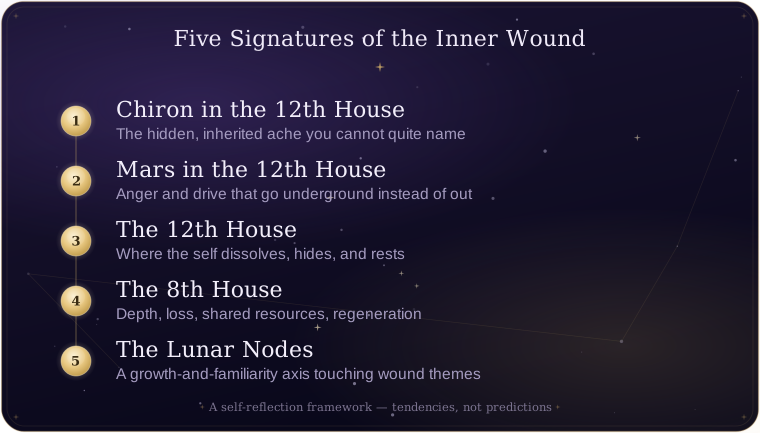
The inner wound: Quick Guide
Chiron in the 12th house — This is usually the first signature people reach for when they map the inner wound, describing a sore spot that feels older than you, tucked into the most private corner of the chart. People with it often sense an ache they cannot trace to a single event, and they tend to carry quiet sensitivity to suffering, their own and other people's. Because the wound lives in the hidden house, it can be hard to point to, which sometimes leaves people feeling like they are aching over nothing. The work here is to sit with the feeling without demanding it explain itself, and to let the sensitivity become a source of compassion rather than a private burden. Common misread: reading this as a fixed wound you were sentenced to, rather than a tender place that can soften with attention. To go deeper, see the Chiron in the 12th house explainer.
Mars in the 12th house — Here the fire that usually pushes outward goes inward instead. Drive, anger, and assertion get filtered through the hidden house, so they can show up as self-sabotage, exhaustion, or a sense of fighting yourself rather than the situation in front of you. People with this placement often act most decisively on behalf of others while struggling to claim things for themselves. The invitation is to make peace with anger as information rather than pushing it back underground, and to find quiet, sustainable outlets for a drive that resists loud display. Common misread: mistaking buried drive for having no drive at all. For the full picture, read the Mars in the 12th house explainer.
The 12th house overall — Both of those placements sit in the same room, so it helps to understand the room itself. The 12th house holds endings, retreat, the unconscious, and everything we keep out of daylight. It is where the self dissolves into something larger, for better and worse, and where the hardest material to face often quietly accumulates. Anything placed here tends to operate behind the scenes, which is why wounds that live in this house can feel so slippery and so persistent at once. Common misread: writing it off as purely the "house of self-undoing" when it also governs rest, compassion, dreams, and release. Read this room as the frame that holds both placements rather than as the wound itself, because when you read these signatures side by side, Healing Your Inner Wound stops being one answer and becomes a small map of how the sore spot forms, defends itself, and points somewhere.
How Shade and Combination Shift Readings
No single signature means the same thing in every chart. The inner wound shows up as a gradient, and the combination of placements shifts the reading more than any one of them alone. The most useful skill is not memorizing what each placement "means" but watching how they color each other. Healing Your Inner Wound, read this way, becomes an exercise in combination rather than lookup.
Start with one practical truth: emphasis is a trade-off. To get the depth and compassion that a strong 12th-house emphasis offers, you sacrifice some of the clean, outward visibility that makes feelings easy to name and act on. A person can be deeply attuned to suffering and still struggle to say plainly what they need, because the same placement that grants the sensitivity also blurs the edges. Naming that trade-off honestly is more useful than pretending the placement is all gift or all burden, and a few combinations show how this works in practice:
- Chiron plus Mars in the same house. The original sore spot and the buried drive share one room, so the ache and the anger about the ache get tangled. The reading shifts from "I am hurt" to "I am furious that I am hurt, and I have nowhere to put the fury."
- A 12th-house wound tied to the 8th house. When the hidden sore spot connects to themes of intimacy and loss, the wound tends to surface inside close relationships. The reading moves from private ache to something that gets triggered by depth and shared vulnerability — see the 8th house overview for that depth-and-loss territory.
- A wound aligned with the nodal axis. When the sore spot sits near the growth axis, the same pattern keeps reappearing precisely because it marks a direction of growth. The reading shifts from "why does this keep happening" to "this keeps happening where I am being asked to grow."
In each case the individual placement barely changes; what changes is the conversation between placements. A practical example makes this concrete. Two people can both have Chiron in the 12th house, yet one experiences it mostly as a tender, compassionate sensitivity to other people's pain, while the other experiences it mostly as a private shame they cannot name. The difference often comes from what else is in the room: a 12th-house Mars sharpens the ache into frustration, while a wound tied to the nodal axis softens it into a sense of unfinished growth. The placement is shared; the reading is not, which is also why two competent astrologers can describe the same chart in noticeably different language without either being wrong. Reading the combination, rather than the parts, is what keeps Healing Your Inner Wound from collapsing into a checklist, and the contrast is sharp:
- What a checklist does. It tells you what each placement supposedly means and stops there, leaving you with a stack of separate traits and no sense of how they pressure each other.
- What a combination reading does. It asks how the placements pressure each other, which one tends to lead, and where they cancel out — slower work, but the work that actually reflects an inner life, which is never the sum of separate traits stacked in a list. That is why a hub view serves you better than a single deep dive when you first sit down with the chart.
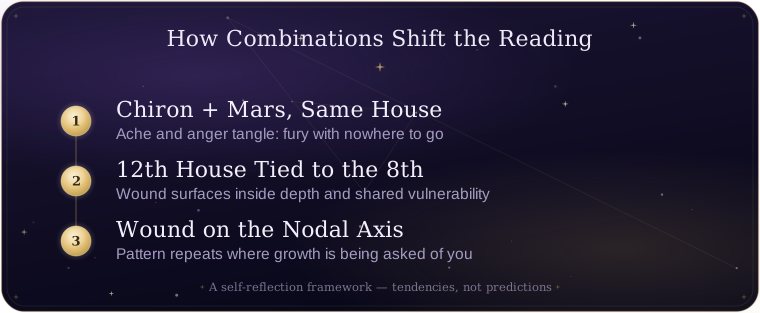
Common Misreads + Framework Limits
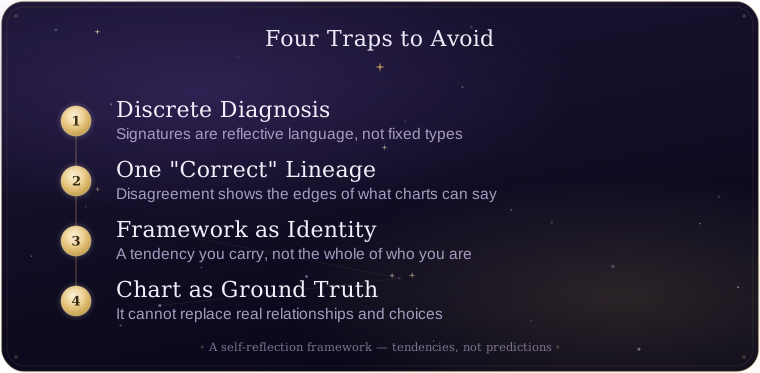
The most common errors with the inner wound happen at the family level, not inside any one placement. Healing Your Inner Wound goes sideways when you mistake a reflective vocabulary for something it is not. A short intro, then the recurring traps:
- Reading the family as discrete diagnosis. The signatures are interpretive language for self-reflection, not categories that sort you into a fixed type. The moment a placement becomes a box you live in, it has stopped doing useful work.
- Forcing one lineage to be the "correct" one. Different astrological traditions weight these placements differently. When two schools disagree, picking one as the single truth misses the point; the disagreement itself often shows you the edges of what the chart can say.
- Promoting the framework into an identity. "I am my Chiron wound" feels insightful and is quietly limiting. A signature describes a tendency you carry, not the whole of who you are, and collapsing the two turns a tool into a cage.
- Expecting the chart to replace lived ground truth. Astrology can frame a feeling, but it cannot stand in for the actual relationships, memories, and choices that make up your inner life. When you ask the chart to do that, you ask it to carry weight it was never built to hold.
There is a quieter limit worth naming, the kind a standard cluster overview tends to skip: the inner wound is shade-sensitive in time. The same placement reads differently at twenty than at fifty, because you have done different living around it. A reading that felt exactly right years ago can feel partial now, and that is not a flaw in the chart — it is a sign the frame is doing its job, holding still while you change. Holding that limit in mind keeps Healing Your Inner Wound honest as a practice rather than a one-time answer.
A second limit lives in the gap between traditions. Older, classical readings often describe the 12th house in stark terms of loss and self-undoing, while modern psychological astrology reads the same house as a place of compassion, retreat, and quiet integration. Neither is the final word, and the honest move is to hold both rather than to flatten the wound into whichever version feels more comfortable. The same caution applies to the nodes, where one school reads the south node as baggage to shed and another reads it as a hard-won resource to keep. When you notice these disagreements instead of resolving them too quickly, the framework stays useful, because the edges of what the chart can say are exactly where you remember it is a frame and not the territory itself.
Common Questions About Healing Your Inner Wound
Can the birth chart actually show my inner wound?
The chart can point to where a long-standing sore spot tends to hide, repeat, and ask for attention, mostly through 12th-house, 8th-house, and nodal signatures. It describes a frame for reflection, not a verdict about your inner life.
Which placements matter most for Healing Your Inner Wound?
The signatures most people start with are Chiron in the 12th house, Mars in the 12th house, the wider 12th house, the 8th house, and the lunar nodes. Read them together, since the pattern lives in how they relate rather than in any single one.
Will understanding my chart make the wound go away?
No. The chart offers language to recognize and work with the pattern, not a method to erase it. Insight can change how you relate to the sore spot, but the slow tending still happens in ordinary life.
Is the south node a flaw I need to fix?
The south node usually marks a comfort zone and a familiar pattern, not a defect. Reading it as something broken misses its real use, which is to show you where you keep returning when the growth direction feels hard.
Reflection Prompts
- Think of a recent moment you withdrew or shut down — what felt too tender to say out loud?
- Notice where your anger goes when it has nowhere to land, and ask what it is protecting.
- Recall a pattern that keeps returning, and ask what direction it might be pointing you toward.
Related Reading
To go deeper into each signature that makes up the inner wound, these explainers cover the spokes and the surrounding territory:
- Chiron in the 12th house deep dive
- Mars in the 12th house deep dive
- 12th house overview
- 8th house guide to depth and loss
- comparison of the north node and south node
Take Action
To start Healing Your Inner Wound in practice, open your full birth chart and locate your own Chiron and Mars in the 12th house, then note which other placements touch them. Doing this gives you a reflective map of possible sore-spot themes and defensive patterns — your own version of the family described above. Seen clearly, that map is less a list of problems to solve than a quieter understanding of why you protect what you protect. Read the full guide to reading a birth chart at reading a birth chart from scratch to find these placements for yourself.
Sources
- Traditional 12th-house teachings — describe the house of the unconscious, retreat, and dissolution that frames both placements in this family
- Modern psychological astrology — developed the reading of Chiron as a sensitive sore spot rather than a fated injury
- Nodal-axis interpretation in person-centered astrology — frames the lunar nodes as a direction of growth rather than a flaw to correct