
What Is How Long Does Saturn Return Last?
How long does Saturn return last is a timing question about one of astrology's most-discussed transits, and the practical answer is roughly two to three years around each return. The exact return — the day Saturn comes back to the same zodiac degree it held at your birth — is a single moment, but the felt window runs wider because Saturn moves slowly and usually backtracks over those degrees while retrograde. According to NASA, Saturn takes about 29.5 years to complete one orbit, which is why this passage recurs near ages 29, 59, and 88. Most people meet it as a season of rebuilding rather than a one-day event, and a clear guide to reading your birth chart shows where it lands for you.
- Peaks near ages 29–30, 58–60, and 88
- Runs about two to three years, not a single date
- Hits hardest when Saturn crosses the natal degree, sometimes up to three times
Why It Matters for Self-Awareness
Knowing how long does Saturn return last matters because it turns a heavy stretch into a bounded chapter with a beginning and an end. In my years moving from commercial data analysis into systematic pattern work on birth charts, the fact that steadies people most is simple: the window closes, and the pressure is a phase rather than a permanent setting. The psychological lineage Liz Greene helped shape reads Saturn as the part of a chart that asks for maturity, structure, and honest limits — a theme to work with, not a verdict handed down. When you can see the timeline, a stressful season stops feeling like your new identity and starts looking like a project with a deadline.
Holding that timeline in view tends to help in a few concrete ways:
- It sets fair expectations. Knowing the pressure lasts a couple of years, not forever, keeps a hard month from reading as a life sentence and lowers the urge to make rushed, fear-based moves.
- It times big choices. Career pivots, moves, and long commitments made inside this window tend to stick, so many people plan the decision on purpose instead of reacting to whatever breaks first.
- It separates signal from panic. Treating the return as a maturing process rather than a countdown to disaster keeps attention on what to build, repair, or finally let go of.
How the Saturn Return Differs From a Saturn Square
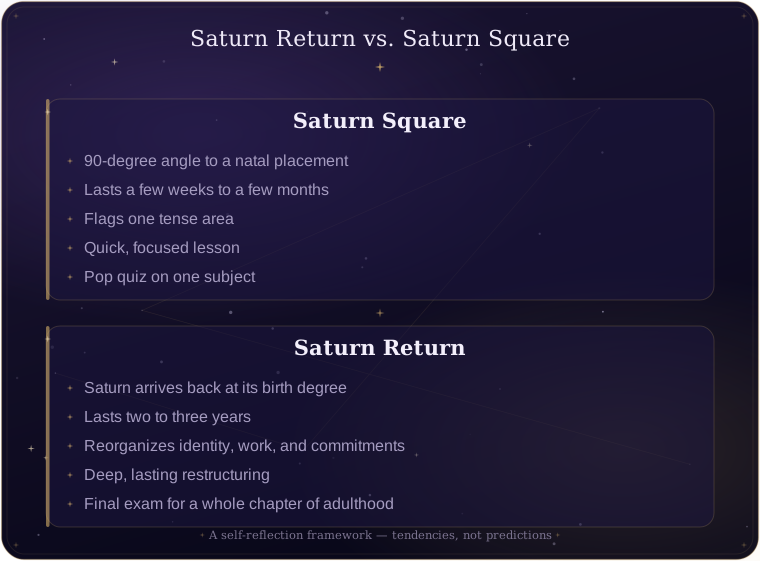
The topic sits between the wider Saturn cycle and practical interpretation, so how long does Saturn return last differs from a Saturn square mostly in scope and meaning. A Saturn square is a shorter friction point where transiting Saturn hits a 90-degree angle to a natal placement; a return is Saturn arriving home to its own birth degree, closing a full ~29.5-year loop. Here is how each works and where the trade-off lands:
- How the square works. It flags one tense area for a few weeks to a few months, then passes. To get that quick, focused lesson you sacrifice the deeper reset — a square rarely rebuilds a whole life structure.
- How the return works. It reorganizes identity, work, and commitments across two to three years. To get that lasting restructuring you sacrifice speed; the return asks for patience the square never demands.
A useful way to picture it: the square is a pop quiz on one subject, while the return is the final exam for a whole chapter of adulthood. Stephen Arroyo's approach frames Saturn in terms of structure and timing rather than punishment, which is why the return reads as an interpretive framework for growth rather than a deterministic sentence about your fate. If you want the shorter transit explained on its own first, the Saturn square aspect explainer breaks it down in isolation.
How to Read the Saturn Return Window in Your Timing
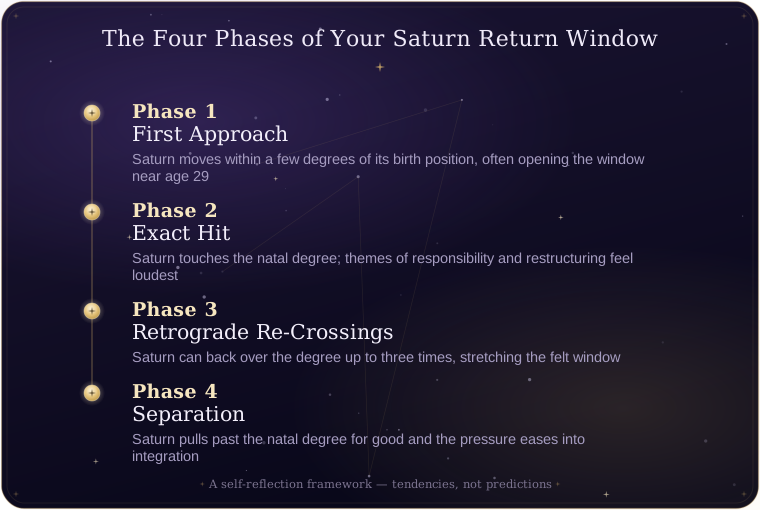
To gauge how long does Saturn return last for you, read the window by tracking Saturn's movement against your natal Saturn degree. Cyclic astrology in the lineage Dane Rudhyar helped define treats these crossings, not the calendar date alone, as the real markers. Watch for these signals:
- The first approach. Saturn moves within a few degrees of its birth position, often opening the window near age 29.
- The exact hit. Saturn touches the natal degree, and themes of responsibility and restructuring feel loudest.
- Retrograde re-crossings. Saturn can back over the degree up to three times, which stretches the felt window.
- The separation. Saturn pulls past the natal degree for good, and the pressure eases into integration.
Common Misreadings
Most quick write-ups blur the timeline, so the return gets read wrong in a few predictable ways. Each correction below matters because people often brace for the wrong thing at the wrong moment.
- "It's just one bad day." Misreading: the return is a single date on the calendar. Actually the active window runs about two to three years around the exact crossing, and the buildup often starts before you notice it.
- "It ruins your life at 29." Misreading: the return guarantees disaster. Actually it tends to surface what is already unstable so it can be rebuilt, and many people later describe the passage as clarifying rather than destructive.
- "Everyone's return is the same length." Misreading: a fixed duration applies to all charts. Actually retrograde passes and the pace of your natal Saturn shift how long the felt window runs from person to person.
Saturn Return Timeline at a Glance
| Property | How It Works | Natal Placement | How to Observe |
|---|---|---|---|
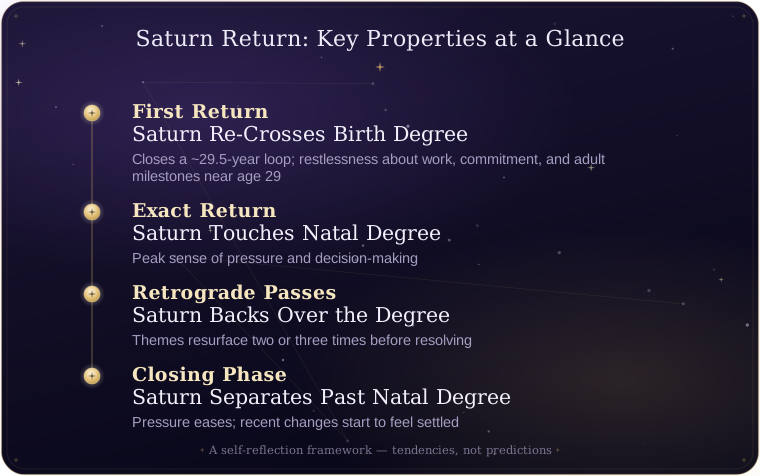
| First Saturn return | Saturn re-crosses its birth degree, closing a ~29.5-year loop | Natal Saturn by sign and house, ~age 29 | Restlessness about work, commitment, and "adult" milestones |
| Exact return | Saturn touches the natal degree precisely | The natal Saturn degree | Peak sense of pressure and decision-making |
| Retrograde re-crossings | Saturn backs over the degree up to three times | Same natal degree revisited | Themes that resurface two or three times before resolving |
| Closing phase | Saturn separates past the natal degree | Just beyond the natal Saturn degree | Pressure eases; recent changes start to feel settled |
Saturn Return Duration FAQ
How long does a Saturn return really last?
The exact return is one day, but the active window runs about two to three years around it. Retrograde passes over the natal degree are the main reason it stretches that long.
When does the Saturn return start and end?
It usually opens as Saturn moves within a few degrees of its natal position, often near age 29, and closes once Saturn separates past that degree. That is why how long the return lasts varies slightly from one chart to the next.
Does everyone get a Saturn return?
Yes, anyone who reaches about 29–30 meets a first return, and near 58–60 a second one arrives. A third can land near age 88.
Is the second Saturn return as intense as the first?
Many people describe the second return as reflective rather than upheaval-driven. It tends to focus on legacy and priorities more than on building a first adult structure.
Reflection Prompts
- Think of a commitment you keep postponing — what structure would make it feel possible to start this month?
- Recall a moment this year when responsibility felt heavy; what was it actually asking you to build?
- Name one limit you resent — how might respecting it reshape your next two years?
Related Reading
- natal Saturn placement in a birth chart — see what Saturn means in your own chart before you time the return.
- tenth house meaning in a birth chart — Saturn's home ground for career and public life often lights up during the return.
- Saturn return (Wikipedia) — a neutral summary of the cycle's timing.
- Saturn (Wikipedia) — background on the planet's ~29.5-year orbit.
Take Action
Ready to pin down your own timing? Explore Your Saturn Return to find your natal Saturn degree and the exact dates your window opens and closes. The calculator returns a personal map of how long does Saturn return last for your chart, so instead of bracing for a vague crisis you can plan the two or three years as a deliberate rebuild of the structures that matter to you.
This is not a clinical interpretation or mental health advice.
Sources
- Liz Greene — shaped the modern psychological reading of Saturn as a call toward maturity and structure
- Stephen Arroyo — framed Saturn in terms of timing, form, and personal growth rather than punishment
- Dane Rudhyar — pioneered the cyclic, person-centered approach to reading astrological returns