
What is a Square?
A square is a 90-degree angle between two planets that creates steady internal tension. In square astrology, that angle pulls two parts of your chart in directions that do not naturally agree, so they grind against each other until you do something about them. The square sits inside the wider glossary of core astrology terms alongside the other major aspects, and it is the one most people learn to dread. The friction is real, but it is also the part of the chart that asks for the most deliberate work, which is exactly why it tends to mark where you develop the fastest.
- Forms when two planets sit roughly 90 degrees apart on the chart wheel
- Reads as a hard aspect, meaning it produces pressure rather than ease
- Often points to the area where sustained effort yields the most growth
Why It Matters for Self-Awareness
Most people meet square astrology through a one-word verdict: a square is "bad." That label is the friction this page exists to fix, because it sends readers looking for a way to remove the tension instead of working with it. The square does not break anything in your chart; it names a place where two drives keep colliding, and the collision is what eventually forces a real choice. When you treat that pressure as a flaw, you spend years bracing against it. When you read it as a prompt, the same pressure starts pointing somewhere useful.
Dane Rudhyar's person-centered tradition gives the better starting point: a square is best read as one half of a relationship between two specific planets, never as a fixed sentence handed down to you. The drive for ease and the drive for structure, for example, will not stop arguing just because you want them to, and that ongoing argument is where the work lives. This is the same idea behind the explainer on the trine aspect: where a trine hands you a talent that can quietly go undeveloped because nothing demands it, a square hands you a problem that keeps demanding attention until you build something durable around it. The trine flows; the square forges. Reading the aspect this way turns a verdict into a working instruction, and that shift is what self-awareness actually looks like here.
Square vs Adjacent Concepts: How It Works + Trade-offs
Square astrology gets confused with two neighbors that look similar on the surface: the smooth aspects people prefer, and the broad "hard aspect" bucket it shares with the opposition. Sorting them out shows how each one works and what you give up by leaning on it.
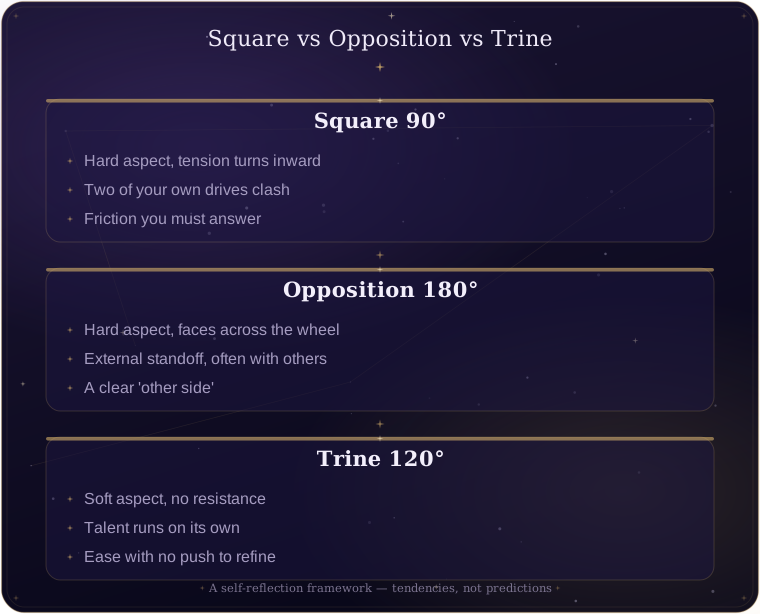
- Square vs trine. A trine lets two planets cooperate with no resistance, so the talent runs on its own. To get that ease, you sacrifice the pressure that would have pushed you to refine it, which is why easy gifts so often stall. A square removes the ease and replaces it with friction you have to answer.
- Square vs opposition. Both are hard aspects, but they work differently. An opposition pulls two planets to face each other across the wheel, so the tension shows up as an external standoff, often with other people. A square turns the tension inward, so it feels like two parts of you pulling against each other. To get the clarity of an opposition's clear "other side," you sacrifice the internal ownership the square forces on you.
- Square vs sextile. A sextile, like the explainer on the sextile aspect, offers a gentle opportunity that only activates if you reach for it. To get that low-cost option, you sacrifice the urgency a square supplies for free. The sextile waits politely; the square does not.
How to Read a Square in Your Chart
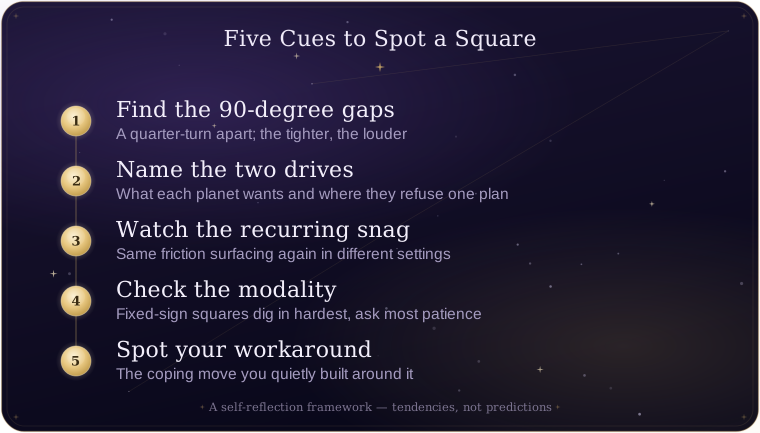
A square rarely announces itself in one obvious placement; square astrology tends to hide in repeating patterns, so hunt for it deliberately. Work down these five cues, settling each one before the next rather than skimming for a quick label.
- Find the 90-degree gaps. Look for two planets about a quarter-turn apart on the wheel; that gap is the square, and the tighter the angle, the louder it tends to run.
- Name the two drives. Identify what each planet wants, then notice where those two wants refuse to share the same plan.
- Watch for the recurring snag. Squares often show up as the same friction surfacing again and again in different settings, not as one big event.
- Check the modality. Squares between cardinal, fixed, or mutable signs feel different; fixed-sign squares tend to dig in hardest and ask for the most patience.
- Notice the workaround you already built. Many people with a tight square have quietly developed a coping move around it; spotting that move is often how you first recognize the square at all.
Common Misreadings
The reason most people stay stuck is that popular write-ups flatten square astrology into a damage report. As Robert Hand's interpretive work makes clear, the same 90-degree angle can read very differently depending on the planets involved, so a few corrections clear the fog.
- "A square is a bad aspect." A square reads as tension, not damage; this is the angle that most reliably drives development when you actually engage it.
- "You should try to cancel out a square." You cannot delete it, and trying to suppress the friction usually just relocates it. The work is to channel the pull, not erase it.
- "Squares only cause problems." The friction is also a steady source of motivation; people often build their most hard-won strengths exactly where a square sits.
- "A wider orb means it does not count." A loose square is quieter, not absent; it still nudges the same two drives, just with less obvious force.
Square at a Glance
| Property | How It Works | Chart Role | How to Observe |
|---|---|---|---|
| 90-degree angle | Two planets press against each other a quarter-turn apart | Marks the chart's main friction point | Look for planets about 90 degrees apart |
| Hard aspect | Produces pressure instead of effortless flow | Pushes you toward sustained effort | Notice where the same snag keeps recurring |
| Internal tension | Turns the conflict inward rather than onto others | Names where two drives refuse to align | Watch for two of your wants pulling apart |
| Growth pressure | Rewards deliberate work over avoidance | Often the site of your hardest-won skills | Find the coping move you built around it |
Questions People Ask About Squares
Is a square always a negative aspect?
No. A square is a hard aspect, which means it creates tension, but tension is not the same as harm. Stephen Arroyo's work emphasizes reading the dynamic rather than scoring the aspect, and the square's friction is usually the part of a chart that drives the most lasting growth.
What is the difference between a square and an opposition?
Both are hard aspects, but a square is a 90-degree angle that turns conflict inward, while an opposition is a 180-degree angle that plays the conflict out between two opposing sides. A square feels like two of your own drives clashing; an opposition more often feels like a standoff with something outside you.
How do I find a square in my birth chart?
Look for two planets sitting roughly 90 degrees apart on the chart wheel, which is a quarter of the full circle. In square astrology, the closer that angle is to exact, the more strongly the two planets tend to press on each other.
Can a square ever feel easy over time?
It rarely disappears, but it can soften. Many people build a steady workaround around a tight square, so the friction stops dominating and starts feeling like a familiar part of how they operate.
Reflection Prompts
- Think of a recent decision where two parts of you pulled in opposite directions; which two drives might form that square?
- Recall a strength you had to fight to build, and ask whether square astrology might be describing the friction you pushed through.
- Picture a snag that keeps resurfacing in different settings; what coping move have you already built around it?
Related Reading
- Astrological aspect (Wikipedia) — for the angular definitions behind every aspect, including the opposition this page contrasts with the square
Take Action
Open your own chart and mark every pair of planets sitting about 90 degrees apart, then write one sentence for each square naming the two drives in tension. You will end up with a short map of exactly where your chart asks for deliberate work, instead of a vague sense that something is wrong. That map tends to be the first time the square stops reading as a verdict and starts reading as a set of instructions for where you grow. Read the full guide to reading a birth chart to locate the squares in your own chart at https://astrologywiki.com/en/wiki/how-to-read-birth-chart.
Sources
- Dane Rudhyar — credited here for the move from fixed verdicts to a square read as a developmental prompt
- Robert Hand — consulted for the practical interpretation of aspects that underwrites this take on the square
- Stephen Arroyo — relied on for reading an aspect by its dynamic rather than scoring it good or bad