
What is krittika nakshatra?
Krittika nakshatra is a Vedic lunar mansion governed by Agni, split between Aries and Taurus. It is the third of the 27 nakshatras in the sidereal zodiac, spanning from 26°40' Aries through 10°00' Taurus — one of several nakshatras whose span crosses a sign boundary. That crossing is the defining structural feature: a moon or ascendant in the Aries portion reads as a different behavioral type than one in the Taurus portion, even though both fall within the same nakshatra. The symbols of the razor and flame encode Agni's core function — fire as discriminating, purifying force that removes what obscures clarity without destroying what sustains it. This sits alongside the broader pillar page on the Vedic nakshatra system, which maps all 27 lunar mansions across the sidereal zodiac.
- Symbolized by a razor or flame: purposive severance, not indiscriminate burning
- Presided over by Agni, whose fire purifies and refines — transformation with direction, not chaos
- Structurally bi-sign: Aries Pada 1 produces impulsive, direct clarification; Taurus Padas 2–4 produce patient, sustained refinement
Why It Matters for Self-Awareness
Understanding krittika nakshatra matters because the sign split is the key to accurate self-recognition, and most published descriptions omit it entirely. When a Taurus-Krittika moon reads descriptions of "sharp, aggressive fire," they find nothing that fits — not because the nakshatra is wrong, but because the description is written for the Aries pada. The same person may spend years trying to identify with a portrait that is describing a structurally different expression.
The confusion surfaces in three recognizable ways:
- Contradictory portraits from different sources. One set of materials describes Krittika as combative and blunt; another describes it as exacting and methodical. Both are accurate for their respective padas. Without the sign split noted, practitioners cannot reconcile them.
- Misapplied self-correction. Students who hear "Krittika people are too critical" may overcorrect for sharpness they don't have (Taurus padas), or dismiss directness they do have as harshness that needs softening (Aries Pada 1) — both corrections move in the wrong direction.
- Misattributed unreliability. When descriptions repeatedly fail to match, practitioners sometimes conclude the entire nakshatra archetype is inconsistent. The real gap is structural: the bi-sign nature is simply never flagged in mainstream descriptions.
krittika nakshatra vs Adjacent Concepts: How It Works + Trade-offs
Krittika nakshatra works through Agni's purifying intent, which distinguishes it from other sharp or cutting nakshatras in the early zodiac. Ardra's incisive quality comes from Rudra's storm — disruption arrives first, clarity (if it comes) arrives after. The way Krittika works is different: the fire is purposive from the start. The razor serves clarity; it doesn't disrupt for disruption's sake. Ashlesha's sharpness comes from Naga's coiling intelligence, operating through strategy and retention. Krittika's fire operates through direct removal of what doesn't belong — no coiling, no delay, just the discriminating cut.
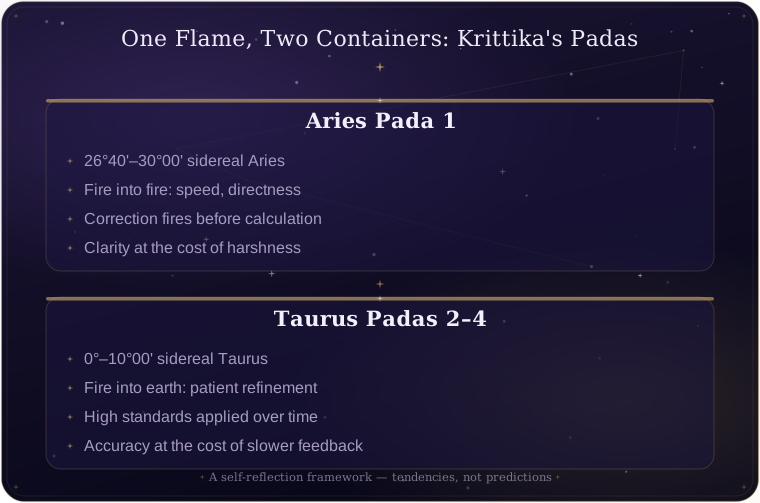
The sign split creates explicit, observable trade-offs. Aries Pada 1 puts fire into fire: speed and directness are the result, and the correction impulse fires before social calculation can intercede. To get that rapid precision, the person accepts that delivery can land as blunt or abrasive. The trade-off is clear — clarity of message at the cost of perceived harshness. Taurus Padas 2–4 place fire into earth: the same Agni force expresses through patient, sustained refinement, with high standards applied over time rather than as immediate correction. To maintain that deliberate quality, urgency is sacrificed. The trade-off runs the other way — sustained accuracy at the cost of slower or withheld feedback.
Compared to Bharani nakshatra overview, which also appears in the early zodiac and involves transformation, Bharani centers on containment and release — the ending of one cycle before the next. Krittika centers on purification within a continuing process: fire that refines what remains, not fire that marks an ending. Choosing Krittika's mode of engagement means gaining a fine edge for clarity, but accepting that the edge is not always read as care by everyone in the environment.
How to Read Krittika Nakshatra in Your Chart
A Krittika nakshatra placement is located by finding the exact degree and sign of the moon, ascendant, or a key planet in a sidereal chart. The single most important step is identifying which sign the placement falls in — Aries or Taurus — before applying any further description. That determination reshapes the reading more than any other factor.
Practical signals to observe by placement:
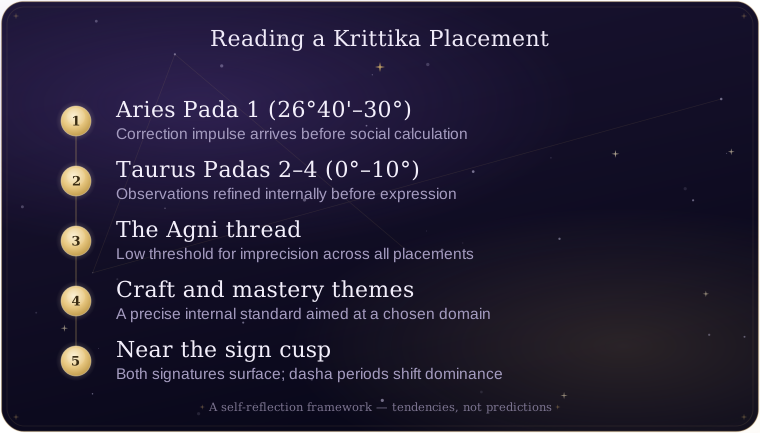
- Aries Pada 1 (26°40'–30°00' sidereal Aries). You might notice the correction impulse arriving before the social calculation — directness that surprises others, since the intent is precision rather than confrontation. Others may describe this as blunt even when the underlying goal is simply clarity.
- Taurus Padas 2–4 (0°–10°00' sidereal Taurus). You may find yourself holding observations internally before expressing them — not withholding, but refining. External output comes later, but the internal standard is continuous and high.
- The Agni thread across both padas. Across all Krittika placements, a low threshold for imprecision or murkiness tends to appear consistently: returning to details others leave unresolved, noticing errors involuntarily, difficulty leaving work at "good enough."
- Craft and mastery as recurring themes. Many people with this placement describe a drive toward specific skill development — not broad ambition, but a precise internal standard applied to a chosen domain.
- Near the sign cusp. If the placement sits within a degree or two of the Aries-Taurus boundary, both signatures may surface, with one becoming more dominant through different dasha periods.
Common Misreadings
The most persistent misreadings of krittika nakshatra trace back to a single source: descriptions that flatten both sign expressions into one behavioral portrait, almost always privileging the Aries pada because its sharp, fire-on-fire quality is more distinctive on paper.
- "Krittika is primarily aggressive." This characterization maps to Aries Pada 1, where Agni's energy meets fire's urgency and the correction impulse fires immediately. Taurus-Krittika expresses the same Agni force through patient discernment — careful and exacting, but not combative by default. Applying the aggressive label to all Krittika placements misdirects anyone in Padas 2–4.
- "The razor means cutting people off." The razor in the Parashari tradition encodes discriminating severance — removing what obscures clarity, not impulsively severing relationships. The instrument is closer to a surgeon's scalpel than a weapon: aimed at what doesn't belong in the work, not at the people in the environment.
- "All fire-associated nakshatras are interchangeable." Krittika's fire is Agni's purifying flame, functionally distinct from Ardra's storm-fire (disruption before clarity) or from the solar warmth of other sun-aligned nakshatras. Intent is the operative difference: Agni clears with precision, it doesn't sweep indiscriminately.
- "High standards mean emotional unavailability." The precision drive is sometimes read as coldness. In practice, the exacting attention to quality often comes from caring deeply about the work — the opposite of indifference. The misread occurs because care is expressed through standards rather than through explicit warmth-signaling behaviors.
Krittika Nakshatra at a Glance
| Property | How It Works | Energy Center | How to Observe |
|---|---|---|---|
| Span | 26°40' Aries through 10°00' Taurus — crosses sign boundary, producing two distinct modes | Mars-ruled Aries (Pada 1) / Venus-ruled Taurus (Padas 2–4) | Identify the exact sign of the placement before applying any general description |
| Symbol | Razor or flame — discriminating severance that removes obscuration to preserve what sustains | Agni (fire deity) — purification as the primary function, not destruction | Watch for the precision-over-ambiguity drive: the involuntary noticing of errors and inconsistencies |
| Primary drive | Clarification and refinement through Agni's fire | Aries fire (impulsive expression) vs. Taurus earth (sustained expression) — same deity, different containers | Note whether corrections emerge immediately or after a deliberate internal process |
| Behavioral signature | Pada 1: fast, direct; Padas 2–4: exacting, patient | Sign placement determines expression; Agni determines intent | Track the precision threshold — what level of imprecision does the person consistently flag? |
Common Questions About Krittika Nakshatra
What rashi does krittika nakshatra fall in?
Krittika spans two rashis: Mesha (Aries) for Pada 1 (26°40'–30°00') and Vrishabha (Taurus) for Padas 2–4 (0°–10°00'). The rashi must always be identified alongside the nakshatra name — both together determine the reading, since the sign shapes how Agni's fire expresses in practice.
What are the main characteristics of a Krittika moon or ascendant?
Consistent characteristics across both sign positions include high standards, low tolerance for imprecision, and a drive toward clarity. The variable is delivery: Aries Pada 1 expresses these through speed and directness, while Taurus Padas 2–4 express them through patience and sustained refinement. The core Agni function — purification through fire — remains consistent; the timing and manner shift by sign.
Which famous personalities are associated with Krittika placements?
Confirming specific public figures requires verified sidereal birth times, which are not reliably available for most individuals in published sources. Any claim linking a specific person to this nakshatra should be cross-checked against a sidereal chart using a confirmed birth time, rather than drawn from general lists that often rely on tropical calculations or approximate data.
How does Agni rulership affect Krittika differently than a Mars-ruled nakshatra?
Agni's function is purification — fire as transformative force aimed at clarifying what remains. Mars-ruled nakshatras channel assertive energy through drive and forward momentum. Krittika's Agni force is more discriminating: the fire selects what to remove rather than pushing forward wholesale. In practice, this shows as precision over aggression, refinement over conquest.
Reflection Prompts
- Think back to a recent moment when you noticed an error — did the impulse to correct arrive immediately, or did you hold it and decide later?
- Recall a piece of work you returned to refine after considering it finished — what internal signal told you it wasn't complete?
- Notice a recent situation where your standards created friction with someone — what did they see that you didn't, and vice versa?
Related Reading
- overview of all 27 nakshatras in Vedic astrology — for placing Krittika in the full nakshatra sequence and understanding how the mansion system maps across the sidereal zodiac
- Rohini nakshatra profile — follows Krittika in Taurus and shares the Venus-ruled sign, but centers on abundance and receptivity rather than precision and refinement
- Krittika (Wikipedia)
Take Action
Generate your free birth chart to explore krittika nakshatra. Once the chart loads, check whether your moon or ascendant falls in late Aries (26°40'–30°) or early Taurus (0°–10°) in the sidereal system — that single degree resolves most of the contradictions in standard descriptions. Knowing which pada applies gives you a more precise framework for recognizing where Agni's pattern of precision, correction, and sustained refinement shows up most persistently in your own decisions and responses.
Sources
- Parashara — foundational Vedic astrology lineage whose nakshatra framework, including the sign-position and deity-based analysis of Krittika, this entry draws on