What is nakshatra?
Nakshatra is one of 27 Vedic lunar mansions tracking the Moon's ecliptic position for timing.
- Each of the 27 stations spans exactly 13°20' of the ecliptic and carries a ruling planet that determines which dasha period activates first in your lifetime's sequence
- The Moon's placement in one of these stations at birth sets the starting point of the Vimshottari dasha cycle — the 120-year planetary timing system Jyotish uses to map when specific life themes become active
- Unlike zodiac signs, which describe character tendencies, these stations function primarily as a timing instrument rooted in lunar astronomy rather than as personality archetypes
The system appears in some of the oldest surviving Indian astronomical texts, including the Atharvaveda, where the stations are described as the Moon's celestial residences. Their starting reference is anchored to the star Chitra, placing the first station (Ashwini) in what corresponds to early Aries by Vedic reckoning. There are 27 standard stations — a 28th, Abhijit, appears in some classical texts but is not universally applied in contemporary practice. In practical Jyotish, knowing your birth station tells you which planetary chapter you entered at birth, how long each chapter lasts, and which themes are due to be most active at any point in life. This sits within the broader Vedic astrology overview, which maps how these lunar stations relate to the full Jyotish framework of signs, houses, and dashas.
Why It Matters for Self-Awareness
Most people who arrive at Vedic astrology already know their Western sun sign and possibly their rising. The gap they discover is a different kind of question — not who am I, but when do particular parts of me become most consequential.
Western practitioners commonly mistake nakshatra for a Moon-focused personality overlay — essentially a zodiac sign applied to the Moon's position. The surface similarity is real: both systems divide the ecliptic into segments, both assign ruling archetypes, and both reference the Moon's position in some calculations. But the underlying purpose diverges sharply. Zodiac signs describe style — how someone tends to move through life, what they emphasize, which relational patterns feel natural. The 27 stations function as a clock — they encode the sequence in which life chapters open and which planetary influence governs each chapter. Two people born with their Moon in Taurus may share the same Moon sign read but enter completely different planetary periods at different life stages, depending on which station the Moon occupied at their birth.
That distinction matters for anyone trying to understand why certain periods felt charged, compressed, or unlike what their personality profile would predict. The answer often lives in the dasha sequence encoded by the Moon's natal station, not in the sign's character description. The Vimshottari dasha system explainer explores how those planetary periods unfold once you know your birth station's starting point.
nakshatra vs Adjacent Concepts: How It Works + Trade-offs
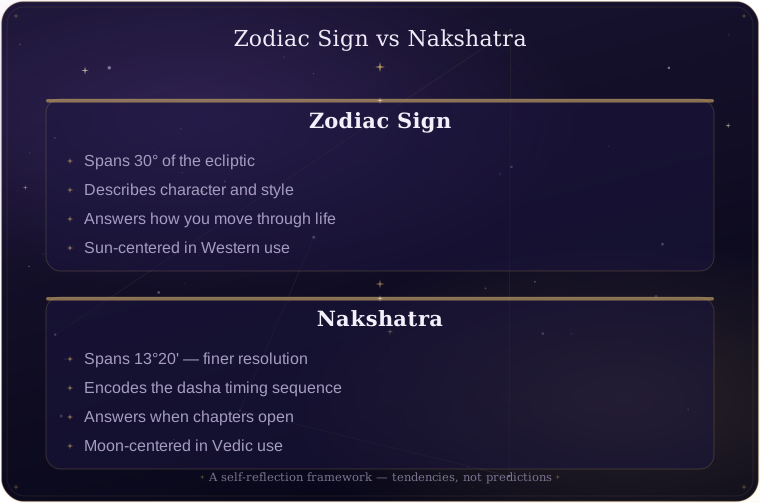
- Nakshatra vs. zodiac sign. Both divide the ecliptic; the functional difference is resolution and purpose. A zodiac sign spans 30°; each nakshatra spans 13°20'. That finer resolution means two people born under the same Moon sign can enter entirely different planetary periods at different life stages — a difference invisible at the sign level. The sign describes how someone tends to move through life; nakshatra encodes when a particular chapter is due. Choosing the sign's broad character sketch over the station's fine timing grid gets you an accessible personality framework, but you lose the timing engine that makes predictive Vedic work possible.
- Nakshatra vs. sun-sign astrology. Western natal work centers the sun — ego drive and the style of self-presentation. The Vedic system centers the Moon, considered the governor of mind, emotional patterning, and daily lived experience. Working with nakshatra rather than sun-sign astrology gives you temporal and emotional resolution; you give up the ego-narrative clarity that sun-sign work provides as a quick orientation. Neither is wrong — they answer different questions.
- Rashi and nakshatra. Both coexist: a Moon in Taurus can fall in Rohini, Krittika, or Mrigashira — each with a different ruling planet (Moon, Sun, Mars respectively) and a different dasha implication. Rashi gives the neighborhood; nakshatra gives the block-level address. Reading only the rashi means knowing the city without the street — the station adds the precision needed for any serious timing work.
How to Read nakshatra in Your Chart
Identifying your nakshatra requires a Vedic natal chart rather than a Western one — the two use different zero-point references (ayanamsha), so the Moon's stated degree will differ between systems. With a Vedic chart available, these are the practical signals to locate and interpret:
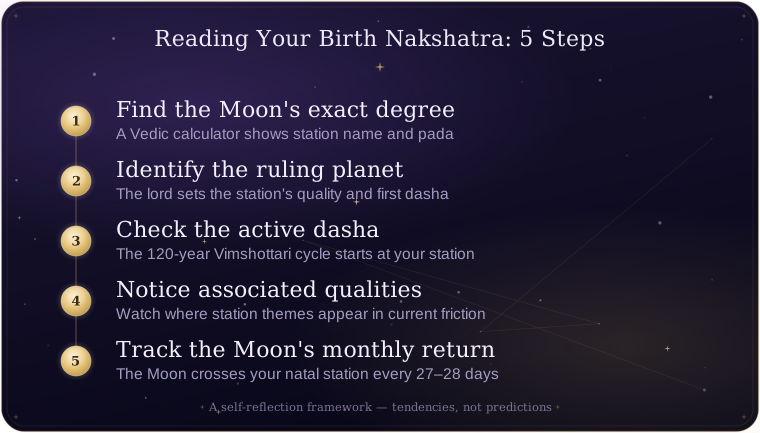
- Find the Moon's exact degree. Your birth station is determined by the Moon's longitude at birth. A Vedic calculator will display the station name and pada (quarter) — one of four 3°20' subdivisions that further refine the placement.
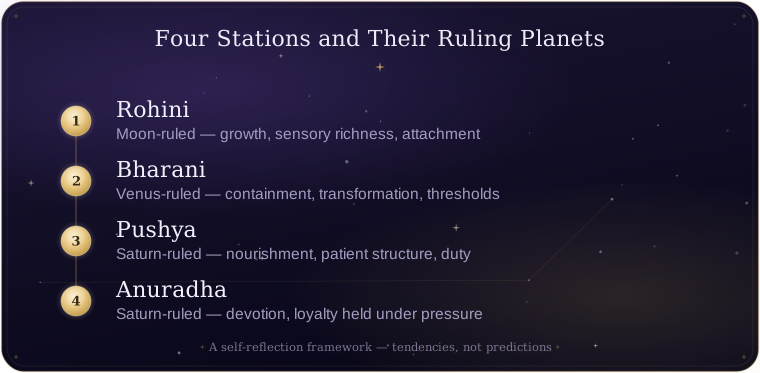
- Identify the ruling planet. Each station has a planetary lord. Rohini is Moon-ruled; Bharani is Venus-ruled; Pushya is Saturn-ruled. That lord determines the quality of the station and initiates the dasha period active at your birth.
- Check which dasha period is currently active. The Vimshottari system runs 120 years total; your birth station sets the starting position. Knowing the current period tells you which planetary theme is operationally dominant right now.
- Notice the station's associated qualities. Anuradha tends to surface themes of devotion and collective loyalty; Ashlesha, penetrating insight and emotional intensity; Rohini, growth and attachment to sustenance. These are observational frames — watch for where the associated qualities appear in current friction, recurring choices, or relationship patterns.
- Track the Moon's monthly return. The Moon completes a full circuit roughly every 27–28 days, passing through your natal station once a month. Many Jyotish practitioners treat that window as a period of heightened resonance with the themes your natal Moon carries.
Common Misreadings
The most persistent misreading of nakshatra is treating the 27 stations as 27 personality types — a finer-grained version of the twelve zodiac archetypes. This sends readers looking for the wrong thing: a character description rather than a timing tool.
- "My birth station is my Moon personality." The stations do carry symbolic texture — Rohini is growth-oriented, Ashlesha is coiled and intense, Pushya is nourishing and duty-bearing. But that texture is secondary to the dasha-timing function. Reading the station as a personality label rather than a timing trigger is like using a GPS to describe road color instead of to navigate.
- "Both systems divide the sky the same way." Zodiac signs apply universally across all planets — Mars can be in Aries, Venus in Taurus. The lunar mansion system, in traditional Vedic usage, is specifically anchored to the Moon's position and the lunar calendar. The ecliptic division is geometrically similar, but the application is distinct.
- "This is just Indian astrology with different sign names." Vedic astrology and Western astrology share ancient precursors but diverged significantly — different ayanamsha, Moon-over-Sun orientation, predictive dasha work over transit-focused interpretation, and different house systems. Treating them as translations of each other misses what each is structurally built to answer.
- "More stations means more personality precision." The precision these 27 points add is temporal, not characterological — a finer-grained clock, not a more elaborate personality taxonomy.
Nakshatra at a Glance
| Station | How It Works | Ruling Planet | How to Observe |
|---|---|---|---|
| Rohini | Associated with growth, sensory richness, and the drive to sustain what feels nourishing; tends to intensify attachment to abundance | Moon | During Rohini periods, notice where the desire to hold onto what feeds you creates friction — the pull toward comfort that resists necessary change |
| Bharani | Linked to containment, transformation, and the threshold between one form and another; carries themes of creative gestation under pressure | Venus | Bharani periods often surface as a sense of holding something difficult before release — watch for what needs to be let go before something new can form |
| Pushya | Associated with nourishment, patient structure, and duty-bearing; lends a quality of disciplined care and long-term service orientation | Saturn | In Pushya dasha, watch for a calling toward caretaking or structure-building — and notice where willing service tips into burden |
| Anuradha | Linked to devotion, sustained friendship, and collective loyalty held under pressure; carries a relational depth that persists through difficulty | Saturn | Anuradha themes often appear as a test of commitment — notice where loyalty is authentic versus where it has quietly become obligation |
Vedic Lunar Mansion FAQ
What is the difference between a nakshatra and a zodiac sign?
A zodiac sign spans 30° and describes broad personality tendencies and elemental character. A lunar mansion spans 13°20', is specifically tied to the Moon's ecliptic position, and encodes the Vimshottari dasha timing sequence that unfolds across a lifetime. The sign describes how a person tends to move through life; the station describes when specific chapters are due.
How do I find my birth station?
You need the Moon's exact degree from a Vedic natal chart — not a Western chart, since the two use different zero-point references and the Moon's stated position will differ between systems. Most online Vedic chart tools display the station name and pada automatically once you enter birth date, exact time, and location.
Are there 27 or 28 stations in the system?
The standard system contains 27 stations. A 28th, Abhijit, corresponds to the star Vega and appears in some classical texts, but it is not universally applied in contemporary Jyotish practice. Most modern practitioners work with the 27-station Vimshottari cycle.
Does the birth station determine personality?
In Vedic interpretation, the birth station primarily governs the dasha timing sequence rather than personality on its own. Character is read across the full chart — ascendant, Moon sign, planetary placements, and aspects all contribute. The station is one coordinate among many, not a character summary.
Reflection Prompts
- Think back to a period when life seemed to accelerate or press on you unexpectedly — does knowing the active dasha for those years shift how you read what was actually happening?
- Recall a recurring emotional theme in the past year — does the ruling planet of your Moon's birth station offer a frame for why that theme keeps returning right now?
- Notice which quality — growth, containment, nourishment, devotion — feels most live in your life today, and whether it maps to what your current dasha lord would suggest.
Related Reading
- guide to all 27 lunar mansions — individual profiles of each station and its dasha implications
- Rohini birth station in-depth page — spoke page for one of the most studied natal placements, Moon-ruled and growth-oriented
- Bharani birth station overview — spoke page for the Venus-ruled transformation station and what its dasha period tends to surface
- Vedic birth chart reading guide — how to locate your Moon's station within the full Jyotish chart structure
Take Action
Generate your free birth chart to explore nakshatra — a Vedic chart shows your Moon's natal station and the dasha period currently active in your timeline. With that information, you get a concrete framework for reading not just your tendencies but when those tendencies become most consequential: which chapters are opening, which are winding down, and why this particular season of life feels the way it does.
Sources
- Parashara — the foundational Vedic sage whose classical texts form the bedrock of Jyotish, including the lunar mansion-based dasha timing system used in modern practice