What are Mahadasha?
A mahadasha is a major planetary period in the Vimshottari timing system of Vedic astrology. They split a 120-year span across the nine grahas (the planets and lunar nodes of Vedic astrology), so that one planet "rules" a long stretch of life before handing over to the next. This is a family of nine related periods, not a single label — each named after a graha (Ketu, Venus, Sun, Moon, Mars, Rahu, Jupiter, Saturn, and Mercury) and each lasting a fixed number of years. Which period you are born into is decided by the Moon's introduction to the nakshatra lunar mansions at the moment of birth.
- A connected system of nine planetary periods that always run in the same fixed order, not nine isolated verdicts
- Each period maps to one graha and one span of years, with sub-periods nested inside it
- Read as a tendency or season that colors a chapter of life, rather than a fixed outcome
Why It Matters for Self-Awareness
Most people meet the word mahadasha in a tense moment. An astrologer or a chart report says "you're entering your Rahu period" or "your Saturn period just started," and the line lands like a sentence handed down rather than a season described. The reader walks away bracing for trouble, with no sense of where the idea comes from or how the spans were decided. Understanding the whole family first is what turns that dread into something you can actually work with.
The reason to learn the system before any single planet is that the periods only make sense in relation to each other. A Saturn period reads differently when you know it follows Jupiter and precedes Mercury, and that its 19 years are the longest of the set. If you study only the one period you are anxious about, you lose the shape of the cycle — the fact that every graha gets its turn, that hard periods end on schedule, and that the same planet that restricts can also build something durable. The period you are in is one movement in a longer piece of music, and the meaning depends on the movements around it. To understand why this kind of long-arc timing exists in the first place, it helps to see comparison of Vedic and Western astrology, because the dasha idea is native to the Vedic system and has no direct equivalent in the Western one.
There is also a quieter reason. When you treat a single period as your fate, you start reading every event of those years through that one lens, which narrows how you see your own life. Holding the full nine-period family in mind keeps any one cycle in proportion: it is a chapter with a beginning, a length, and an end, not a permanent identity. That framing is the difference between using the system as a planning tool and using it as a source of fear.
The Mahadasha at a Glance
| Planetary Period | Span (Years) | Core Theme | Life Domains Emphasized | Common Misread |
|---|---|---|---|---|
| Ketu | 7 | Detachment, endings, inner search | Spirituality, loss, letting go | Read only as bad luck rather than release |
| Venus | 20 | Relationship, comfort, artistry | Love, beauty, wealth, pleasure | Assuming all 20 years feel easy and indulgent |
| Sun | 6 | Authority, visibility, self-definition | Status, father, leadership, health | Treated as guaranteed fame rather than a test of ego |
| Moon | 10 | Emotion, nurture, the public | Mind, mother, home, audiences | Mistaking emotional sensitivity for instability |
| Mars | 7 | Drive, courage, conflict | Energy, siblings, property, disputes | Read as pure aggression instead of focused effort |
| Rahu | 18 | Ambition, hunger, the unconventional | Worldly gain, foreign matters, obsession | Cast as a curse rather than a period of intense growth |
| Jupiter | 16 | Wisdom, expansion, fortune | Knowledge, children, faith, mentors | Expecting easy luck with no responsibility attached |
| Saturn | 19 | Discipline, delay, maturity | Work, endurance, time, limitation | Equated with punishment instead of slow building |
| Mercury | 17 | Intellect, exchange, skill | Communication, business, learning | Reduced to mere cleverness without depth |
The Nine Mahadasha Periods: Quick Guide
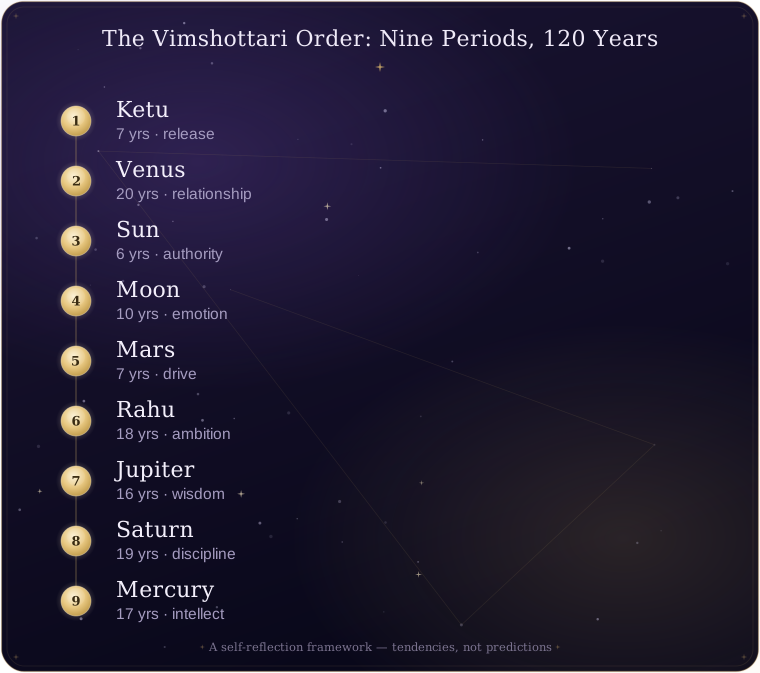
The Vimshottari scheme of the Brihat Parashara Hora Shastra runs the nine mahadasha periods in a fixed order, each carrying its own theme, span, and characteristic misread. Here is the whole family at a glance, with the headline tendency for each and the trap to avoid:
- Ketu period (7 years) — The shortest period after the Sun, Ketu's stretch tends toward detachment, loose ends, and a pull inward. Classical readings tie it to release, spiritual questioning, and the quiet dismantling of things that no longer fit. The common misread is to label every Ketu year as misfortune; the same energy that strips away can also free you from what you were clinging to. Read it as a clearing season, not a punishment, in guide to the Ketu planetary period.
- Venus period (20 years) — The longest period of all, Venus colors two decades with themes of relationship, comfort, creativity, and material ease. It often coincides with marriage, artistic output, and a softer relationship with pleasure and money. The trap is assuming twenty years will be uniformly sweet; Venus also tests how you handle attachment and excess, and the period reads very differently depending on the planet's condition in the chart. A fuller treatment lives in overview of the Venus planetary period.
- Sun period (6 years) — The briefest of the nine, the Sun's period turns the focus to authority, recognition, and the question of who you are when you stand on your own. It can bring visibility and responsibility in equal measure. Readers often expect guaranteed fame, but the period more honestly tests the ego — whether your sense of self can hold up without external applause.
- Moon period (10 years) — A ten-year period that emphasizes emotion, nurture, the mind, and your relationship to the public and to home. Feelings run closer to the surface and the inner weather shifts more visibly. The frequent error is to read heightened sensitivity as instability; it is better understood as a decade where emotional life carries more weight in your decisions.
- Mars period (7 years) — Seven years weighted toward drive, courage, and the willingness to push against resistance. It can sharpen ambition and physical energy, and sometimes surface conflict or disputes. The misread is to treat Mars as nothing but aggression; channeled well, the same heat becomes focused, decisive effort rather than reactivity.
- Rahu period (18 years) — The 18-year node period that readers most often ask about with dread. Rahu's themes are hunger, ambition, the foreign and unconventional, and a restless reaching for more. It is rarely calm, but "intense" is not the same as "cursed." Many people achieve their largest worldly gains here while also confronting the cost of obsession. The full nuance, including why it gets such a fearful reputation, is in explainer on the Rahu planetary period.
- Jupiter period (16 years) — Sixteen years tied to wisdom, growth, teaching, faith, and good fortune. It often correlates with learning, mentorship, children, and a broadening of life. The common overreach is to expect effortless luck; Jupiter's gifts usually arrive alongside the responsibility to use them well, not as a free pass.
- Saturn period (19 years) — The 19-year Shani period, the longest after Venus, built around discipline, delay, endurance, and maturity. It has the heaviest reputation of the set, and it does ask for patience. But reading it only as punishment misses the point: Saturn rewards steady, unglamorous work and tends to build things that last. See how to work with its long arc in deep dive on the Saturn planetary period.
- Mercury period (17 years) — Seventeen years emphasizing intellect, communication, commerce, and skill. It can sharpen learning, writing, business, and the exchange of ideas. The misread is to flatten Mercury into mere cleverness; at its fuller range the period is about how clearly you think and how well you connect what you know to what you do.
How Shade and Combination Shift Readings
The single most useful thing to understand about this family is that no mahadasha reads the same way twice. The planet's name gives you the headline theme, but three layers underneath bend that headline in very different directions. Treating the period as a fixed label is exactly the mistake that turns timing into fatalism.
- The sub-period inside it (antardasha) shifts the tone. Each major period is divided into nine sub-periods, one for every graha, running in the same order. A Saturn period with a Jupiter sub-period feels different from the same Saturn period with a Mars sub-period. To get the broad theme of the whole period, you sacrifice the texture of any given year — which is why the sub-period matters for actually dating events.
- The planet's condition in the birth chart shifts the strength. The same Venus period plays out very differently for someone whose Venus sits strong and well-placed than for someone whose Venus is weak or under strain. To get a clean, one-word reading of a period, you sacrifice the accuracy that only the natal placement provides. A "good" planet poorly placed can deliver a hard period, and a "hard" planet well placed can deliver a productive one.
- The planet's relationships shift the flavor. A graha that befriends or fights the houses it touches will color its period accordingly. Rahu's 18 years are not generic Rahu years; they carry the imprint of which house Rahu occupies and which planets it associates with. Lean entirely on the planet's reputation and you sacrifice everything its specific placement is telling you.
Two quick illustrations make this concrete. First, a Saturn period is often dreaded, but for someone in a career that rewards patience and structure, those same 19 years can be the period of their most durable achievement — the restriction and the discipline are the same thing seen from two angles. Second, a Rahu period that frightens one person can coincide with another person's breakthrough into an unconventional field, because Rahu's hunger finds an outlet that suits the chart. The planetary period sets the theme; the shading decides whether that theme reads as pressure or as growth.
Common Misreads + Framework Limits
Most of the trouble people have with this system comes from a handful of predictable errors, and naming them is the fastest way to read a mahadasha more honestly.
- Treating a planetary period as a discrete verdict. The periods are interpretive vocabulary, not fixed boxes. "You're in Saturn" describes a tendency for a stretch of time, not a fixed outcome you are sentenced to. Read it as a season with weather, not a label stamped on you.
- Forcing one lineage to be the single correct answer. Vedic traditions differ on detail, and different teachers weight planets and sub-periods differently. When sources disagree, the honest move is to hold the tension rather than picking one reading and calling everyone else wrong.
- Elevating a period into an identity. A planetary period is something you are passing through, not who you are. Saying "I am a Rahu person" because of the period you are in collapses an 18-year chapter into a permanent self-description and quietly distorts how you see everything else in your life.
- Expecting the framework to replace ground truth. A planetary period is a lens for reflection, not a substitute for medical, psychological, or relational reality. It cannot identify a medical condition, predict a guaranteed event, or stand in for the actual work of a hard situation. Hold tendency-based readings clearly apart from fatalistic ones: the system describes pressures and openings, it does not seal your future.
The limit worth stating plainly is that the spans are a structured convention, set out in the classical Vimshottari teaching, not a measured law of nature. They are useful precisely because they give a shared, repeatable map of timing — and they are misused the moment that map is treated as destiny rather than as a tool for paying attention.
Common Questions About the Planetary Periods
How is my current planetary period actually determined?
Your running period is calculated from the Moon's position at birth — specifically the nakshatra (lunar mansion) the Moon occupied. That starting point sets which graha's period you were born into and how much of it remained, and the nine periods then proceed in their fixed order from there.
Why do the nine periods add up to exactly 120 years?
The Vimshottari system assigns each graha a set span — Ketu 7, Venus 20, Sun 6, Moon 10, Mars 7, Rahu 18, Jupiter 16, Saturn 19, Mercury 17 — and those nine spans total 120 years, the symbolic full life in this tradition. The figure is a classical convention for organizing time, not a prediction of lifespan.
Does a "bad" planetary period mean bad years are guaranteed?
No. A period names a theme and a set of tendencies, but how it plays out depends on the planet's placement and sub-periods in your specific chart. A heavy planet's period can be productive when that planet is well placed, so any dasha is best read as pressure and opportunity rather than a fixed sentence.
Are these planetary periods part of Western astrology too?
They are not. The dasha system is specific to Vedic astrology and has no direct counterpart in the Western tradition, which times life through transits and progressions instead. That difference is one of the clearest lines between the two systems.
Reflection Prompts
- Think of a recent year that felt like a distinct chapter — what theme ran through it, and which graha's tendency does that match?
- Notice where you have been reading a single period as your identity rather than as a season you are passing through.
- Recall a "hard" stretch that later built something lasting, and ask what it was quietly constructing.
Related Reading
- explainer on the Rahu planetary period for the 18-year node period readers ask about most
- guide to the Ketu planetary period for the 7-year node period and its themes of release
- deep dive on the Saturn planetary period for the longest hard period and how to work with it
- overview of the Venus planetary period for the 20-year relationship and comfort period
- comparison of Vedic and Western astrology for why dasha timing exists in one system and not the other
- reading a Vedic birth chart calculator output for finding your Moon nakshatra and the dasha currently running
- introduction to the nakshatra lunar mansions for the lunar map that decides which period you start in
Take Action
New to the Vedic system? Start by reading comparison of Vedic and Western astrology to see why planetary periods belong to the Vedic tradition, then map your own Moon nakshatra to find which mahadasha is currently running in your chart. Doing both gives you a dated timeline of your life's chapters instead of a single scary headline — and, more usefully, it trains you to read any period as a season with a beginning and an end rather than a verdict about who you are.
Read how Vedic and Western astrology differ, then find your current period: https://astrologywiki.com/en/wiki/vedic-vs-western-astrology
Sources
- Vimshottari dasha system — the classical framework that defines the nine planetary periods and their fixed 120-year spans
- Brihat Parashara Hora Shastra — the foundational Vedic text in which the Vimshottari dasha scheme is set out and attributed to the sage Parashara