
What is neptune in pisces?
Neptune in Pisces is a dignified generational transit that amplifies collective intuition, boundary dissolution, and shared spiritual longing as Neptune moves through its own home sign. This placement belongs to the broader framework of pillar page on outer planet transits and generational astrology, which maps how slow-moving planets shape cultural eras and birth cohorts. Every chart cast between 2012 and 2026 carries this signature not as a personal quirk but as a shared generational imprint, and reading it well requires a fundamentally different interpretive approach than standard natal planet analysis.
- Marks all charts from 2012 to 2026 as part of the same cohort-level signature, not an individual personality descriptor
- Amplifies Neptune's characteristic functions: dissolving fixed structures, heightening receptivity, activating collective spiritual longing
- Because Neptune rules Pisces natally, the planet operates in its own sign at full intensity — a dignified placement rather than a borrowed one
Why It Matters for Self-Awareness
The central friction neptune in pisces generates is structural: it dissolves the line between ambient collective emotion and individual psychological experience. People born during this window often describe an unusual permeability — absorbing the emotional tone of rooms, communities, or cultural moments without a clear personal trigger for what they're feeling. Most popular astrology content frames this as a positive personality trait: "you are deeply intuitive, spiritually open, naturally empathic." That framing makes the placement harder to read, not easier.
The more accurate interpretive move is recognizing that heightened emotional sensitivity during this era often has a collective origin rather than a personal one. Neptune's dissolving quality during this transit isn't generating individual emotional profiles — it's conditioning a shared cultural and spiritual field. What registers as "my intuition" or "my grief" may be partly that, and partly the ambient feeling-texture of a historical moment. Distinguishing the two doesn't diminish what's felt; it redirects the interpretive work toward something productive.
For people with strong natal Pisces placements — several planets clustered in Pisces, a Pisces Ascendant, or Pisces on the cusp of an angular house — this distinction carries additional weight. Neptune both rules Pisces and currently moves through it, running the sign's characteristic themes at maximum intensity. The transit doesn't just condition the shared field for these individuals; it concentrates that dissolution in specific life areas, making the work of separating personal feeling from collective absorption an ongoing interpretive practice rather than a one-time insight.
neptune in pisces vs Adjacent Concepts: How It Works + Trade-offs
Neptune in Pisces is frequently conflated with two related but distinct ideas: Neptune as a personal natal influence, and Pisces as a natal sun or rising sign. Understanding what separates each concept — and where the interpretive trade-offs fall — determines whether the transit gets read usefully.
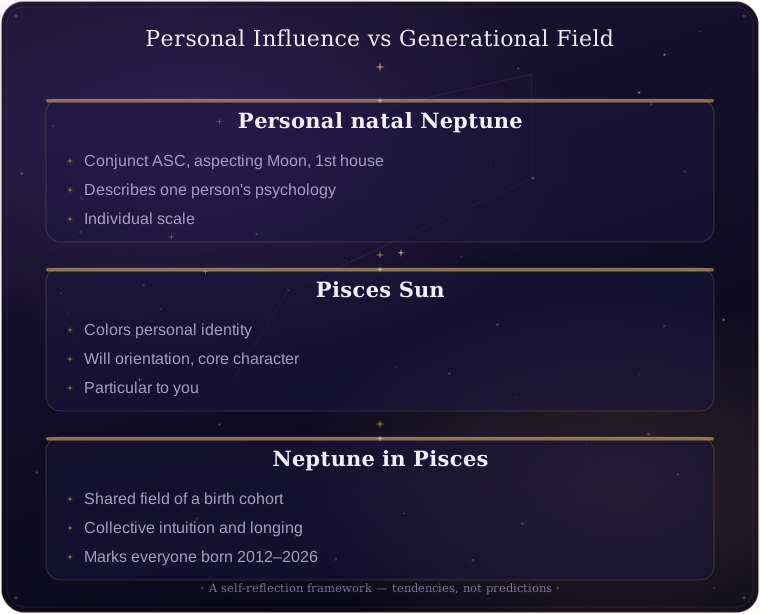
When Neptune occupies a personal position in a natal chart — conjunct the Ascendant, tightly aspecting the Moon, or placed in the first house — it describes something individual: how this specific person's energy meets the world, or how one function of their psychology expresses through a Neptunian lens. The transit works at a fundamentally different scale. It describes the shared intuitive and spiritual field that an entire birth cohort inhabits. To read it at that generational scale, you give up individual psychological specificity — the gain is an interpretive frame that actually fits what the placement is doing: shaping collective cultural and spiritual conditions.
The contrast with a Pisces sun or rising is equally worth separating. A Pisces sun colors personal identity — will orientation, core character — while neptune in pisces colors the collective environment the cohort inhabits; a Pisces sun says something particular to you, while the generational placement says something about the conditions everyone born in this window shares. To get the personal read, look at which house Pisces rules in your natal chart and what planets sit there — covered in detail at guide to reading personal vs generational placements in a birth chart. One further trade-off runs through the transit's defining feature: the heightened collective spiritual receptivity it generates carries a corresponding risk — spiritual bypassing, using transcendence as avoidance rather than as a path toward integration. The gain is an unusually open channel to collective intuitive material; the cost is that the channel requires deliberate discernment to use well. Without it, receptivity tips into absorbed projection rather than personal insight. The placement offers the sensitivity; the discernment has to be built separately.
How to Read the Transit in Your Chart
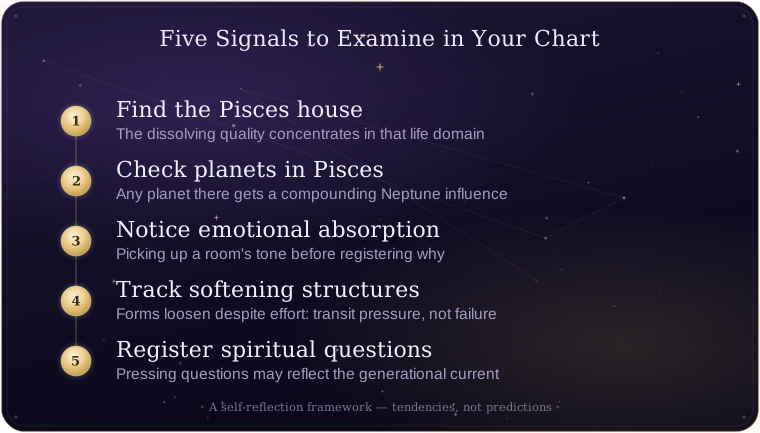
Reading neptune in pisces usefully starts with the natal chart. Five concrete signals to examine:
- Identify which house Pisces rules. This is where the dissolving quality concentrates. Boundaries soften and structures become fluid in the life domain governed by that house — relationships, finances, career, or creative work, depending on where Pisces falls in your chart.
- Check for natal planets in Pisces. Any planet placed there receives a compounding influence during this window. Neptune both rules the sign and currently transits through it, amplifying that planet's themes in ways that may not feel predictable from the natal chart alone.
- Notice emotional absorption patterns. A recurring signal for people with strong Pisces placements is picking up the emotional tone of a group or room before consciously registering what's happening around them. This is the transit's receptivity amplification at work, not a personal defect.
- Track where structures soften despite effort. Neptune dissolves fixed forms. The Pisces-ruled area of your chart may show repeated themes of structures loosening regardless of how deliberately you maintain them — transit pressure, not personal inadequacy.
- Register which spiritual questions feel unusually pressing. Collective spiritual longing is a defining feature of this era. Questions arising without a clear personal trigger may reflect the generational current rather than individual psychological material.
Common Misreadings
A consistent cluster of interpretive errors surrounds neptune in pisces in mainstream astrology writing. Each one redirects readers away from what makes the transit interpretively useful.
- Treating it as a personal sensitivity indicator. The most widespread misread: describing the placement as evidence that the individual is "deeply empathic," "intuitive," or "spiritually drawn" as a stable personality type. This is a generational transit that marks every chart from 2012 to 2026. Reading it as a personal trait descriptor applies the wrong interpretive lens and misses the transit's actual function — conditioning a collective field, not profiling individual psychology.
- Equating heightened receptivity with spiritual advancement. The access to collective intuitive material under this transit is real. That doesn't indicate personal spiritual maturity. The same permeability that opens the intuitive channel also makes it easier to absorb collective emotional material without recognizing it as such. Distinguishing genuine personal insight from absorbed projection requires active interpretive work, not just openness.
- Assuming it sorts by sun sign. Generational transits don't differentiate by sun sign. Whether you're a Capricorn or a Gemini sun, if your chart was cast between 2012 and 2026, this placement is in it. Personal relevance depends on natal Pisces placements and which house Pisces rules — not on solar identity.
- Treating it as equivalent to Neptune in other water signs. Neptune rules Pisces, making this a dignified transit rather than a standard water-sign stay. Dignity means the planet operates at the fullest expression of its characteristic themes — dissolution, collective intuition, spiritual longing. Neptune in Cancer or Scorpio carries Neptunian qualities through borrowed sign frameworks; here it works in its own territory, which structurally amplifies every associated theme well past what other water-sign Neptune placements generate.
The 2012–2026 Cohort at a Glance
| Property | How It Works | Natal Placement | How to Observe |
|---|---|---|---|
| Sign dignity | Neptune rules Pisces; this transit operates at full amplification, not in borrowed territory | House Pisces occupies in your natal chart | Which life area shows recurring boundary softening or structural fluidity |
| Generational scope | Every chart from 2012–2026 carries this as a natal signature; personal effects vary by individual chart factors | Natal planets in Pisces receive compounding Neptune influence | Track whether emotional intensity has personal or collective origins |
| Dissolution theme | Fixed structures soften in the Pisces-ruled house; this is transit pressure, not personal failure | Natal Neptune's house position adds a personal interpretive layer | Recurring situations where structure loosens despite deliberate effort |
| Spiritual receptivity | Collective spiritual longing activates at cultural scale; discernment between insight and absorbed projection becomes necessary | Pisces house cusp indicates the affected life domain | Spiritual urgency arising without a clear personal trigger |
Questions About This Generational Placement
When did Neptune enter Pisces and when does it leave?
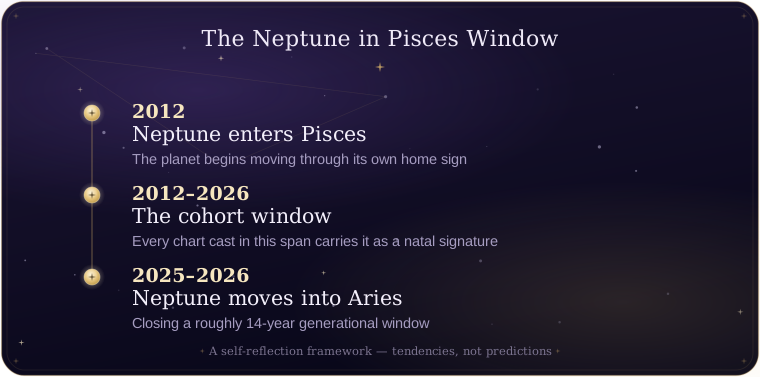
Neptune entered Pisces in 2012 and moves into Aries around 2025–2026, closing roughly a 14-year generational window. Every chart cast during that span carries the placement as a natal signature rather than a transiting event. For people born before 2012, it has functioned as a long transit through their existing natal chart.
Does neptune in pisces affect everyone born in the cohort the same way?
Not uniformly. The transit conditions the shared cultural and intuitive field, but personal chart factors determine how directly that effect arrives. Those with natal planets in Pisces, or with Pisces ruling an angular house — the 1st, 4th, 7th, or 10th — tend to experience the themes more intensely than those with sparse natal Pisces.
What makes this transit "dignified" compared to Neptune in other signs?
Neptune is the modern ruler of Pisces, which means it operates in its home sign during this window. Dignity doesn't mean comfortable or easy — it means the planet's characteristic themes run at their fullest expression. Neptune in Cancer or Scorpio works through a borrowed emotional framework; here it works in its own sign, which structurally intensifies all associated themes.
How does this generational placement differ from having a Pisces sun?
A Pisces sun describes personal identity — the character at your core and how you orient your will. This generational placement describes the collective intuitive and spiritual field the cohort shares. Both can be present in the same chart and read in relation to each other: the sun sign gives personal character; the generational placement gives the shared conditions that character operates within.
Reflection Prompts
- Think back to a recent moment when you couldn't determine whether what you were feeling originated with you or came from the emotional atmosphere of the space around you — what was different about that situation?
- Which area of your life has shown the most repeated structural softening over the past several years — where do you find yourself rebuilding the same boundary or plan?
- Recall a moment when a spiritual framework genuinely helped you engage with something difficult, versus a moment when it let you step around it — what was the difference between those two experiences?
Related Reading
- pillar page on Neptune transit dates through all zodiac signs — covers the full 164-year Neptune cycle with exact dates across all signs, including the 2012–2026 Pisces window
- spoke page on Pisces as a natal sign — explains Pisces's characteristic themes as a natal placement, distinct from the generational transit reading covered here
Take Action
Generate your free birth chart to explore neptune in pisces as it lands in your personal chart. You'll see exactly which house Pisces rules in your natal map — the life domain where the dissolving quality concentrates for you specifically. That single detail shifts the interpretation from a shared generational description to a chart-grounded read of what this era asks of you.
Sources
- Dane Rudhyar — pioneered the psychological, humanistic reading of outer planet transits as generational and cultural forces rather than purely individual psychological descriptors
- Liz Greene — developed the interpretive framework for reading Neptune's mythological and psychological dimensions in transit and natal chart work
- Robert Hand — wrote extensively on outer planet transits and their practical application to birth chart timing and interpretation