This guide covers Persephone on two levels: the Greek myth and archetype (the goddess, her story, and the psychological pattern she names), and the Persephone asteroid (#399) in astrology — how to read it in your birth chart. Skip to whichever brought you here.
Who Is Persephone — Goddess, Myth, and Asteroid?
Persephone is the Greek goddess of the underworld whose myth maps the human pattern of descent, change, and altered return — and, in modern astrology, the name of an asteroid (number 399) you can locate in your own birth chart. In Greek myth she is the maiden daughter of Demeter and Zeus who is pulled down into the underworld by Hades, mourned by her grieving mother, and finally allowed to spend part of each year above ground. That underworld she presides over symbolically overlaps with some modern eighth-house themes read through the explainer on the eighth house of loss and regeneration, where loss and regeneration concentrate in a chart. In astrology and depth psychology, the persephone goddess works as a living archetype rather than a finished story, naming a process people move through again and again — and the Persephone asteroid gives that archetype a specific point on the chart wheel to read by.
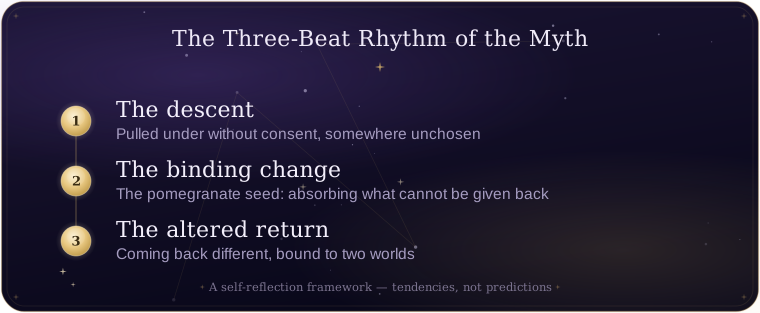
- Describes a three-beat rhythm: being pulled under, being changed, and coming back different
- Carries both roles at once, the innocent maiden and the queen of the dead
- Read through the Persephone asteroid (#399), Pluto, eighth-house themes, and chart factors tied to loss-and-renewal symbolism
The Myth in Brief
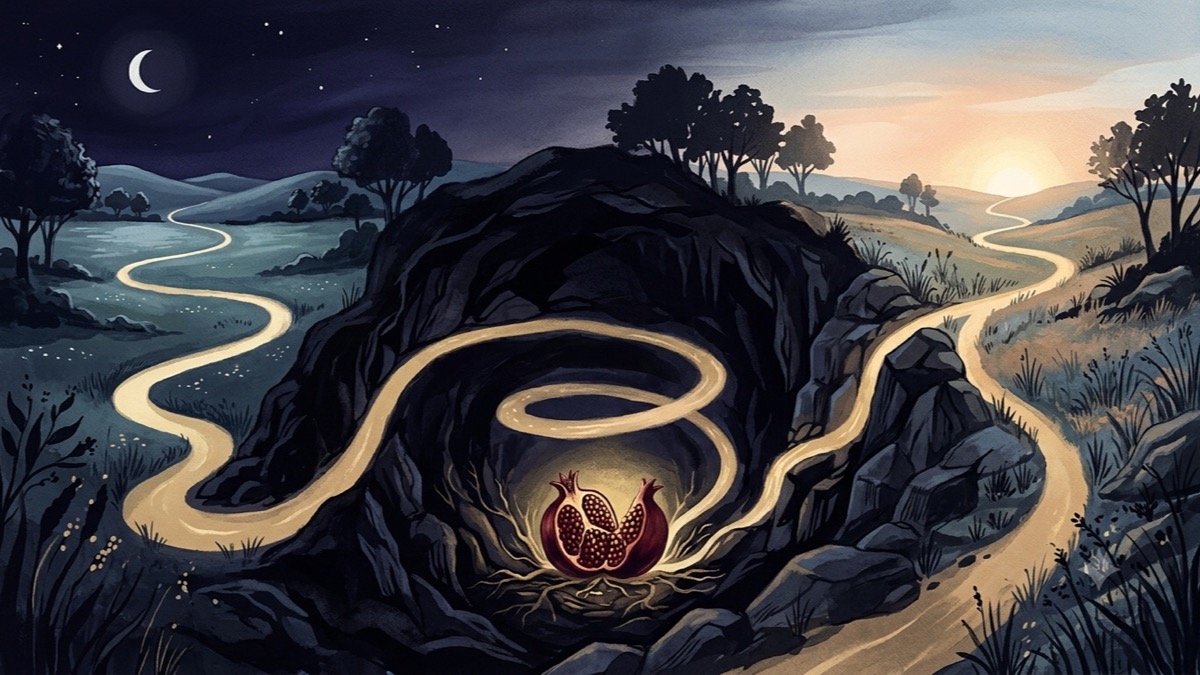
In the oldest telling, recorded in the Homeric Hymn to Demeter, Persephone (also called Kore, "the maiden") is gathering flowers when the earth splits open and Hades, lord of the dead, seizes her into the underworld. Her mother Demeter, goddess of the harvest, searches the world in grief, and as she mourns the crops wither — the first winter. Zeus finally brokers a return, but because Persephone has eaten a few pomegranate seeds in the underworld, she is bound to spend part of each year below and part above. Her annual descent and return became the Greek myth for the turning of the seasons: she leaves, and the earth goes barren; she rises, and spring returns.
Persephone as a Psychological Archetype
Depth psychology reads that seasonal story as something happening inside a person, not only in the sky. As an archetype, Persephone names the experience of being pulled out of an innocent, sheltered life into something darker and larger than you chose — and slowly being changed by it until you can no longer go back to who you were. Crucially, she is not only the victim of the abduction; by the end she rules the realm that claimed her. That double identity, maiden and queen, is what makes the archetype useful: it holds both the genuine wound of a forced descent and the hard-won authority that can come out the other side. This is the layer most people are reaching for when they search "Persephone archetype," whether or not they ever open a birth chart.
Why It Matters for Self-Awareness
Most readers meet the persephone goddess as a tidy seasonal fable and stop there, which is exactly where the trouble starts. The friction is not that people misremember the plot; it is that they treat the abduction, the underworld, and the return as a single ancient event instead of a pattern that keeps repeating inside a life. Someone in the middle of a hard separation, a forced ending, or a slow grief rarely recognizes that they are standing in the descent phase of a cycle they have lived before.
Seeing this matters because the archetype gives shape to experiences that otherwise feel like pure chaos. When you can name the part of the cycle you are in, the underworld stops looking like a permanent sentence and starts reading as one movement in a longer rhythm. Consider a few situations where this naming changes everything. A person whose long marriage has just ended often feels they have simply failed; reading the moment as a descent phase lets them see it as a passage they are moving through, not a verdict on their worth. Someone who has lost a job that held their whole identity can stop asking what is wrong with them and start asking what this underworld stretch is asking them to release. A parent watching a grown child leave home, the very situation the original Demeter and Persephone story was built to hold, can recognize the grief as part of a recurring human rhythm rather than a private catastrophe.
That reframing is the difference between feeling buried and recognizing that descent, in this pattern, is followed by return. None of this promises a particular outcome or timeline; it offers a shape to stand inside while the hard season runs its course. To trace where loss and regeneration concentrate in a chart, this archetype is read through the underworld houses, the terrain Persephone presides over.
Persephone vs Demeter vs Pluto: Three Lenses on the Same Loss
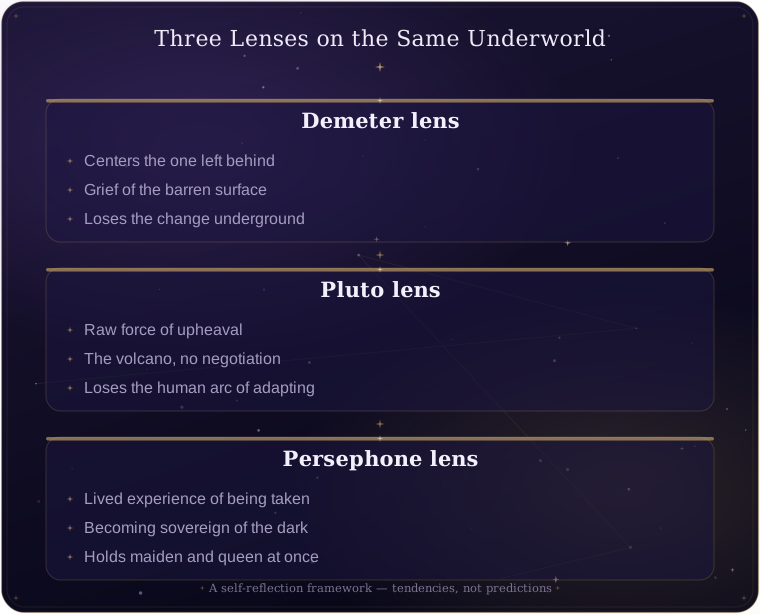
The persephone goddess is easy to blur with neighboring figures, so it helps to compare how each one works and what you trade by reading through it. The Demeter pattern centers on the one left behind, the parent or partner whose world goes barren when something is taken; reading through Demeter gets you the grief of loss, but you lose sight of the person who is actually changing underground. To get the mother's anguish, you sacrifice the daughter's transformation. This is why two people in the same family rupture can be living completely different myths at once: one is grieving on the surface while the other is being remade below.
Persephone also differs from the pure Pluto signature. Pluto names the raw force of upheaval, the volcano that erupts without negotiation, while Persephone names the experience of being taken under and slowly becoming its sovereign. Choosing the Pluto lens over the Persephone lens gets you the scale of the power at work, but you lose the human arc of adapting to it. The way it works is sequential: the descent (Pluto seizing), the change (eating the pomegranate seed that binds part of you to the dark), and the altered return. In the tradition descending from Liz Greene, the seed is the hinge; once you have tasted the underworld you cannot return unchanged, only deepened.
A third comparison is worth holding: the difference between the innocent-maiden Kore reading and the queen reading of the same figure. Some treat her only as the abducted girl, which gets you the sympathy of the victim but costs you the whole second half of the story, where she takes the throne of the place that claimed her. To read her purely as the maiden, you sacrifice her authority; to read her purely as the queen, you sacrifice the genuine wound that the descent began with. The pattern asks you to hold both at once. That same descent-and-return rhythm is sometimes read along the soul axis described in this guide to the lunar nodes as a descent-and-return soul axis, where the pull downward and the climb back form a single line.
How to Read Persephone in Yourself
The persephone goddess shows up less as a fixed trait and more as a recognizable sequence you can learn to spot in real time. Look for these signals:
- A forced descent. Something you cherished is taken or ends without your consent, and you find yourself somewhere you would not have chosen to go.
- The pomegranate moment. You take in something from the hard season, a truth, a loss, an identity shift, that you cannot give back.
- Two-world living. You feel split between the surface life you returned to and the underworld knowledge you now carry.
- The altered return. People say you seem different; you have authority where you once had only innocence.
- The recurring cycle. You notice this is not the first descent, and the pattern itself becomes familiar.
People who recognize which phase they are standing in tend to move through the descent with far less self-blame than those who read it as personal failure. This way of treating myths as recurring patterns rather than relics owes a great deal to the archetypal lineage Richard Tarnas helped formalize, where the same mythic structures keep activating across both individual lives and shared history. The signals above are not a diagnosis and they do not predict an outcome; they are a way of locating yourself inside a rhythm. Often the most useful question is not how do I get out of this, but which beat of the cycle am I actually in right now, and what does this beat tend to ask of a person. Naming the phase rarely shortens the descent, but it tends to change how you carry it, and that shift is frequently what people describe as the turning point.
Persephone Asteroid in the Houses
If you want a specific point to read rather than a general theme, calculate the Persephone asteroid (#399) in your birth chart — most asteroid-capable chart tools will plot it once you add it by name or number. The house it falls in suggests the life area where the descent-and-return pattern most often plays out for you. Persephone in the 4th house, for instance, can tie the rhythm to home and family ruptures; in the 7th, to partnerships that pull you under and remake you; in the 10th, to career or public identity that you lose and rebuild on different terms. Read the house as the stage on which this cycle tends to recur, not as a prediction that loss must happen there.
Persephone Conjunct Personal Planets
The asteroid speaks loudest when it sits close to (conjunct) a personal planet — the Sun, Moon, Mercury, Venus, or Mars. Persephone conjunct the Moon can color your emotional life with cycles of withdrawal and return; conjunct Venus, with relationships that follow a descent-and-transformation arc; conjunct the Sun, with an identity that is repeatedly remade through underworld passages. A tight conjunction (within a few degrees) is the strongest signal; a wide one is a quieter undertone. As with any asteroid, treat it as a flavor that deepens the planet it touches, not as a force that overrides the major chart.
The Persephone-Pluto Pattern
The most resonant configuration is a meaningful aspect between the Persephone asteroid and Pluto — the planet that carries the same underworld charge in modern astrology. When the two are linked, the myth and the planetary force point at the same place at once: Pluto names the raw power of being seized and transformed, while Persephone names the lived human experience of surviving it and slowly coming to rule it. In the tradition descending from Liz Greene, this pairing reads as a signature for someone whose growth keeps arriving through depth, loss, and regeneration rather than through steady linear climb. It is intense, but it is not a verdict; it describes a way a life tends to deepen, not a fate to brace against.
Common Misreadings
The persephone goddess gets flattened in a handful of predictable ways, and each misreading keeps people stuck. Here are the most common:
- Misreading: she is a passive victim. Reality: the myth holds both coercion and a later sovereignty as underworld queen, the abduction and pomegranate binding alongside the throne she eventually takes; the archetype carries both.
- Misreading: the return means going back to normal. Reality: she comes back altered and bound to two worlds, so return is transformation, not reversal.
- Misreading: it is a one-time event. Reality: the persephone goddess names a repeating cycle, and most people meet several descents across a lifetime.
- Misreading: the underworld is purely negative. Reality: in this pattern the dark place is where depth and authority are earned, not just where things are lost.
Persephone at a Glance
| Property | How It Works | Astrological Field | How to Observe |
|---|---|---|---|
| Forced descent | An ending or loss pulls you somewhere unchosen | Pluto, eighth house | A cherished thing is taken without consent |
| Binding change | You absorb something you cannot give back | Twelfth house, Scorpio | A truth or grief that reshapes your identity |
| Altered return | You re-emerge carrying underworld knowledge | Pluto, Scorpio / eighth-house symbolism, and relevant hard aspects | Others notice a new depth or authority in you |
| Recurring rhythm | The cycle repeats across a lifetime | Pluto transits, hard aspects | You recognize this descent is not your first |
Common Questions About Persephone
Is Persephone a goddess or just a mythological figure?
She is a full goddess in Greek religion, holding the title Queen of the Underworld alongside her role as a spring and grain deity. Her dual standing as both maiden and queen is central to how this figure functions as an archetype.
What does the Persephone archetype mean in astrology?
It names the descent-and-return pattern read mainly through Pluto and the underworld houses. Astrologers treat it as a map for how a person is pulled under, changed, and brought back with new depth rather than as a prediction of events.
Why did Persephone have to return to the underworld each year?
Because she ate pomegranate seeds in the underworld, binding part of her to it permanently. In the archetypal reading this seed stands for whatever you absorb in a hard season that you can never fully release.
How is Persephone different from Hades or Pluto?
Hades names the underworld's ruler (and Pluto the modern planet that carries the same charge), while the underworld itself is the realm; Persephone is the figure who undergoes the descent and slowly comes to rule that realm alongside him. The archetype centers the lived experience of transformation, not the raw power behind it.
Reflection Prompts
- Think of a recent ending you did not choose, and ask which phase of descent, change, or return you are standing in now.
- Recall something a hard season left you carrying, and name the pomegranate seed you cannot give back.
- Picture how others described you after your last major loss, and notice what depth or authority returned with you.
Related Reading
- explainer on the twelfth house as the hidden dissolving realm — the unseen, dissolving terrain Persephone crosses into during the underworld phase of the cycle.
Take Action
Map your own chart for the descent-and-return pattern by working through the full birth-chart walkthrough step by step. You can come away with the specific placements, Pluto, the underworld houses, the nodal axis, where this rhythm tends to surface for you, along with a clearer sense of which season of the cycle you are living through right now and which one tends to come next. Reading your chart this way turns the myth from a story you admire into a map you can stand inside, so the next time the ground opens you already know the shape of the path back. Read the full guide to reading a birth chart to see where the descent-and-return pattern shows up for you.
Sources
- Liz Greene — shaped the depth-psychological reading of Pluto through the Hades and Persephone myth that this archetype draws on
- Richard Tarnas — developed the archetypal approach linking planetary patterns to recurring mythic experiences in individual and collective life