What is Rahu and Ketu?
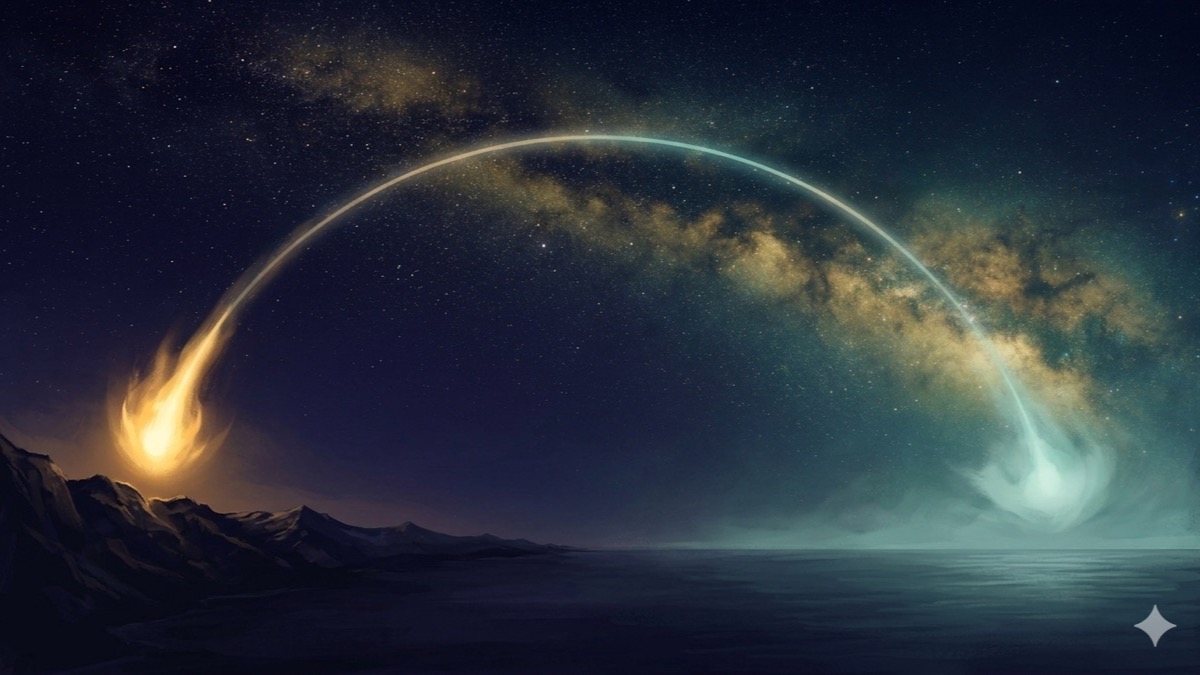
Rahu and Ketu are the two lunar nodes of Vedic astrology — Rahu the north node of insatiable worldly desire and Ketu the south node of spiritual release — that together form the karmic axis charting the soul's pull between craving and liberation. They are not physical bodies but mathematical points where the Moon's path crosses the Sun's, which is why tradition calls them shadow planets. Anyone studying rahu and ketu astrology is really studying a single 180-degree line that runs through every birth chart, and the Vedic lunar nodes pillar page is the hub where that axis is read in full.
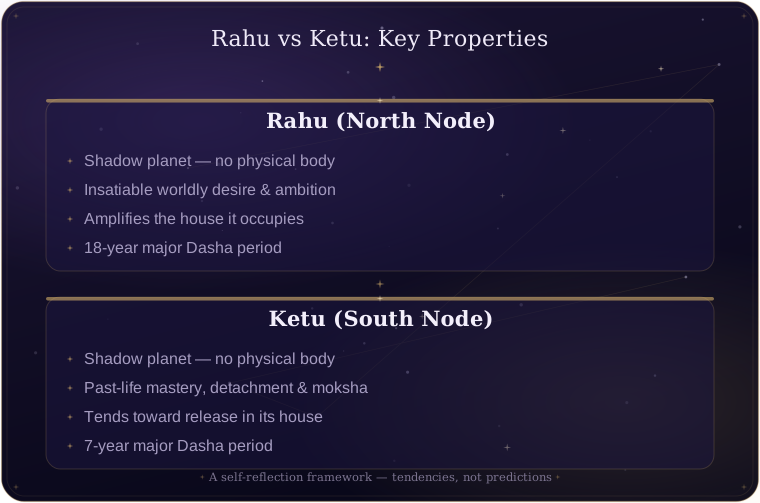
- Rahu is the north node, amplifying the worldly desire and ambition of whatever house it sits in
- Ketu is the south node, marking past-life mastery and a pull toward detachment and moksha
- The two are always exactly opposite, so they must be read as one karmic desire-liberation polarity
This is an interpretive framework for self-reflection, not a fixed prediction of events or a guarantee of outcomes.
Why It Matters for Self-Awareness
Most introductions to rahu ketu meaning name the two nodes and stop, which leaves a reader with a label but no working idea of what the axis is for. The point of reading Rahu and Ketu is not to learn which house is "good" or "bad" but to see a tension the chart has been describing all along: the place where you reach outward for more, and the place where you already carry enough. Held that way, the nodes become a mirror for how a person spends attention rather than a forecast of what will happen to them.
That mirror is useful because the axis names a familiar pattern in plain terms. Rahu tends to mark the appetites that feel newest and most unfinished, the arena where ambition runs hot and never quite settles; Ketu marks the ground that feels so familiar it can be taken for granted, a competence built up long before this life. Reading the two together turns a vague sense of "I keep chasing this and neglecting that" into something a chart can locate, which is exactly the kind of self-knowledge an honest astrology offers and a horoscope rarely does.
Rahu and Ketu vs Adjacent Concepts: How It Works + Trade-offs
It helps to set Rahu and Ketu against their Western counterparts, because the confusion between them is where most interpretation goes wrong. Mathematically there is no difference at all: the rahu north node ketu south node pair points to the same two intersections that Western astrology labels the North Node and South Node. The trade-off is interpretive, not astronomical. Vedic practice reads the same axis through a karmic, past-life framework, while modern Western evolutionary astrology reads it as the soul's growth edge within a single lifetime.
Against the Western model, the Vedic view trades open-ended growth language for a more deterministic karmic timing. Where an evolutionary reading might frame the South Node as comfortable habits to move beyond, the Vedic Ketu is spiritual capital already earned, and Rahu is the hungry frontier the soul has not yet integrated. To gain that sense of inherited karma, you give up the lighter "this is your growth direction" framing — the prescriptions differ because the philosophies differ, even though the math is identical.
This is also where the honest reading of astrology lives. The classical Jyotish tradition recorded by Sage Parashara in the Brihat Parashara Hora Shastra treats the nodal axis as shadow grahas with timed Dasha cycles, and later interpreters such as B. V. Raman read the chart as a language of karmic meaning rather than a fixed script — so neither the Vedic nor the Western reading should be taken as a verdict on a person's worth or fate. The rahu and ketu in astrology question, taken that way, lets you use whichever framework clarifies your own pattern while remembering that the same sky supports more than one honest reading, and that the north and south nodes comparison is the place to weigh them side by side.
How to Read Rahu and Ketu in a Chart
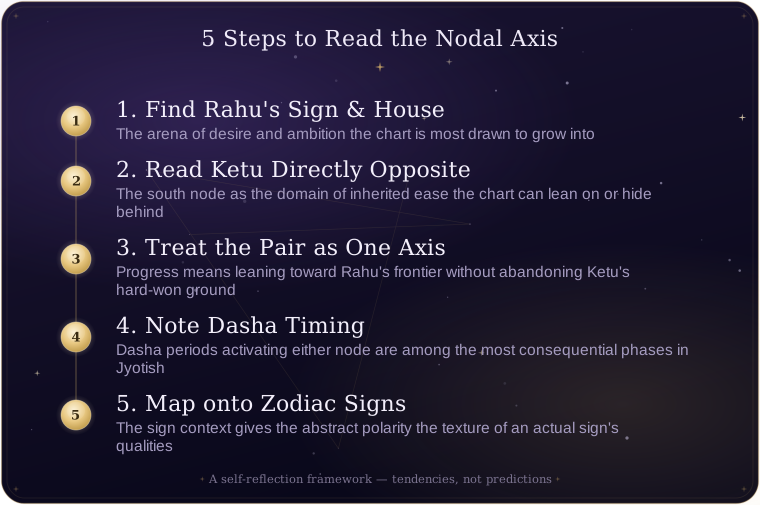
You can begin reading the nodal axis with a few grounded steps, and the method holds whether you lean Vedic or Western.
- Find the sign and house of Rahu, the north node — this is the arena of desire and ambition the chart is most drawn to grow into.
- Read Ketu directly opposite, the south node, as the domain of inherited ease the chart can lean on or hide behind.
- Treat the pair as one axis: progress usually means leaning toward Rahu's frontier without abandoning Ketu's hard-won ground.
- Note any Dasha period that activates either node, since these are among the most consequential predictive phases in Jyotish.
- Map the axis onto the relevant zodiac sign meaning pages so the abstract polarity gains the texture of an actual sign.
Common Misreadings
- Rahu is simply malefic and Ketu benefic. Neither node is good or bad on its own; Rahu's hunger drives growth as often as excess, and Ketu's detachment can read as wisdom or as avoidance depending on the rest of the chart.
- The nodes predict fixed events. A node placement describes a tension and a timing, not a destined outcome; reading it as a forecast mistakes a symbol for a script.
- Vedic and Western nodes are different points. They are the same two intersections of Moon and Sun; only the interpretive tradition differs, which is the single fact that resolves most cross-system confusion.
- Ketu means you should renounce its house. Ketu marks past mastery and a pull toward release, not an instruction to abandon that area of life.
Rahu and Ketu at a Glance
| Property | Rahu (North Node) | Ketu (South Node) | How to Read It |
|---|---|---|---|
| Nature | Shadow planet, no physical body | Shadow planet, no physical body | Read as points, not planets |
| Direction | Insatiable worldly desire, ambition | Past-life mastery, detachment, moksha | The growth edge versus the inherited ground |
| House effect | Amplifies the house it occupies | Tends toward release in its house | One arena reaches out, the other lets go |
| Dasha length | 18-year major period | 7-year major period | Among the most consequential life phases in Jyotish |
Common Questions About Rahu and Ketu
What is Rahu and Ketu in simple terms?
They are the two lunar nodes — the points where the Moon's orbit crosses the Sun's path — read in Vedic astrology as shadow planets. Rahu, the north node, stands for worldly desire and ambition; Ketu, the south node, stands for past-life mastery and spiritual detachment. Together they form a single karmic axis rather than two separate forces.
Is Rahu the same as the North Node?
Yes, mathematically. Rahu is the Sanskrit name for the ascending lunar node, which Western astrology calls the North Node, and Ketu is the descending node, the South Node. The points are identical; the interpretive traditions built on them differ, which is why the prescriptions often sound nothing alike.
Why are Rahu and Ketu called shadow planets?
Because they are not physical bodies that cast light or have mass. They are calculated intersection points associated with eclipses, where the Sun and Moon are obscured, so tradition treats them as shadow-casting influences rather than literal planets in the sky.
How long do Rahu and Ketu periods last?
In the Vimshottari Dasha system the Rahu major period runs 18 years and the Ketu major period runs 7 years. These phases are considered among the most consequential predictive windows in Jyotish, which is why their timing draws so much attention.
Reflection Prompts
- Where in your life do you keep reaching for more, even after the last goal was met — and what would it mean to read that hunger as a direction rather than a flaw?
- Think of a skill or role that feels almost too easy; could that ease be a strength you under-credit, or a place you hide?
- Notice when you want a chart to settle a question for you — what does treating the nodal axis as a mirror, rather than a verdict, free up?
Related Reading
- Vedic lunar nodes pillar page — the hub that frames the full nodal axis
- north and south nodes comparison — the Western counterpart to this Vedic reading
- Dasha period timing in Jyotish — how the nodes' predictive cycles are timed
- zodiac sign meaning pages — the signs that give the axis its texture
Take Action
Generate your free birth chart to find where Rahu and Ketu fall in your own chart and read the karmic axis for yourself. You get a clear view of the two nodes and the houses they activate, and, more usefully, a way to ask where you are reaching outward and where you already stand on solid ground before treating either node as a verdict.
Sources
- B. V. Raman — grounded the classical reading of the lunar nodes within the Jyotish predictive tradition this framework draws on
- Sage Parashara, Brihat Parashara Hora Shastra — the foundational Vedic text describing Rahu and Ketu as shadow grahas and their Dasha periods