
What is sattva rajas tamas?
Sattva rajas tamas is the three-guna framework from Samkhya-Yoga philosophy that maps every moment of consciousness into shifting proportions of clarity, drive, and inertia. This framework sits within the broader tradition of Vedic self-inquiry; a fuller map of that tradition is available in the pillar page on Ayurvedic body types and energies.
- Sattva brings clarity, discernment, and still awareness
- Rajas fuels desire, movement, and goal-directed energy
- Tamas provides rest, stability, and grounding resistance
All three qualities are present in every moment — what shifts is their proportion. The Bhagavad Gita returns to this framework across multiple chapters because understanding which proportion dominates right now, not which one you "are" by nature, is what makes the system useful. Sattva does not win by eliminating rajas and tamas; it calibrates them. A surgeon needs rajasic focus and enough tamasic steadiness to hold the instrument still; sattva is what lets them read the situation accurately enough to deploy both.
Why It Matters for Self-Awareness
Understanding sattva rajas tamas matters because the most common presentation turns it into a fixed personality hierarchy, and that reading destroys its diagnostic value.
When practitioners encounter the gunas through mainstream yoga writing, they almost always find sattva labeled "goodness," rajas labeled "passion," and tamas labeled "ignorance" — three rungs of a moral ladder. The natural response is to pursue sattva and suppress everything else. That response is understandable, but it collapses a real-time diagnostic into a self-improvement identity. Someone who has decided they are "a rajasic person" stops observing their current state and starts confirming a label.
The real difficulty is more specific: the three qualities don't announce themselves clearly. Excessive rajas feels like productivity until the exhaustion hits. Tamas that is appropriate for nighttime recovery looks identical to tamas that is avoiding a difficult conversation. Sattva that is serving clarity looks identical to spiritual bypassing — staying calm and observant to sidestep decisive action. Learning to distinguish these requires observing proportions, not assigning types. That observational practice is where the framework's actual value lives.
sattva rajas tamas vs Adjacent Concepts: How It Works + Trade-offs
The sattva rajas tamas framework is frequently confused with the Ayurvedic doshas — vata, pitta, and kapha — but the two systems work at different levels. Doshas describe constitutional tendencies in the body that shift slowly with age, season, and lifestyle; the gunas describe the quality of consciousness available in a particular moment, which can shift within hours. To get the dosha system's constitutional stability and long-view clarity, you give up the guna system's moment-to-moment precision. To use the doshas well, you identify a baseline type; to use the gunas well, you read a changing proportion. Neither system substitutes for the other.
The gunas are also conflated with the chakra system, which maps specific energy centers along the spine and their associated functions. The gunas are not center-specific — a conversation can carry rajasic intensity at the throat or tamasic heaviness at the root center. The guna framework applies across any activity, not just body-specific energy locations. To get chakra work's locational specificity and precise mapping of particular functions, you give up the guna framework's universal scope. See chakra healing overview for how these systems can inform each other when kept distinct.
A subtler comparison is with contemplative state-language in other traditions — absorption, equanimity, spiritual darkness. Those frameworks describe experiential qualities; the guna framework describes the material conditions that make certain experiences more or less likely. To get the experiential richness of contemplative state descriptions, you sacrifice the guna system's causal structure — its claim that adjusting food, breath, or schedule actually shifts the proportion available in the next hour.
How to Read sattva rajas tamas in Yourself
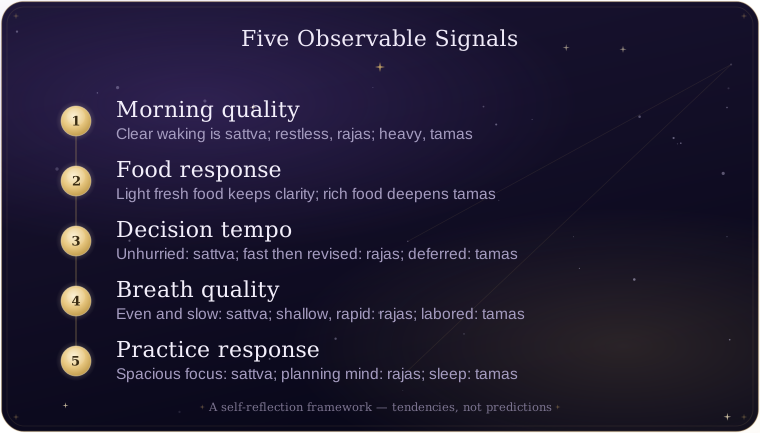
The most reliable way to observe sattva rajas tamas directly is through the first hour after waking, before external demands have imposed a guna profile. Five observable signals:
- Morning quality. Waking alert and clear with no particular urgency points to sattvic predominance. Waking restless with a mental task-list already running suggests rajas. Waking heavy and reluctant, wanting to return to sleep, suggests tamas.
- Food response. Fresh, lightly cooked, simply seasoned food tends to maintain sattvic clarity through the following two to three hours. Stimulant-heavy or spicy food amplifies rajasic activity. Heavy, rich, or overly processed food deepens tamas — which may or may not be appropriate, depending on whether rest is what the moment requires.
- Decision tempo. In a sattvic state, choices feel grounded and unhurried. In a rajasic state, choices come fast and are often revised the next day. In a tamasic state, choices get deferred — sometimes appropriately (the situation genuinely does not require urgency), sometimes not (the deferral is avoidance).
- Breath quality. Even, slow breathing without visible effort is traditionally associated with sattva. Shallow, high-chest, rapid breathing tends to accompany rajas. Slow but labored or irregular breathing tends to accompany tamas.
- Practice response. Meditation that feels spacious and returns to focus easily suggests sattvic conditions. Meditation where the mind generates plans throughout suggests rajas. Meditation where you fall asleep or cannot sustain any thread suggests tamas — and sometimes the correct response is to rest rather than resist it.
Common Misreadings
These misreadings of sattva rajas tamas each follow from the same root mistake — treating shifting proportions as fixed categories:
- "Tamas is ignorance and should be eliminated." Tamas governs rest, consolidation, and the deep sleep phase that makes sattvic clarity available the next morning. The body needs it to repair. What the tradition cautions against is tamas in excess at times requiring clarity or action — not the quality itself.
- "Sattva is the destination." The Bhagavad Gita addresses this directly: even sattva binds you if you become attached to the state of clarity. The framework points toward discernment about what each moment requires, not toward permanent residence in any one guna. Fixating on sattva as a goal is itself a form of rajasic attachment dressed in sattvic clothing.
- "I'm a tamasic person" or "You're very rajasic." The gunas describe moments and conditions, not personality types. Applying them as labels freezes a snapshot into an identity — exactly the misuse the Samkhya tradition was designed to prevent. Someone who identifies as tamasic has simply stopped observing.
- "More sattva means more spiritual progress." This conflates the conditions of a present moment with a measure of development. The framework carries no fixed hierarchy — each quality is essential, and each can be the most appropriate one to cultivate depending on what the situation actually calls for.
Sattva Rajas Tamas at a Glance
| Property | How It Works | Energy Center | How to Observe |
|---|---|---|---|
| Sattva | Reduces distortion in consciousness, allowing clear perception and discernment | Conscious mind and clarity | Alert, calm waking; patient decisions; spacious meditation |
| Rajas | Generates kinetic energy in body and mind, activating desire and movement | Will and motivation | Restlessness, rapid thinking, goal-focus, stimulant craving |
| Tamas | Slows activity toward consolidation or rest, grounding the system | Body and inertia | Heaviness, sleep pull, resistance to change, preference for comfort |
Common Questions About Sattva Rajas Tamas
What is the fastest way to shift from tamas to a more sattvic state?
Movement and breath change guna proportions faster than intention alone. A short walk, pranayama practice, or lighter food at the next meal tends to reduce tamasic heaviness within an hour or two. Small inputs to breath and diet are where most of the actual influence lies — major lifestyle overhauls are rarely the entry point.
How do sattva rajas tamas relate to daily routine?
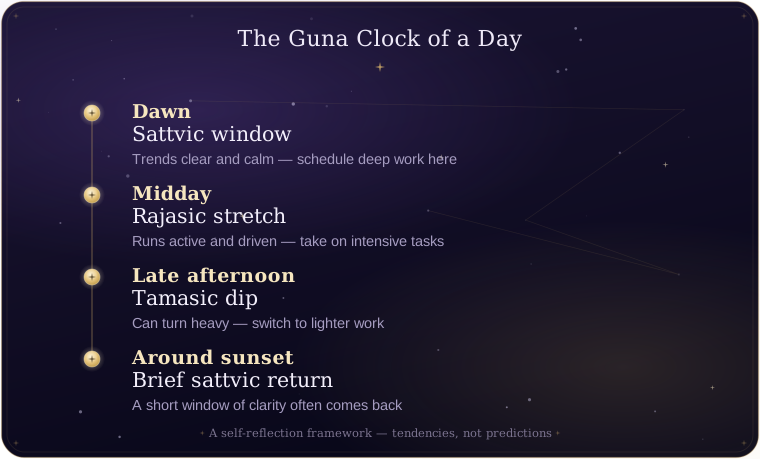
Ayurvedic dinacharya is built around the observation that different times of day carry natural guna profiles — dawn trends sattvic, midday runs rajasic, late afternoon can turn tamasic, and a brief sattvic window often returns around sunset. Aligning activities to these natural windows — deep work at dawn, intensive tasks at midday, lighter work in late afternoon — is how the framework becomes a scheduling tool rather than an identity label.
Can all three gunas be present simultaneously?
Yes — this is the system's core claim. All three are always present in different proportions. A focused work sprint might show high rajas in motivation, enough tamas to provide physical steadiness, and sufficient sattva to sustain concentration. Identifying a single dominant guna is useful shorthand; reading the full proportion is the more accurate diagnostic.
Do the gunas apply to emotions, or only to physical states?
Both. The Samkhya framework treats mind and body as continuous expressions of the same natural world, so guna proportions apply across physical sensation, emotional tone, thought patterns, and perceptual clarity. Anger typically carries high rajas; grief often carries tamasic weight; equanimity reflects sattvic conditions in the mind. The same person can move through all three emotional registers in a single afternoon.
Reflection Prompts
- Think of a morning this week when your mind felt unusually clear — what did you eat the night before, how long did you sleep, and what time did you wake?
- Recall a decision you made quickly and then revised within two days — what quality was most active in the moment you first chose?
- Notice the next time you resist starting a task — is the resistance more consistent with genuine rest (tamas serving recovery) or avoidance of something uncomfortable?
Related Reading
- Ayurvedic dosha overview — how doshas and gunas interact in Ayurvedic practice, and where the two systems should be kept distinct to preserve each one's precision
- sattvic diet and food guidelines — practical detail on how food choices shift guna proportions, expanding the observational signals covered in How to Read
- pranayama and breathwork techniques — breath practices most used to shift guna states, particularly from tamas toward sattvic clarity or from excess rajas toward calm
- Guṇa (Wikipedia)
Take Action
Generate your free birth chart to explore sattva rajas tamas. Your chart can point to planetary placements traditionally linked to each guna's qualities — Mars and dynamic aspects often correspond to rajasic drive, Saturn and fixed configurations to tamasic stability or resistance, benefic placements in prominent positions to sattvic clarity. Seeing which conditions are emphasized at your birth gives you a starting point for understanding why certain guna proportions feel native — and which adjustments tend to take more deliberate practice to sustain.
Sources
- Samkhya philosophy — the classical Indian school of thought in which the three-guna framework originates; describes prakriti (nature) as constituted by sattva, rajas, and tamas in all combinations and proportions
- Bhagavad Gita — the classical Sanskrit text whose fourteenth, seventeenth, and eighteenth chapters provide the most extended treatment of the three gunas as shifting proportions rather than fixed moral categories