
What Is the Second Saturn Return?
The second Saturn return is Saturn's second full return to its natal position, arriving near ages 58 to 60.
- Marks the close of a second complete Saturn cycle, following the first return near age 29
- Lands on your specific natal Saturn, so its sign and house shape the reading
- Reads as a threshold for consolidation and honest review, not a fixed fate
According to NASA, Saturn takes about 29.5 years to orbit the Sun, which is why this transit recurs near ages 29 and 59. Where the first return tested the life you assembled in your twenties, this passage reviews the structures built across a full working life — the career, the partnerships, and the routines that have carried you for decades. Astrologers treat it as an interpretive window rather than a scheduled event, and reading it well starts with your pillar guide to reading a birth chart, since the return activates your natal Saturn by exact degree.
Why It Matters for Self-Awareness
The second Saturn return matters because it lands at a life stage where the underlying question shifts from building to keeping. By your late fifties you carry decades of choices — a career, relationships, a home, a set of habits — and this passage tends to bring those structures forward for honest review.
Where the value shows up
In my work applying pattern-recognition frameworks to chart structure, the charts that read most clearly at this age belong to people who can name what they built on purpose versus what they inherited or drifted into. That single distinction is where the self-awareness payoff sits. You might notice which commitments still fit your life and which you keep only out of momentum, and you may start to separate the roles you chose from the ones that chose you. A person who spent thirty years in a family business, for instance, may use this window to ask whether staying is a genuine choice or simply the path of least resistance — and either answer can bring relief once it is named.
What the tradition points to
The tradition gives that review a shared vocabulary. Robert Hand describes Saturn transits as periods when whatever was built carelessly asks to be rebuilt and whatever was avoided asks to be faced. Liz Greene frames the return itself as a threshold rather than an event — a point where you test whether the life you have is genuinely yours or a long response to other people's expectations. Reading your natal Saturn through a guide to Saturn's placement by house in a birth chart gives the review a specific focus, so it becomes a clear look at one or two life areas instead of a vague sense of stocktaking. Seen this way, the return is less a warning than an invitation to audit your own life on your own terms.
Second Saturn Return vs Uranus Opposition
The second Saturn return often gets folded into a broad idea of a late-life reckoning, but it is not the same transit as the Uranus opposition, the Chiron return, or the cultural shorthand people call a midlife crisis. Keeping these separate is what keeps the reading scoped, and it is the single most useful thing you can do with the topic.
Here is how each one works and where the trade-off falls:
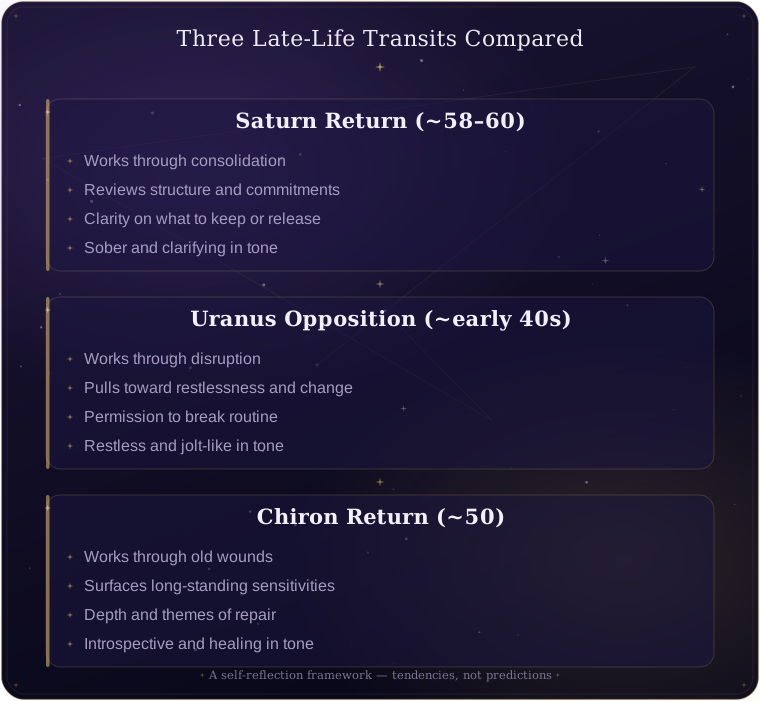
- Saturn's return works through consolidation. It reviews structure, responsibility, and whether your commitments hold up. Read a period through the Saturn lens and you gain clarity about what to keep or release, but you lose the drama of sudden reinvention — Saturn rarely blows things up.
- The Uranus opposition works through disruption. Near the early forties, transiting Uranus opposes its natal spot and pulls toward restlessness and change. Choose the Uranus reading and you get permission to break routine, but you sacrifice the steadying, take-stock quality that belongs to Saturn.
- The Chiron return works through old wounds. Around age fifty, Chiron returns and surfaces long-standing sensitivities. Read a moment as Chiron and you gain depth and themes of repair, but you lose the practical, structural angle that the return of Saturn supplies.
The midlife-crisis label is the trickiest of the three because it is cultural rather than astrological, so it quietly absorbs all the others. When someone at 59 pictures a convertible and a sudden exit, they are borrowing the Uranus image and pinning it to the wrong decade. Dane Rudhyar's cycle-based approach helps untangle this: instead of asking what a single transit is doing to you this month, you ask where you stand in each planet's longer arc, which keeps Saturn's slow consolidation distinct from Uranus's faster jolt. A practical example makes the line clear — someone at 59 weighing whether to retire is usually inside the return of Saturn, thinking about structure and timing, while the same person at 42 quitting on impulse to travel is closer to the Uranus opposition.
How to Read the Second Saturn Return in Your Timing
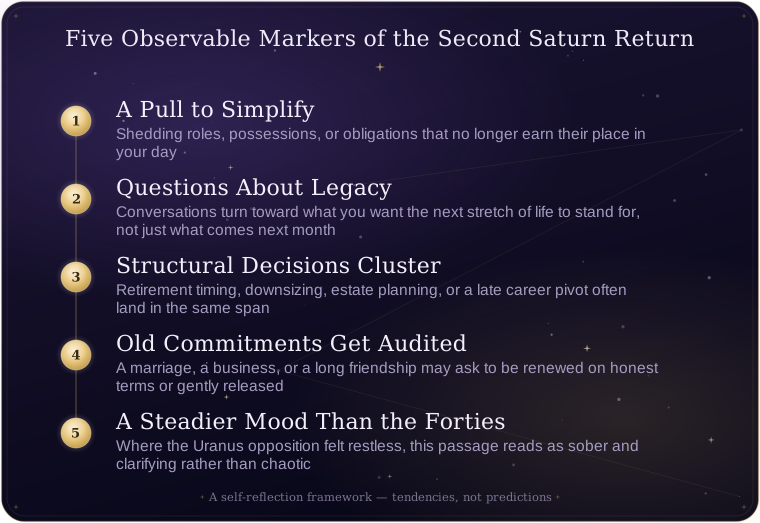
You cannot feel a transit as a single date, but the second Saturn return tends to leave observable markers across the two-to-three-year window it covers. None of these signals proves the transit on its own; together they point to it. Watch for these:
- A pull to simplify. You may find yourself shedding roles, possessions, or obligations that no longer earn their place in your day.
- Questions about legacy. Conversations turn toward what you want the next stretch of life to stand for, not just what comes next month.
- Structural decisions cluster. Retirement timing, downsizing, estate planning, or a late career pivot often land in the same span.
- Old commitments get audited. A marriage, a business, or a long friendship may ask to be renewed on honest terms or gently released.
- A steadier mood than the forties. Where the Uranus opposition felt restless, this passage usually reads as sober and clarifying rather than chaotic.
To read these well, anchor them to your natal Saturn rather than to the calendar alone. The house it sits in shows which arena tends to carry the most weight — the tenth house points to career and public standing, the fourth to home and family, the seventh to a defining partnership. When several of the signals above cluster in that one area, you are almost certainly inside the window.
Common Misreadings
Because the second Saturn return sits near so many other late-life themes, broad write-ups tend to blur it into one big reckoning. A few misreadings come up again and again:
- Misread: it is a second midlife crisis. In reality, that restless feeling belongs mostly to the Uranus opposition in the forties; by the late fifties the return reads as consolidation, not upheaval.
- Misread: it guarantees a dramatic life change. More often it marks a review that may confirm your direction as easily as it redirects it.
- Misread: it is only about loss and endings. It can close chapters, but many people describe it as earned authority and a clearer sense of what matters most.
- Misread: the exact birthday is the whole event. The transit spans roughly two to three years around ages 58 to 60, not a single day.
The thread running through each of these is scope. When coverage treats every late-life shift as the same phenomenon, the specific meaning of the return gets lost. Holding it to what it actually describes — the testing of built structures against reality — is what keeps a reading useful rather than a catch-all for growing older.
Second Saturn Return at a Glance
| Property | How It Works | Chart Anchor | How to Observe |
|---|---|---|---|
| Timing | Transiting Saturn returns to natal Saturn | Natal Saturn's exact degree | Recurs near ages 58 to 60 |
| Duration | Slow transit with a wide orb | Natal Saturn's sign and house | Themes build over two to three years |
| Core theme | Consolidation and honest review | The house of natal Saturn shows the life area | Decisions about legacy, work, and commitments |
| Register | Sobering and clarifying, not chaotic | Aspects to natal Saturn add nuance | Steadier than the forties Uranus phase |
Common Questions About the Second Saturn Return
At what age does the second Saturn return happen?
It arrives near ages 58 to 60, when transiting Saturn completes its second orbit back to your natal Saturn. The exact timing depends on your birth chart, since Saturn's speed shifts slightly across the zodiac.
Is the second return harder than the first?
Not necessarily harder, just different in focus. The first return builds a first adult identity, while the second reviews decades of choices and asks what still fits.
How long does this transit last?
Its core window runs roughly two to three years around the exact return. The themes tend to build gradually rather than switch on at a single moment.
Does everyone experience it the same way?
No. The house and sign of your natal Saturn shape which life area comes under review, so two people can meet this passage very differently.
Reflection Prompts
- Think of one commitment you kept this year mainly out of habit — does it still earn its place in your life?
- Recall a structure you built in your thirties; which parts feel genuinely yours now, and which feel inherited?
- Name one thing you want the next decade to stand for, and one you are ready to set down.
This is not a clinical interpretation or mental health advice.
Related Reading
- Saturn square aspect explainer — how Saturn's earlier squares set up the tension the return later resolves.
- meaning of the tenth house in a birth chart — the career and legacy themes that often surface during this stage.
- Saturn return (Wikipedia) — background on the transit across both the first and second returns.
Take Action
Run your birth details through the Explore Your Saturn Return tool to find the exact window when Saturn meets your natal placement. It returns your personal return dates along with the sign and house it activates, so the review lands on real ground instead of a rough age range. Knowing when this threshold opens gives you time to decide what to keep, on purpose, before the moment arrives.
Sources
- Liz Greene — framed the Saturn return as a psychological threshold rather than a single event
- Robert Hand — mapped Saturn transits as periods of maturation and structural review
- Dane Rudhyar — pioneered the cycle-based, person-centered reading of planetary returns