
What is shadow work journal prompts?
Shadow work journal prompts are structured written questions designed to surface repressed psychological material — the attitudes, impulses, and memories a person has disowned or suppressed during development.
- Draw on Carl Jung's shadow complex: the organized cluster of qualities pushed out of conscious identity because they conflicted with how a person needed to be seen
- Distinguish between surface emotional activation and the source behavioral patterns beneath it
- Function as a diagnostic framework rather than a list of open-ended feelings exercises
The approach is grounded in the observation that the shadow complex does not dissolve through emotional expression alone. It shifts through recognition of what the defended material is protecting. A pillar page on Jungian psychology and self-reflection practices provides broader context for how this framework fits into integrated inner development work.
Why It Matters for Self-Awareness
Most people searching for journaling tools are already caught in a recurring loop — the same argument returning, the same self-critical voice, the same pull toward withdrawal or overperformance. Shadow work journal prompts matter because generic question lists activate that loop without giving it structural direction.
The difference is in what the prompt targets. A quantity-driven list asks "how does X make you feel?" — which rehearses the emotion but does not anchor it to a source. A diagnostic prompt asks where the feeling has appeared before, what behavior follows it, and whose face it originally wore. That sequence moves from symptom to pattern to origin, which is where behavioral change happens.
Marie-Louise von Franz, who extended Jung's shadow work into detailed case studies of projection, noted that the shadow complex rarely announces itself directly — it speaks through the emotional charge in reactions to other people. That observation is the practical basis for diagnostic prompting: the charge points to the disowned material, and the prompt gives it a structured way in. Without that map, writers can fill notebooks without touching the structure producing the distress.
shadow work journal prompts vs Adjacent Concepts: How It Works + Trade-offs
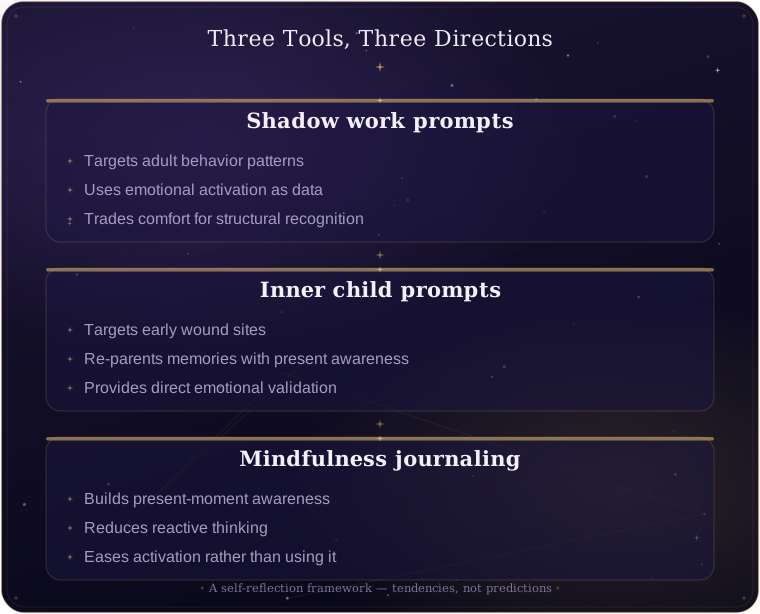
Three tools appear regularly in the same searches: shadow work journal prompts, inner child journal prompts, and general mindfulness journaling. They each work differently and serve different goals.
- These prompts vs. inner child journal prompts. Inner child work targets specific early experiences — the wound site — and asks the writer to re-parent those memories with present-day awareness. Shadow work targets the adult behavior produced by that wound: the defensive pattern, the projection, the overcorrection. To get to the behavioral root, shadow work sacrifices the direct emotional validation that inner child work provides.
- These prompts vs. mindfulness journaling. Mindfulness builds present-moment awareness and reduces reactive thinking. Shadow work deliberately increases friction with the defended material — it is designed to produce discomfort, because the shadow complex forms precisely to avoid that discomfort. To get below the surface, shadow work sacrifices the calm that mindfulness delivers.
The trade-off is directional: mindfulness and inner child work ease activation; shadow work uses activation as data to locate source patterns. Which approach fits depends on whether the immediate goal is relief or structural recognition — these tools answer different questions.
How to Read shadow work journal prompts in Yourself
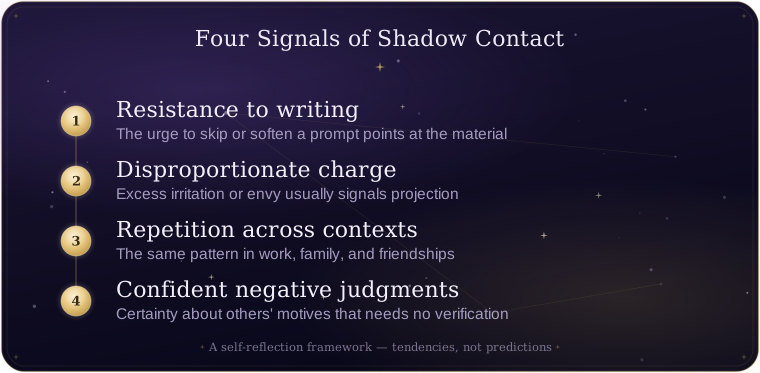
The prompts produce movement when applied to concrete, recent moments rather than abstract tendencies. Four observable signals indicate a prompt is touching shadow material rather than surface reflection:
- Resistance to writing. A strong impulse to skip a prompt or soften its wording points toward the material the shadow complex is organized around.
- Disproportionate charge. When a reaction to another person feels excessive — irritation at a minor habit, envy at an achievement — that intensity usually signals projection rather than a situational response.
- Repetition across unrelated contexts. The same emotional pattern appearing in work, family, and friendships points to a source pattern, not a contextual reaction.
- Confident negative judgments. Shadow material often surfaces as certainty about another person's motives that feels entirely factual and requires no verification.
Common Misreadings
Four misreadings consistently lead writers away from productive shadow work and back into surface cycling.
- More prompts equals deeper work. Volume lists encourage quantity over precision. One well-aimed prompt worked repeatedly across different memories produces more structural movement than cycling through dozens of general questions without slowing down. The length of a list is not a proxy for the depth of the inquiry.
- Writing about emotions is enough. Naming a feeling does not move shadow material. What moves it is tracing the feeling back to a behavioral pattern — identifying when it appears and what it protects, not just that it appears. The goal is structural recognition, not emotional release alone.
- Shadow work is only for people who have experienced serious trauma. The shadow complex forms in ordinary development. Compulsive agreeableness, difficulty receiving criticism, and over-identification with competence are as common shadow presentations as suppressed anger. These patterns emerge from the ordinary need to belong and to be approved of.
- Completing a prompt sequence closes the pattern. Shadow integration is not sequential. The same pattern resurfaces in new form after significant life changes — a new relationship, a career shift, a loss. The prompts function as a recurring diagnostic tool, not a course to complete once and leave behind.
Shadow Work Prompts at a Glance
| Property | How It Works | Structural Focus | How to Observe |
|---|---|---|---|
| Projection mapping | Surfaces disowned qualities through the emotional charge in reactions to others | Shadow complex (Jung) | Journal entries where judgment of others carries unusual intensity or certainty |
| Behavioral incongruence | Tracks the gap between stated values and actual behavior under pressure | Source pattern vs. symptom | Recurring choices that contradict self-description across different situations |
| Source-moment tracing | Locates the first occurrence of a defensive pattern in memory | Childhood-to-adult continuity | Earliest memory carrying the same emotional quality as a current recurring reaction |
| Integration writing | Converts shadow material into acknowledged, usable personality traits | Ego–shadow relationship | Reduced charge when encountering the original trigger after working the prompt |
Questions About Shadow Work Journaling
What makes a shadow work prompt different from a clinical journaling question?
Shadow work journal prompts are structured self-reflection tools used in personal journaling practice. They are not clinical instruments and do not replace professional mental health support. This is not a clinical interpretation or mental health advice.
How many prompts should someone work with at one time?
One prompt worked deeply across three to five recent memories tends to produce more movement than moving quickly through a large set. Specificity matters more than volume — the goal is tracing a behavioral pattern, not cataloguing emotions.
Can this type of journaling increase distress?
Writing into shadow material can surface activation — discomfort, irritability, or temporary emotional intensity — because the prompts are designed to contact defended material. If writing consistently increases distress without producing any sense of recognition or relief, working with a licensed mental health professional alongside journaling is worth considering.
What is the difference between shadow work and dark side journaling?
Dark side journaling is a broader category that includes writing about difficult thoughts, regrets, and impulses without a specific framework. Shadow work within that category is more structured: it uses prompts to track projection patterns and behavioral incongruence rather than relying on free-form expression of difficult material.
Reflection Prompts
- Think of a person who irritated you recently — what specific quality triggered the strongest charge, and when did you last notice that quality in yourself?
- Recall a moment last month when your reaction exceeded the situation — what pattern does that intensity map onto across other relationships or time periods in your life?
- Identify a value you claim to hold and a recent decision that contradicted it — what did the gap between them protect you from?
Related Reading
- pillar page on Jungian shadow complex and psychological integration — foundational framework that the prompting approach draws on
- inner child journal prompts guide — adjacent self-reflection approach with a different structural emphasis
- dark side journaling overview — broader context for integrative writing practices
Take Action
Generate your free birth chart to explore shadow work journal prompts alongside your astrological structure. Your chart reveals the planetary placements most likely to shape your shadow complex — the house positions and aspect patterns connected to defended psychological material. That structural map gives your journaling practice a specific anchor, so prompts land on identifiable patterns rather than abstract tendencies.
Sources
- Carl Jung — developed the shadow complex as the repository of disowned psychological material; foundational to the diagnostic prompting approach used in shadow work
- Marie-Louise von Franz — extended Jungian shadow theory through case studies of projection and integration processes across cultural contexts