
What Is the Sinner–Zverev Wimbledon Final Chart?
The Sinner–Zverev Wimbledon Final Chart is a symbolic, side-by-side reading of the 2026 men's final that places each player's birth chart against the sky at the match moment. It does not call a winner. Instead, Sinner vs Zverev Wimbledon Final astrology treats the meeting as a comparative event chart for temperament and momentum, not the scoreline.
- Maps each player's Sun, Moon, and Mars signature against the day's transits
- Reads the psychological tone and symbolic tension between two natal styles
- Reflects on mood and narrative, never on grass-court skill or the final result
Built on the same fundamentals as any pillar guide to reading a birth chart, the framework simply applies them to two athletes and one high-pressure afternoon on Centre Court, turning familiar chart factors into a reflective lens on the occasion.
Why It Matters for Self-Awareness
Understanding Sinner vs Zverev Wimbledon Final astrology matters because it gives fans a language for something they already feel while watching — the contrast between two competitors' inner weather. The point is reflective rather than predictive, and the value tends to show up in a few concrete ways:
- It names temperament you already sense. You may notice one player looks ice-cold under pressure while the other runs hotter; the chart gives that gut read a vocabulary of Sun, Moon, and Mars styles instead of vague impressions.
- It separates mood from outcome. Reading the day's atmosphere as tense or buoyant is a different act from betting on a result, and keeping those apart stops expectation from hardening into certainty.
- It turns fandom into self-reflection. Watching how you project onto a "calm" or "hot-headed" player often reveals as much about your own relationship to pressure as it does about either athlete.
This person-centered way of reading a moment descends from the tradition Dane Rudhyar established, where a chart maps psychological tone rather than fixed fate. According to the Pew Research Center, about 29% of U.S. adults said they believed in astrology, so for a sizeable slice of the audience this symbolic layer already sits comfortably beside the stats and the odds.
Consider a fan who always sides with the steadier competitor and feels rattled when their pick shows nerves. Reading the two temperament styles side by side can reframe that reaction: the discomfort often points back to how the viewer themselves handles a wobble under pressure. Used this way, the final becomes a mirror for timing, identity, and emotional regulation — the same themes people bring to any personal chart, just staged on the biggest court in tennis.
Symbolic Event Chart vs a Match Prediction: Where People Mix Them Up
The most common mix-up is treating Sinner vs Zverev Wimbledon Final astrology as another forecast sitting next to the betting odds. The two look alike because both start from the same Sunday match, but they do opposite jobs, and seeing the trade-off makes each one more useful on its own terms.
A match prediction works by weighing form, head-to-head record, surface, and fitness to output a probable winner. An event chart works differently: it reads the natal signatures of both players against the match-moment sky to describe temperament, momentum, and emotional tone — the story's mood, not its ending. To get a confident pick, a prediction sacrifices nuance about how each player might feel on court; to get that psychological texture, the chart sacrifices any claim on the scoreline. You trade certainty for reflection, or reflection for certainty — you cannot have both from the same tool.
That distinction is easy to lose because sports coverage and symbolic readings often share the same headlines, dates, and player names. It also separates the event chart from a two-person compatibility read. Comparing how two players' planets interact is closer to the logic behind guide to the square aspect between planets, where tension between placements is symbolic friction rather than a verdict. In the lineage of event-chart astrology that Robert Hand helped bring to modern readers, the chart correlates with narrative tone and never with grass-court skill or the final result.
How to Read the Sinner–Zverev Final in the Chart
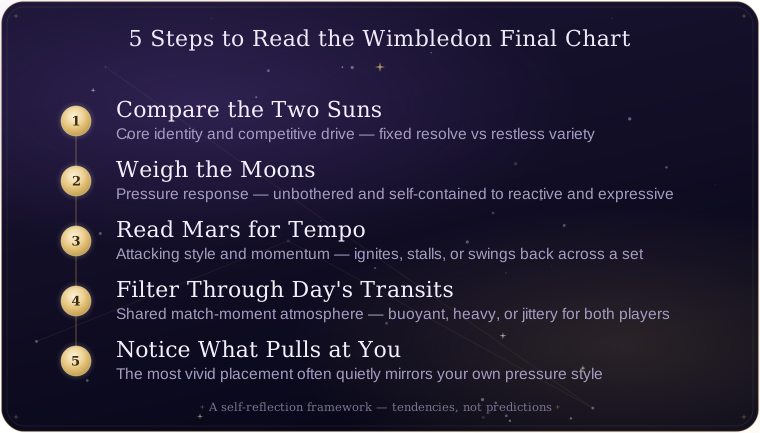
Reading Sinner vs Zverev Wimbledon Final astrology is about spotting a handful of observable signals rather than crunching every degree. The idea is to watch the final with more texture, so start with the big three placements and finish with the shared sky:
- Compare the two Suns. Sinner's 16 August birthday places his Sun in Leo, while Zverev's 20 April birthday sits on the Aries–Taurus cusp; the core identity and competitive "why" of each player — steady and fixed, or restless and adaptable — sets the baseline contrast to watch for.
- Weigh the Moons for pressure response. The Moon hints at how each handles a tight tiebreak emotionally, running from unbothered and self-contained to reactive and expressive.
- Read Mars for tempo and aggression. Mars describes attacking style and how momentum tends to ignite, stall, or swing back across a set.
- Filter it all through the day's transits. The match-moment sky colors the shared atmosphere — buoyant, heavy, or jittery — that both players step into together.
- Notice which story pulls at you. The placement you find most vivid is often the one quietly mirroring your own pressure style.
Each of these is a symbolic cue, not a scoreline signal. Treat the exercise as a way to feel the shape of the occasion, and let the actual result stay exactly where it belongs — with the tennis.
Common Misreadings
Because the topic sits so close to previews and picks, a few misreadings surface again and again. Correcting them keeps Sinner vs Zverev Wimbledon Final astrology honest:
- Misreading: the chart predicts the winner. In reality it describes temperament and mood only. The trophy comes down to skill, form, and conditioning on grass, which the chart never claims to measure.
- Misreading: a "stronger" chart means a stronger player. Charts carry no ranking. A dramatic placement reads as intensity of style, not superiority on court, and can just as easily describe volatility.
- Misreading: it replaces the preview and odds. It sits alongside them as a reflective layer. The chart answers a different question — about atmosphere and psychological tone — rather than about probability.
- Misreading: the day's transits favor one player personally. The match-moment sky sets a shared mood both walk into. It is a common atmosphere, not a private advantage handed to either finalist.
The Sinner–Zverev Wimbledon Final Chart at a Glance
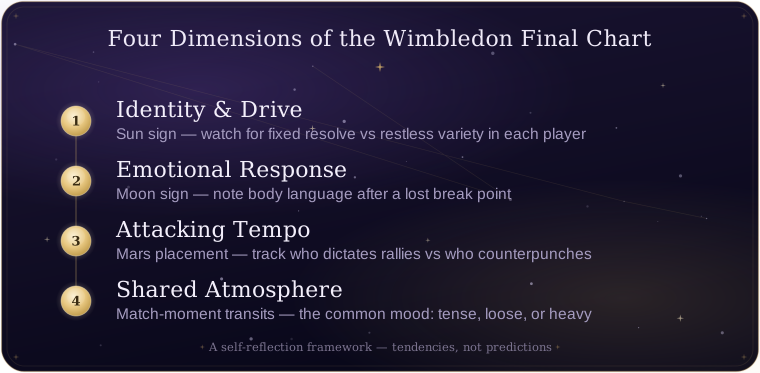
| Property | How It Works | Energy Center | How to Observe |
|---|---|---|---|
| Identity & drive | Contrasts each player's core competitive "why" | Sun sign of each player | Watch who plays with fixed resolve versus restless variety |
| Emotional response | Maps how each handles pressure moments | Moon sign of each player | Note body language after a lost break point |
| Attacking tempo | Describes aggression and momentum style | Mars placement of each player | Track who dictates rallies versus who counterpunches |
| Shared atmosphere | Colors the mood both step into | Match-moment transits | Feel the tone of the occasion — tense, loose, or heavy |
Questions People Ask About the Sinner–Zverev Wimbledon Final Chart
Can the chart tell me who wins the 2026 Wimbledon final?
No — it reads temperament, momentum, and mood, not the result. The winner depends on grass-court skill, form, and fitness, which no chart claims to measure.
Do I need both players' exact birth times?
Exact times sharpen the reading of the Moon and rising sign, but a Sun-Moon-Mars comparison still works without them. Many public sports charts rely on birth dates alone and simply note the uncertainty.
Is this the same as a betting preview?
No, and that's the point. A preview estimates probability, while this event chart offers a reflective, symbolic layer about psychological tone that sits beside the odds without competing with them.
Which placements matter most in an event chart like this?
The Sun, Moon, and Mars of each player carry the most weight for temperament and tempo, all filtered through the day's transits. Rising signs and finer aspects add detail once accurate birth times are confirmed.
Reflection Prompts
- Recall a recent high-pressure moment of your own — did you go ice-calm like one player or fire up like the other?
- Think of a match where you assumed a "hot-headed" player would crack. What did that assumption reveal about you?
- Notice which player's temperament you root for. What does that pull say about your own relationship to competition?
Related Reading
- meaning of the rising sign — the rising sign refines how each player's on-court persona actually comes across.
- birth chart profile of Serena Williams — a published athlete chart that shows how natal placements map onto a competitive career.
- Electional astrology (Wikipedia) — outside context on the older tradition of charting chosen or notable moments.
Take Action
Generate your free birth chart to explore Sinner vs Zverev Wimbledon Final astrology, then set your own Sun, Moon, and Mars beside each finalist's. You'll get a clear map of your temperament and pressure style — and, more than any scoreline, a sharper sense of how you meet your own high-stakes moments. Generate your free birth chart to begin the comparison.
Sources
- Dane Rudhyar — pioneered the psychological, person-centered reading of astrological charts and cycles
- Robert Hand — helped bring event-chart and horary astrology into modern practice