
What is swati nakshatra?
Swati nakshatra is the fifteenth lunar mansion in Vedic astrology, spanning 6°40'–20°00' Libra with Rahu as planetary ruler and Vayu, the wind deity, as its presiding force. It occupies Libra entirely — a sign Venus governs — giving this lunar station an orientation toward exchange, aesthetic sensitivity, and relational movement rather than fixed accumulation. That pairing produces a Rahu-Venus circulation pattern: resources and relationships flow through rather than pool.
- Positioned entirely within Libra, orienting it toward social exchange and aesthetic values over retention
- Governed by Rahu, the shadow node tied to amplified desire cycles and boundary-crossing momentum
- Symbolized by a coral bead or a blade of grass swaying in the wind — adaptive motion is the defining character, not fixed form
This nakshatra sits within the broader framework covered by pillar page on all 27 Vedic nakshatras, which maps each lunar station against its ruling planet, presiding deity, and core behavioral themes.
Why It Matters for Self-Awareness
Understanding swati nakshatra matters most at the point where the standard narrative stops being useful. Most available content covers the obvious territory — independence, social grace, diplomatic sensitivity — and gets the characteristics right. What gets skipped is the part people actually search for: why money keeps moving.
Many people with prominent Swati placements describe a recurring experience across years: income arrives, redistributes quickly, and doesn't settle into a reserve the way conventional financial planning assumes it should. The redistribution often goes somewhere meaningful — a collaborative project, a relational investment, a quality-of-life expense tied to aesthetic values — but the destination doesn't stop the pattern from reading like failure when the reserve never forms. When that cycle repeats, the instinctive self-reading is personal failure — poor discipline, missed decisions, a fundamental gap that others seem to have sorted out. The traditional Vedic frame runs differently. Rahu co-ruling a Venus-sign station creates circulating energy rather than building energy. The pattern isn't dysfunction; it's the signature of a placement built for exchange rather than retention.
That shift — from "I keep losing money" to "my wealth runs on a circulation rhythm" — is where self-awareness becomes directly usable. It changes the question from "what's wrong with me?" to "what structures actually work with this pattern?" — a question with practical answers.
swati nakshatra vs Adjacent Concepts: How It Works + Trade-offs
swati nakshatra operates differently from other placements that share some of its surface traits, and those differences carry real trade-offs. Three comparisons make the distinctions concrete.
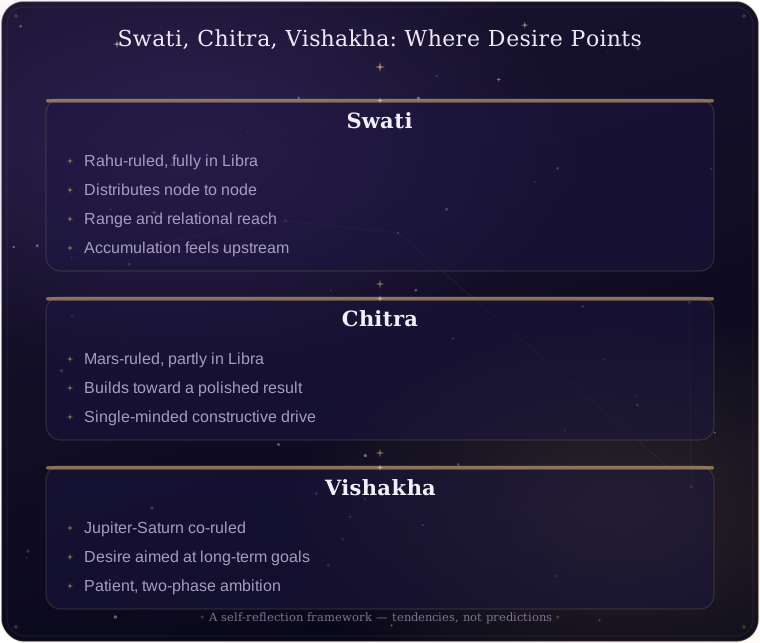
- Swati vs. Chitra nakshatra. Chitra (Mars-ruled, also partially in Libra) channels energy toward building — creative ambition aimed at a polished, finished result. Swati channels energy toward distribution, moving resources and connections from one node to another rather than consolidating them at a center. To get Swati's cross-network social fluency and relational range, you give up Chitra's single-minded constructive drive. The quality that makes circulation natural also makes sustained accumulation projects feel like working against the current.
- Swati vs. Taurus (Venus's fixed earth expression). Taurus operates from what Venus holds onto. Swati operates from what Venus passes along. The Rahu co-rulership amplifies desire without the fixed-earth containment that allows a reserve to form — each desire cycle peaks, redirects resources outward, and resets before the accumulation takes hold. To get Rahu's momentum and Libra's relational reach, you sacrifice the Taurean capacity to hold still long enough to build a cushion. That trade-off isn't a failure pattern — it's a structural difference between fixed-sign retention and moveable-nakshatra circulation.
- Swati vs. Vishakha nakshatra. Vishakha (Jupiter-Saturn co-ruled, spanning Libra and Scorpio) directs desire toward defined long-term goals with a patient, two-phase ambition structure. Swati's Rahu rulership amplifies desire in cycles without the Jupiter principle grounding them toward a single sustained horizon. To get Swati's flexibility and broad relational reach, you give up Vishakha's pointed forward movement toward a defined target. People with both placements prominent often describe that tension directly: range on one side, directed drive on the other.
A deeper reading of how Rahu's positioning shapes this flow pattern is at guide to Rahu's influence in Venus-ruled signs.
How to Read swati nakshatra in Yourself
Five observable patterns tend to surface when this placement is prominent in a natal chart. These are concrete signals to look for in real situations, not abstract tendencies:
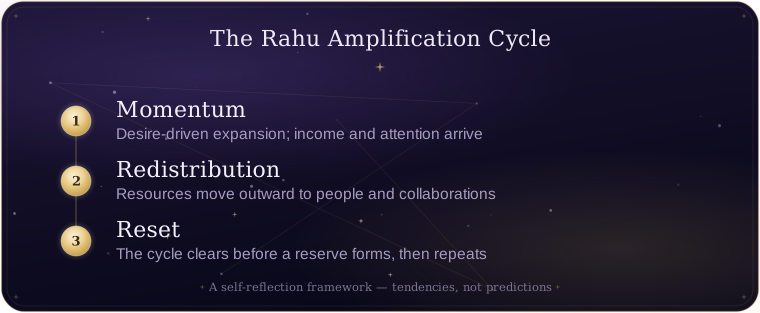
- Money circulates quickly. Income arrives and redistributes — to people, collaborations, or relational contexts — before a reserve forms. This follows Rahu's amplification cycle: momentum, redistribution, reset. It's not the same as overspending; the outflow often tracks genuine exchange or relational investment rather than carelessness.
- Strong collaborative output, thinner solo accumulation. Joint ventures, multi-party projects, and network-based work tend to come naturally. Long stretches of solitary focused effort aimed at building a stable reserve often feel draining in a way that partnership contexts don't, and output quality frequently reflects that gap.
- Aesthetic sensitivity as a decision filter. Choices — including financial ones — run through a sense of harmony or imbalance before logical analysis catches up. What "feels off" registers early and often drives decisions in ways that can look irrational from outside but land correctly in ways that accumulation-first logic misses.
- Rahu amplification cycles become visible over time. Periods of intense momentum and desire-driven expansion alternate with redistribution phases where resources move outward. Over a long enough timeline, the cycle becomes recognizable — and the redistribution phase stops reading as loss and starts reading as transition.
- Conventional retention structures produce friction. Fixed savings schedules, long-hold investments, and structured accumulation plans often show disruptions or irregular results — not from incompetence, but from a placement that runs on flow. Working with structures that accommodate circulation tends to reduce that friction rather than add to it.
Common Misreadings
Most available content on this placement either emphasizes social charisma and independence without addressing the financial pattern, or frames the circulation tendency as instability without explaining what's driving it. For swati nakshatra, the misreadings cluster around two assumptions — that circulation means disorder, and that adaptability means lack of discipline. The specific corrections:
- "Circulation means financial instability." The more accurate frame is a different rhythm, not a broken one. Wealth arriving and moving on before a reserve forms is a Rahu-cycle pattern, not evidence of poor financial instinct. The instability read usually comes from applying fixed-sign accumulation expectations to a placement built for flow.
- "Strong independence means emotional unavailability." This placement is associated with a genuine need for personal space and self-direction. That often gets conflated with an inability to connect or commit. Space-preservation and intimacy-avoidance are different orientations, and the first doesn't require the second.
- "Adaptability signals lack of direction." Because Vayu symbolism emphasizes movement without fixed form, this placement sometimes reads as scattered or unfocused. The closer read is range — capacity to function across multiple contexts, domains, and relationships that more fixed-sign placements find harder to access.
- "Rahu influence equals materialistic drive." Rahu amplifies desire, but in Libra its appetite is relational and aesthetic as much as financial. What many people with this placement describe as their actual motivation is harmony and connection, with money functioning as one channel for that rather than the end point.
Swati at a Glance
| Property | How It Works | Energy Center | How to Observe |
|---|---|---|---|
| Degree span | 6°40'–20°00' Libra — entirely in one Venus-ruled sign | Air element / Libra | Check natal Moon, Ascendant, or stellium for this degree range |
| Planetary ruler | Rahu creates amplified desire cycles; wealth and attention arrive, redistribute, and reset in recurring patterns | Rahu / shadow node | Recognizable momentum-then-redistribution rhythm visible over multi-year periods |
| Sign ruler | Venus orients the placement toward exchange, aesthetics, and relational values over retention | Libra (Venus-ruled) | Financial decisions often filter through relational and aesthetic sense before logical analysis |
| Presiding deity | Vayu (wind god) encodes adaptive directional force without fixed structure — movement is the base state | Directional / kinetic | Strong output in collaborative, multi-network contexts; lower output in extended solo-hold situations |
| Symbol | Coral bead or blade of grass in wind — motion as primary orientation, not deviation from it | Motion / exchange | Resources, relationships, and attention circulate rather than accumulate over time |
Common Questions About Swati
What rashi does Swati fall in?
Swati falls entirely within Tula rashi (Libra), spanning 6°40' to 20°00'. Whether the search uses an alternate spelling or romanization, both common variants refer to the same lunar station — fully within the sign Venus governs, which sets the relational and aesthetic orientation this placement carries.
What are the core characteristics of this nakshatra?
The core characteristics cluster around the Rahu-Venus dynamic: outward social fluency and aesthetic sensitivity paired with an inner pull toward independence and personal space. The financial circulation pattern — wealth moving through rather than pooling — is one of the most consistently described lived experiences among people with this placement prominent in their chart.
Is this nakshatra considered auspicious?
In the Parashara tradition, Swati is classified as a Chara (moveable) nakshatra, considered well-suited for activities involving exchange, negotiation, and movement — trade, travel, and new beginnings that require flexibility. Activities requiring fixed retention or long-hold stability are traditionally regarded as less aligned with its directional energy.
How does the Rahu co-rulership affect financial patterns?
Rahu amplifies desire in cycles rather than building steady accumulation. In Libra, those cycles take on a relational and aesthetic character — resources often move in response to connection, exchange, or a felt sense of imbalance that needs correcting. The practical result is that conventional accumulation timelines tend to get disrupted, not from absent income but from the redistribution dynamic built into the Rahu cycle itself.
Reflection Prompts
- Think of a time money arrived and moved on quickly — where did it go, and what exchange was it serving?
- Notice which contexts energize you: collaborative multi-party exchanges, or solo focused efforts aimed at building a stable reserve?
- Recall a moment something leaving — a resource, a project, a phase — turned out to be transition rather than permanent loss.
Related Reading
- overview of Rahu placements across the zodiac — examines how Rahu's co-ruling role shapes nakshatra expressions across different signs, including the Libra-Scorpio axis where Swati and Vishakha sit adjacent
- guide to Libra in the natal chart — covers Venus-ruled Libra's orientation toward exchange, partnership, and aesthetic value that anchors this nakshatra's home sign
- Svati (nakshatra) (Wikipedia)
Take Action
Generate your free birth chart to see where this nakshatra falls in your own placements. Once you can locate the Rahu-Venus axis in your chart, the circulation pattern stops reading like a problem and starts reading like a map — one that shows you what structures to work with rather than against.
Sources
- Parashara — foundational Vedic astrologer whose nakshatra classification system, including the Chara/moveable designation, underlies modern Jyotish interpretation