
What is the Midlife Uranus Transit?
The uranus opposition is the transit that occurs when Uranus reaches a point exactly 180 degrees from where it sat at your birth, an alignment that lands for most people somewhere between the ages of 38 and 44. Because Uranus takes roughly 84 years to complete one orbit, the halfway point of that journey is the moment the planet stands opposite its natal position. The chart records it as a precise geometric event with a definite start and end, which is what separates the data from the folklore. If you want the broader sky context, the transit_events cluster on 2026 planetary transits tracks how the slower planets move during this window.
- It is a once-in-a-lifetime transit, tied to Uranus's roughly 84-year orbit
- The exact opposition usually arrives between ages 40 and 42, with effects felt across a 38-to-44 band
- Astrologers read it as a demand for authenticity, not a fixed verdict about your life
This is an interpretive framework drawn from observed cycles, not a prediction of specific events or a clinical assessment.
Why It Matters for Self-Awareness
The arithmetic behind the uranus opposition is unusually clean for astrology, which is part of why the pattern is so consistent across charts. Uranus needs about 84 years to travel the full zodiac, so reaching the point directly across from its birth position takes roughly half that span. That places the exact opposition near ages 40 to 42 for most people, with a few years of variation on either side because the planet does not move at a perfectly even pace through its orbit. Knowing your own timing window is the first piece of self-awareness this transit offers, because it turns a vague dread of "midlife" into a defined, readable passage.
That variation matters when you read an individual chart. Uranus speeds up and slows down depending on where it sits relative to Earth, so two people born in different decades can hit the opposition at slightly different ages. The 38-to-44 range that gets quoted in most write-ups is the honest version of the timing: a band, not a birthday. Reading it as a window rather than a fixed date is the difference between using the chart as a map and treating it as a deadline.
the Midlife Uranus Transit vs Adjacent Concepts: How It Works + Trade-offs
It helps to set the uranus opposition against the story most people already carry about this age, because the two get confused constantly. The cultural midlife crisis is a narrative about decline, regret, and conspicuous purchases. The transit, read structurally, describes something different: a period when the parts of life that were set aside for the sake of fitting in start asking to be accounted for. The trade-off is that the astrological reading gives up the drama of a breakdown in exchange for a more workable process of integration.
The planetary structure explains the difference. In the natal chart, Uranus sits in a house and a sign that describe one pole of a polarity. When the transiting planet reaches the opposite point, it activates the complementary house across the chart, the life domain that has usually been underdeveloped. The work of the transit is to bring that suppressed side into the picture rather than to demolish what already exists. That is why practitioners describe it as polarity integration: not a verdict, but a rebalancing.
This is also where the honest reading of astrology lives. Liz Greene treated the chart as a language of symbol rather than a statistical claim about fate, and Robert Hand framed transits as patterns of meaning rather than a predictive machine that dictates outcomes. Read that way, this transit is a structured invitation to examine what authenticity costs, not a guarantee that any particular event will happen. The symbol carries weight; it does not carry certainty.
How to Read the Uranus Opposition in Your Chart
You can locate this transit yourself with a few honest steps, and the same process works whether you are reading your own chart or learning the technique on someone else's.
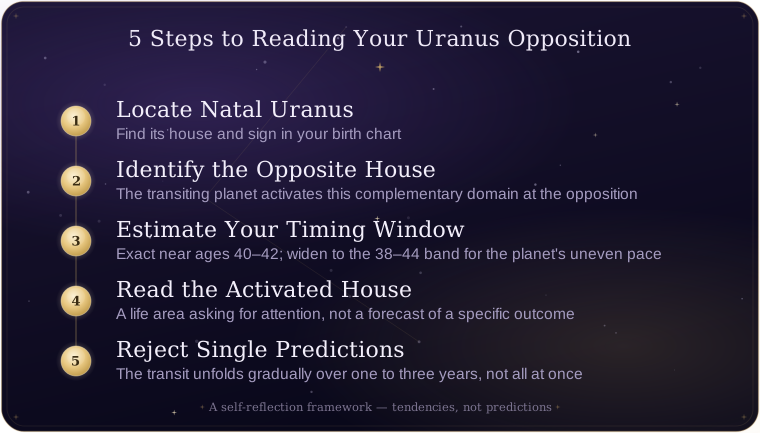
- Find the house and sign of your natal Uranus, which marks one end of the polarity the transit will eventually engage.
- Identify the opposite house across the chart, since that is the domain the transiting planet activates at the opposition.
- Estimate your timing as a window around ages 40 to 42, then widen it to the 38-to-44 band to account for the planet's uneven pace.
- Read the activated house as a life area asking for attention, not as a forecast of a specific outcome in that area.
- Treat any single dramatic prediction about the transit as a misreading of a process that unfolds gradually over one to three years.
Common Misreadings
- It is the same as a midlife crisis. The cultural script predicts collapse; the transit describes a structured pattern of integration that can be deliberate rather than destructive.
- The opposition guarantees a major life event. The chart marks a window of pressure, not a scheduled outcome; what you do inside that window is not written into the transit.
- It only affects people who feel stuck. The activated house asks for attention regardless of how settled life looks, because the process is about an underdeveloped polarity, not visible unhappiness.
- You read someone else's opposition differently from your own. The method is identical: locate natal Uranus, find the opposite house, read the window honestly, for anyone.
the Midlife Uranus Transit at a Glance
| Property | What the Chart Shows | Typical Timing | How to Read It |
|---|---|---|---|
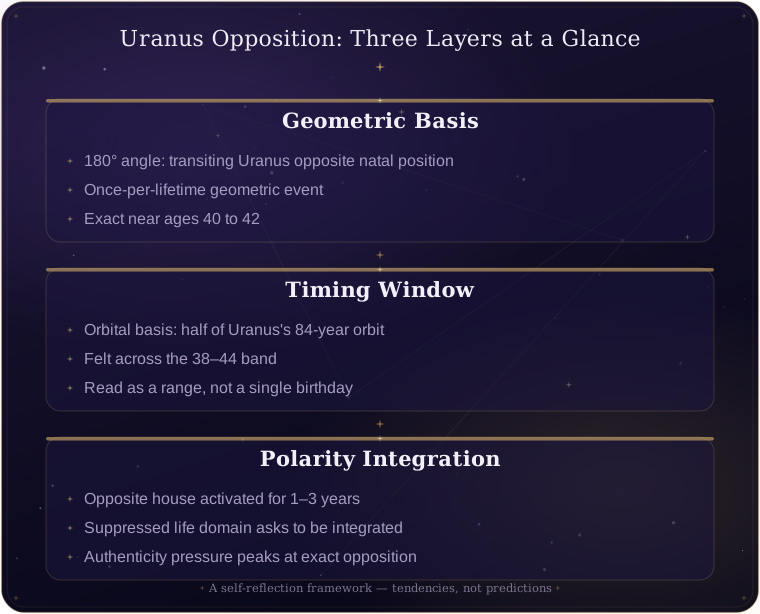
| The 180-degree angle | Transiting Uranus opposite its natal position | Exact near ages 40 to 42 | A once-per-life geometric event, not a recurring one |
| The orbital basis | Half of Uranus's roughly 84-year orbit | Felt across the 38-to-44 band | Timing is a window because the planet's pace varies |
| Polarity activation | The house opposite natal Uranus is engaged | One to three years around exact | A suppressed life domain asks to be integrated |
| The authenticity theme | Pressure on whatever was set aside to conform | Peaks at the exact opposition | A demand to revisit, not a verdict to accept |
Common Questions About the Uranus Opposition
What age does the uranus opposition happen?
For most people it lands between ages 38 and 44, with the exact opposition usually near 40 to 42. The spread exists because Uranus does not travel at a steady speed, so the precise age shifts slightly depending on the birth year. Reading it as a window rather than a single birthday is the accurate way to time it.
Is this transit the same as a midlife crisis?
No. The midlife crisis is a cultural narrative about decline and impulsive change. The transit, read through the chart, describes a structured period in which an underdeveloped side of life asks for attention. One predicts breakdown; the other describes a workable process of rebalancing the chart's polarities.
How long does the uranus opposition last?
The active period typically runs one to three years, with the strongest pressure clustered around the exact opposition. Because Uranus moves slowly and can station, the influence builds and recedes over a span rather than switching on for a single day, which is part of what makes it a mappable passage.
Does the transit decide what happens to me?
No. The chart marks a window and a theme, not an outcome. Practitioners read the opposition as a question about authenticity that you answer through your own choices, which is why it is described as an invitation to integrate rather than a sentence to serve.
Reflection Prompts
- Notice a part of yourself you set aside years ago to fit a role; what would it cost, and what would it free, to revisit it now?
- Think of a recent restlessness you were tempted to call a crisis; could it instead be a signal about something underdeveloped asking for attention?
- Consider where you read a timed transit as a deadline rather than a window; what changes when you give yourself the full range instead of a single date?
Related Reading
- Saturn in Aries 2026 transit guide — the other slow-planet restructuring that overlaps this window
Take Action
Generate your free birth chart to locate your natal Uranus and the house it sits in, so you can read your own window with the timing kept in honest perspective. You get a clear view of the polarity the transit will eventually engage and a reminder that a chart marks a pattern, not a fate, and, more usefully, a habit of asking what a life domain is asking for before reading any transit as a forecast.
Sources
- Liz Greene — grounded the reading of the chart as a language of symbol rather than a statistical claim about fate
- Robert Hand — known for treating transits as patterns of meaning rather than a predictive machine that dictates outcomes