
What a Vedic Birth Chart Calculator Gives You
A vedic birth chart calculator builds a sidereal map of where the planets stood at the moment you were born, calculated from your exact date, time, and place of birth — and it does it in seconds. The hard part is not generating the chart; it is reading what comes back. The calculator fixes each planet against the fixed stars (via the ayanamsa offset) rather than the seasons of the year, then hands you a dense wheel: sign placements, your ascendant or lagna (the sidereal degree and sign rising on the eastern horizon at your birth), and a dasha timeline — the sequence of planetary periods that the classical Jyotish tradition descending from Parashara uses to time the chapters of a life. Most people pull this chart in under a minute and then stall, because the output looks like a ring of symbols with no obvious starting line. This guide is the missing key: it walks through each placement a vedic birth chart calculator returns, in the order a practitioner actually reads them. For the wider context before you read any single placement, start with the companion explainer on Vedic vs Western astrology, which covers why your signs differ from a Western chart in the first place.
- Fixes the planets to the sidereal zodiac, not the tropical seasons
- Centres the reading on your lagna, the ascendant that anchors every house
- Adds a dasha timeline that maps which planet governs each phase of life
Why It Matters for Self-Awareness
The gap a vedic birth chart calculator exposes is not access — anyone can pull a free chart in under a minute — but interpretation. You are handed a finished diagram and left to guess where to look. The friction shows up in three predictable ways:
- The placements stay abstract. You can read that the Moon sits in Taurus or Mars in the tenth house, but nothing on the screen tells you what that pattern tends to mean for how you actually behave — a gap a plain-language walkthrough of how to read a birth chart helps close.
- The lagna gets ignored. Most beginners check the Sun placement first out of Western habit, yet a sidereal chart hangs almost every interpretation off the ascendant, so they start from the wrong anchor.
- The dasha timeline goes unread. The output includes a decades-long schedule of planetary periods, and without a key it reads like a train timetable printed in an unfamiliar script.
Reading the output well changes what the chart is for. Instead of a one-time curiosity, it becomes a way to name tendencies you already live with — the stretch of years that felt heavier, the area of life where your attention reliably concentrates — and to see them located in a structure rather than felt only vaguely. That move, from generating to reading, is the entire point of learning the chart at all.
Vedic Calculator vs Western Calculator: Why the Output Differs
The output of a vedic birth chart calculator looks similar to a Western natal wheel, but the two systems are built on different sky maps, and conflating them is the single most common interpretive error. Here is how each one works and what each one costs.
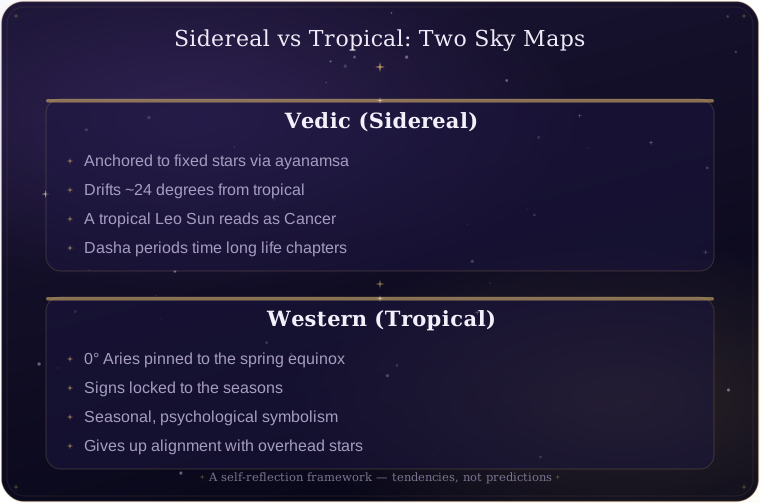
A Western natal chart uses the tropical zodiac, which pins the signs to the seasons — 0° Aries always falls at the spring equinox. A Vedic chart uses the sidereal zodiac — twelve equal 30° signs anchored to the fixed stars — which drifts from the tropical one by roughly 24 degrees, an offset called the ayanamsa. How it works in practice: the sidereal calculation often shifts a planet back a whole sign, so a tropical Leo Sun reads as a sidereal Cancer Sun. That single shift is why a lifelong "Leo" can open a Vedic chart and find a Cancer Sun looking back — not an error, but a different reference frame. To get the seasonal, psychological symbolism that modern Western astrology leans on, you sacrifice alignment with the stars actually overhead at your birth, and the reverse is equally true. For the full mechanics of that offset, the Vedic vs Western astrology guide walks through it slowly.
A second contrast sits inside the Vedic system itself: dasha timing versus transit reading. Dasha periods, a classical Jyotish timing framework from the Parashara tradition (the Vimshottari dasha) later popularised and case-studied by teachers such as B. V. Raman and K. N. Rao, track long internal chapters, while transits track short external triggers. Choosing dasha as your primary lens gets you a clear life-stage narrative, but you lose the day-to-day precision that transit work offers.
How to Read Your Vedic Birth Chart in Practice
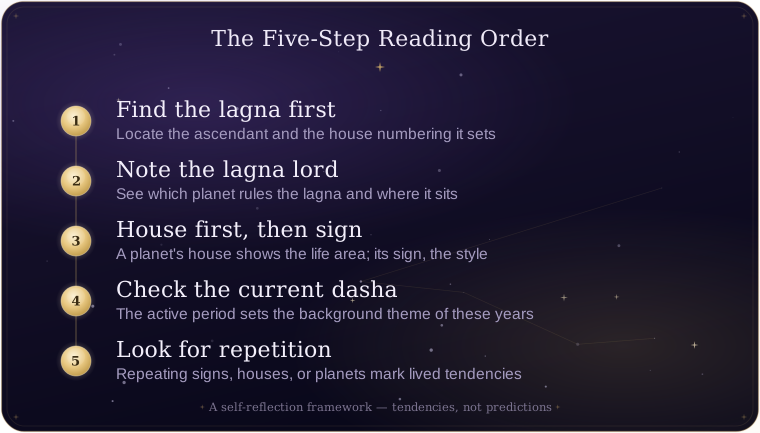
A vedic birth chart calculator gives you the raw data; reading it is a matter of working in the right order rather than left to right. As a second-generation Jyotish practitioner, the sequence I was taught — and still run first on any chart — starts with the frame, not the planets:
- Find the lagna first. Locate your ascendant and the house numbering that flows from it; every other placement is read relative to this anchor.
- Note the lagna lord. See which planet rules your ascendant and where it sits — its house often shows where your energy concentrates.
- Read planets by house, then sign. A planet's house shows the life area it colours; its sign shows the style. House first, sign second.
- Check the current dasha. Identify the planetary period you are in now; it tends to set the background theme for this stretch of years.
- Look for repetition. When the same sign, house, or planet keeps surfacing, that emphasis often points to a lived tendency rather than a stray detail.
Worked in this order, the chart reveals itself as a layered structure rather than a flat list. The lagna is the room you are standing in, the houses are the walls, the planets are the furniture, and the dasha tells you which room is lit right now. The calculator will never hand you that narrative directly; building it from the raw placements is the skill that turns data into self-knowledge. The four placements below are the ones your calculator returns that most reward a close reading.
Lagna (Ascendant) — Where to Start
The lagna is the sidereal sign that was rising on the eastern horizon at your birth, and in a Vedic chart it is the headline, not the Sun. Everything else is read relative to it: the lagna becomes the first house, and the house numbering flows from there counterclockwise. Your calculator will list it as the "ascendant" or "lagna." Because the rising sign changes roughly every two hours, an accurate lagna depends on a precise birth time — get the minute wrong and the entire house framework can shift. Read the lagna first for the style you meet life with, then note its ruling planet (the lagna lord) and follow it to wherever it sits; that planet's house often shows where your energy genuinely concentrates.
Moon Sign (Rashi) in Vedic Astrology
In Western astrology the Sun sign is king; in Vedic practice the Moon sign, or rashi, carries far more weight. It anchors much of the predictive work, and it is the placement most classical Jyotish readings open with after the lagna. Your calculator will name your rashi and usually the nakshatra (lunar mansion) the Moon falls in. Read the rashi for emotional temperament and inner needs, and expect it to differ from the Moon sign a Western app gave you — that one-sign shift is the ayanamsa doing its job, not a calculation error.
Reading the Navamsa Chart
Most full vedic birth chart calculators also generate a navamsa (D9) chart — a divisional chart that subdivides each sign into nine parts and is read alongside the main birth chart (the rashi chart, or D1). Practitioners use the navamsa to check the underlying strength of a placement and, traditionally, for marriage and partnership themes. A planet that looks strong in the main chart but weak in the navamsa is read as promising but unsupported; one that strengthens in the navamsa is considered to deliver on its potential. You do not need to master it on day one — but knowing the D9 exists explains the second wheel your calculator quietly produces.
Dasha Periods and Timing
The dasha timeline is what most distinguishes a vedic birth chart calculator's output from a Western one. The standard system, Vimshottari dasha, divides life into planetary periods (mahadashas) lasting anywhere from 6 to 20 years, each subdivided into shorter sub-periods (antardashas). Your calculator prints these as a dated schedule. Read the dasha you are in now for the background theme of this stretch of years — it sets emphasis and timing, not a fixed event. A dasha never predicts a specific outcome; it tells you which planet's themes are currently lit, so you can read the rest of the chart through that active lens.
Common Misreadings
Most confusion around a vedic birth chart calculator comes from importing habits that belong to a different system. Four misreadings account for the bulk of it:
- Reading the Sun placement as the headline. In a sidereal chart the lagna carries that weight; the Sun is one placement among many, not the summary of the chart.
- Treating the chart as fixed fate. Placements describe tendencies and timing pressures, not sealed outcomes — the dasha shows when a theme is active, not that it must occur.
- Assuming your signs are wrong. When the output returns different signs than a Western app, that is the ayanamsa at work, not a glitch.
- Skipping the houses. Many readers memorise sign meanings and never check which house a planet occupies, which is where most of the practical detail actually lives.
None of these misreadings come from the chart being wrong; they come from reading a sidereal map with tropical assumptions. Once you expect the signs to differ, treat the lagna as the headline, and read placements as tendencies rather than verdicts, the same output that felt contradictory starts to line up into something you can use.
Your Vedic Birth Chart at a Glance
| Property | How It Works | Chart Domain | How to Observe |
|---|---|---|---|
| Lagna (ascendant) | Sets the house framework from the sign rising at birth | First house and the overall chart frame | The sign listed as your ascendant or lagna |
| Sidereal placement | Locates each planet against the fixed stars via the ayanamsa | The sign and house each planet occupies | Compare to a Western chart; signs often shift back one |
| Bhava (house) | Divides the chart into twelve life areas | The numbered houses around the wheel | Note which house holds each planet |
| Dasha period | Sequences planetary rulership across decades | The active and upcoming planetary periods | Read the dated dasha list in the output |
Questions People Ask About Reading a Vedic Chart
Why does my vedic birth chart calculator show different signs than my usual horoscope?
Vedic charts use the sidereal zodiac, which stays anchored to the fixed stars, while most Western horoscopes use the tropical one. The roughly 24-degree gap, called the ayanamsa, often shifts a placement back by one sign.
What should I read first in the output?
Start with the lagna, your ascendant, because it sets the house structure the rest of the chart hangs on. Reading the Sun placement first is a Western habit that misleads in a sidereal chart.
Do I need an exact birth time?
Yes for the lagna and houses, which can change within minutes, and yes for an accurate dasha timeline. Sign placements are more forgiving, but the frame of the chart depends on a precise time.
Is the dasha a prediction of what will happen?
No. A dasha period tends to set the active theme of a stretch of years, pointing to timing and emphasis rather than a fixed event.
Reflection Prompts
- Think of a recent decision and ask which house or planet in your chart you can see shaping how you made it.
- Recall a multi-year stretch that felt distinct, then check which dasha period was running and what it emphasised.
- Notice one trait others regularly name in you, then locate the lagna or placement that describes that same tendency.
Related Reading
- Hindu astrology (Wikipedia) — context on the system's classical roots and vocabulary.
- Ayanamsa (Wikipedia) — the technical reason Vedic and Western charts return different placements.
Take Action
Open the chart your tool saved, then read it in order: lagna first, lagna lord, planets by house, then the current dasha. Do that and you turn a screen of symbols into a few plain sentences about how you tend to operate and what this period is asking of you. To interpret each placement properly, read the How to Read a Birth Chart guide and apply it to the output in front of you — the chart stops being someone else's jargon and starts describing a life you recognise as your own.
Sources
- Parashara — sage credited with founding the classical Jyotish tradition that defines the chart's houses and dasha framework
- B. V. Raman — twentieth-century astrologer who taught and popularised classical Vedic chart reading for modern readers
- K. N. Rao — teacher known for rigorous, case-based study of the classical dasha system