
What Is Am I Meant to Be My Own Boss?
Am I Meant to Be My Own Boss is a reflective astrology question that looks at how a birth chart symbolizes your relationship to work, autonomy, and responsibility. It reads best as a symbolic lens for weighing entrepreneurial fit, not a fixed verdict. Astrologers usually approach it through the second, sixth, and tenth houses, the Midheaven, and Saturn — the areas tied to money, daily labor, public role, and self-discipline. None of this decides your future; it organizes patterns you can hold up against your own experience. Used that way, it becomes a thinking tool drawn from the same map you'd use in a broader pillar guide on how to read a birth chart, rather than a prophecy about your career.
- Focuses on the chart zones for resources, daily work, and public role (2H, 6H, 10H)
- Works as a reflection tool, not a fixed prediction of success
- Easily blended with unrelated "will I be rich" or "will I be famous" questions
Why It Matters for Self-Awareness
Understanding am I meant to be my own boss matters because the pull toward working for yourself is rarely just about income — it touches how much structure you need, how you handle risk, and where you locate your sense of authority.
What the chart actually points to
The placements tied to this question describe tendencies, not outcomes. They can help you name a restlessness you already feel: maybe you thrive with autonomy but stall without an external deadline, or you crave ownership yet quietly rely on a team's rhythm to stay productive. Much of that theme clusters in the guide to the tenth house of career and public role, where visibility and self-direction concentrate. Seeing the pattern laid out gives you language for a decision you might otherwise make on impulse — in a burst of frustration with a current job, or a wave of enthusiasm after one good week of freelancing.
Where it helps you decide
The practical payoff is honest self-comparison. Someone with strong tenth-house and Saturn signatures might read that as ambition plus staying power, then check it against real evidence: do they finish long projects alone, or fade once the novelty passes? A different chart might show a clear need for collaboration, which reframes "should I go solo" into "what kind of ownership actually fits me." Building on the person-centered approach Dane Rudhyar established, the aim is reflection rather than prophecy. The chart raises the question honestly; your track record and values answer it.
A concrete example
Picture two people who both ask this question after a rough quarter. One has Saturn strong in the tenth house and a busy second house; reflecting on it, she recognizes that she already runs side projects to completion and resents having her calendar set by others — the cues match her behavior. The other has the same tenth-house emphasis but thrives on a manager's feedback and loses momentum without it. Same headline signal, opposite honest conclusions. The chart didn't decide anything; it handed each of them a sharper mirror.
Reading Chart Cues vs Predicting Your Career: Where They Split
Am I meant to be my own boss splits into two readings that people constantly blend: reading chart cues for self-employment fit, and predicting a fixed career outcome. Keeping them apart is the difference between a useful reflection and a false promise.
How each reading works
The interpretive read looks at how placements like the sixth house (daily work), the tenth house (public role), and Saturn (discipline) tend to function together. The way it works is comparative: it shows where autonomy is supported in your chart and where it might cost you, then leaves the conclusion open. A fixed prediction skips all of that and claims the chart simply names your job or guarantees you'll succeed solo. One offers a map; the other pretends to be the territory.
The trade-off you're making
The trade-off is real and worth stating plainly. To get the reassurance of a definite answer, you sacrifice accuracy, because no placement guarantees an outcome. To get an honest interpretive read, you give up certainty and accept ambiguity you'll have to resolve through action. Liz Greene's work on Saturn frames this well: Saturn can describe a capacity for self-built structure, but the same signature often appears in people who feel safest with a steady employer. The cue is identical; the life around it decides the meaning. Choosing the interpretive read over the tidy prediction gets you truth, but you lose the comfort of being told exactly what to do.
Why blending them backfires
When the two readings get mixed, people walk away with false confidence in either direction. Someone told "your chart says you're an entrepreneur" may quit a stable job on the strength of a symbol, then blame the stars when reality turns out harder. Someone told the opposite may talk themselves out of a venture their experience already supports. Keeping the interpretive read separate protects you from both traps: it hands you information to weigh, not a script to obey. That separation is the whole reason to treat this as reflection.
How to Read Entrepreneurial Cues in Your Chart
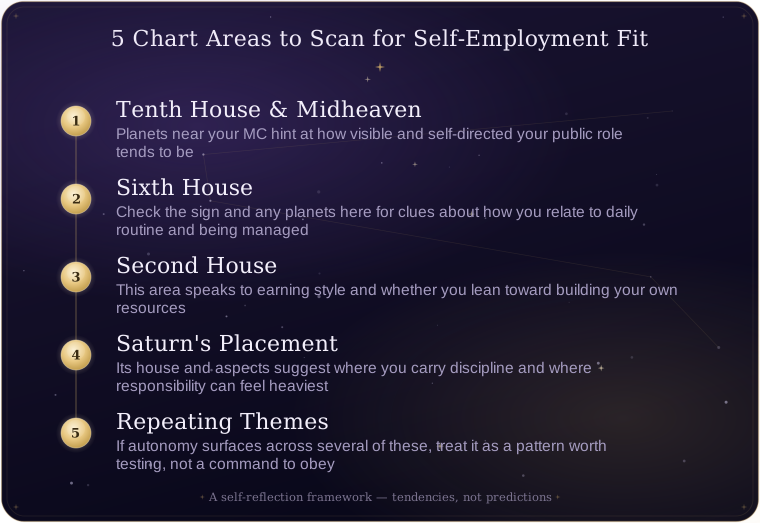
Reading these cues is less about finding one magic placement and more about noticing where a theme repeats. Howard Sasportas mapped these houses in a way that keeps them practical, so you can look at each area and ask what it suggests about your relationship to work and autonomy. Scan for these signals:
- Tenth house and Midheaven. Note planets near your MC — they hint at how visible and self-directed your public role tends to be.
- Sixth house. Check the sign and any planets here for clues about how you relate to daily routine and being managed.
- Second house. This area speaks to earning style and whether you lean toward building your own resources.
- Saturn's placement. Its house and aspects suggest where you carry discipline and where responsibility can feel heaviest.
- Repeating themes. If autonomy surfaces across several of these, treat it as a pattern worth testing, not a command to obey.
Common Misreadings
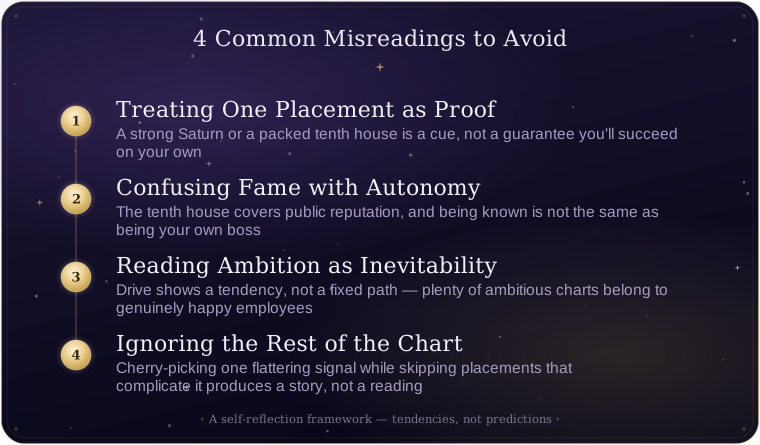
Because am I meant to be my own boss reads like a yes-or-no question, quick takes tend to force a verdict the chart never gives. The most common slips are easy to spot once you know them:
- Treating one placement as proof. A strong Saturn or a packed tenth house is a cue, not a guarantee you'll succeed on your own.
- Confusing fame with autonomy. The tenth house covers public reputation, and being known is not the same as being your own boss.
- Reading ambition as inevitability. Drive shows a tendency, not a fixed path — plenty of ambitious charts belong to genuinely happy employees.
- Ignoring the rest of the chart. Cherry-picking one flattering signal while skipping placements that complicate it produces a story, not a reading.
Entrepreneurial Fit at a Glance
| Property | How It Works | Chart Area | How to Observe |
|---|---|---|---|
| Public role | Signals visibility and self-direction in career | Tenth house / Midheaven | Notice whether you prefer leading over being led |
| Daily work | Shapes tolerance for routine and being managed | Sixth house | Track whether structure energizes or drains you |
| Resources | Reflects earning style and drive to own outcomes | Second house | See if you build income streams on your own |
| Discipline | Shows staying power and how you handle limits | Saturn | Watch whether you finish long solo projects |
Questions People Also Ask
Does my birth chart decide whether I should be my own boss?
No. A chart maps tendencies around work and autonomy, not fixed outcomes. It can inform the decision, but your experience and choices carry the real weight.
Which placements matter most for self-employment fit?
Astrologers usually weigh the tenth house and Midheaven, the sixth house, the second house, and Saturn. Together they describe public role, daily work, resources, and discipline.
Can two people with similar placements end up in very different work lives?
Yes. The same signature can support a founder or a content employee. Circumstances, timing, and personal values shape how a placement actually plays out.
How long does Saturn take to shape these themes?
According to NASA, Saturn takes about 29.5 years to complete one orbit. Its return near age 29 is often when questions about autonomy and career direction feel loudest.
Reflection Prompts
- Think of a recent project you ran alone — did the autonomy energize you or leave you craving structure?
- Recall a time a manager's oversight helped rather than chafed; what did that support actually give you?
- Name one week you fully controlled your own schedule — did your output rise or scatter?
Related Reading
- overview of Saturn in the birth chart — how discipline and responsibility show up in a reading of this question.
- guide to the sixth house of work and daily routine — the day-to-day work area behind self-employment cues.
- guide to the second house of money and resources — the earning-style zone tied to building your own income.
Take Action
Run your birth chart through a tool and pull up your tenth house, sixth house, second house, and Saturn placements. You'll come away with a short list of concrete cues — visibility, routine tolerance, earning style, discipline — instead of a vague hunch about your working life. Seeing them together often clarifies not whether the stars "decide" anything, but which kind of work fits who you already are. Explore Astrology Tools to map yours and turn the question into an informed reflection.
Sources
- Dane Rudhyar — pioneered the person-centered reading of astrological cycles that frames this topic as reflection rather than prediction.
- Liz Greene — deepened the psychological reading of Saturn, central to interpreting discipline and self-built structure.
- Howard Sasportas — mapped the astrological houses in a way that keeps the second, sixth, and tenth concrete and readable.