What Is How Do I Stop Burnout?
How do i stop burnout, read through astrology, is the question of where a birth chart shows repeated cycles of over-giving and depletion — and it works less as a fix and more as a symbolic lens for reading depletion patterns in a chart. The framing looks at two common signatures: the tension between Saturn and the Sun, which points to the pull between duty and vitality, and the sixth house, traditionally linked to daily work, routine, and the body's reserves. In my years applying data-analysis frameworks to chart structure, I've found these patterns tend to repeat like a signature rather than surface once and vanish. Reading it this way sits alongside the broader pillar guide on how to read a birth chart, which maps how placements interact. It names a pattern; it does not promise a cure.
- Names two chart signatures — Saturn–Sun tension and sixth-house depletion — instead of one catch-all cause
- Works as an interpretive framework for reflection, not a diagnosis or a treatment plan
- Points to seasonal and cyclical timing, including the lunar cycle, as windows for slowing down
Why It Matters for Self-Awareness
Understanding how do i stop burnout matters because the astrological version of the question is easy to blur with generic wellness advice, and most people can't tell which one they're actually reading. Broad tips treat everyone the same; the chart framing is narrower and more personal, because it ties depletion to your own placements and timing rather than a one-size list. The value is not a promise of relief — it is a sharper way to see where your own limits keep getting crossed.
That difference shows up in a few concrete ways:
- It separates a pattern from a mood. A hard week is a mood; a repeating tension between Saturn and the Sun is a pattern you can track across months, and the guide to the sixth house in a birth chart shows where daily depletion tends to register.
- It ties depletion to timing. Instead of only asking why you feel flat, you can ask when your chart tends to run low — often around specific transits or points in the lunar cycle.
- It reframes over-giving as a theme, not a flaw. Saturn contacts and a loaded sixth house are traditionally linked to service and responsibility, which gives you a calmer way to reflect on where you say yes too often.
Read this way, the question stops being a vague complaint and becomes something you can observe, log, and plan around. That is the practical payoff: less "why am I like this," more "here is the pattern, and here is when it tends to peak."
Saturn–Sun Tension vs Sixth-House Depletion: What Actually Differs
how do i stop burnout usually splits into two chart signatures, and telling them apart changes how you read the whole thing. They look similar from the outside — both end in exhaustion — but they work differently, and each one asks you to give something up in exchange for clarity.
How Saturn–Sun tension reads
Saturn–Sun tension is about pressure between responsibility and vitality. Here is how it works: when Saturn contacts the natal Sun by aspect, the reading points to a person who pushes through duty at the cost of rest, treating "should" as louder than "can." This builds on the psychological approach to Saturn that Liz Greene helped establish, where the planet marks structure and limits rather than punishment. According to NASA, Saturn takes about 29.5 years to complete one orbit, which is why astrologers tie its returns to roughly ages 29 and 58 — long arcs that often coincide with people rethinking overwork. Reading burnout this way gives you clarity about limits, but to get that structure and discipline, you sacrifice some spontaneity and easy play.
How sixth-house depletion reads
Sixth-house depletion is about the slow drain of daily routine. The way it functions: the sixth house describes work, habits, and the body's upkeep, so a crowded sixth house reads as someone whose exhaustion builds from many small repeated demands rather than one dramatic pressure point. This draws on the person-centered reading of cycles that Dane Rudhyar pioneered, where patterns unfold over time instead of striking all at once. Choosing to track the daily grind over the big-pressure story gets you early warning signs, but you lose the clean drama of a single cause — the drain is quieter and harder to point at.
Which one fits you
To get a useful read, you rarely pick one and drop the other. Most charts show both to some degree, and the trade-off is real: leaning on the Saturn story gives you a clear "too much responsibility" narrative, while leaning on the sixth-house story gives you granular, day-level signals. Naming which one dominates is what turns a general feeling into something you can actually watch.
How to Read Burnout Signatures in Your Chart
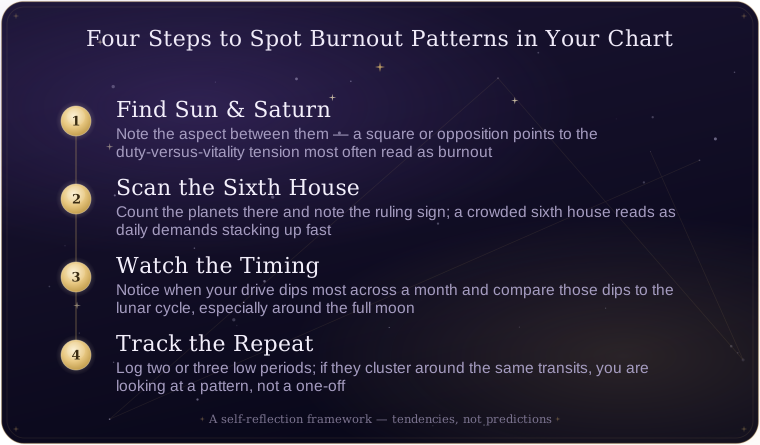
To spot how do i stop burnout as a chart pattern rather than a passing slump, look for a few observable markers you can actually check against your own placements.
- Find your Sun, then your Saturn. Note the aspect between them; a square or opposition points to the duty-versus-vitality tension most often read as burnout.
- Scan the sixth house. Count the planets there and note its ruling sign; a crowded sixth house reads as a life where daily demands stack up fast.
- Watch the timing. Notice when your drive dips most across a month and compare it to the lunar cycle, especially the days around a full moon.
- Track the repeat. Log two or three low periods; if they cluster around the same transits, you are looking at a pattern, not a one-off.
None of these steps require special software — a printed chart and a simple monthly note are enough to start seeing whether the signature holds.
Common Misreadings
A few common misreadings keep people stuck when they try to read burnout in a chart.
- Treating it as a diagnosis. The chart names a theme to reflect on; it does not label you with a condition or hand you a treatment plan.
- Blaming one placement. Burnout usually reads as several factors interacting — Saturn contacts, a loaded sixth house, and timing — not a single "burnout planet."
- Confusing it with everyday stress. A stressful week is normal; the chart pattern is about repeated depletion cycles, which is a slower and different story.
- Expecting the chart to fix it. The framing supports reflection and better timing, but any real recovery step happens in daily life, not on the page.
Most of these slip in because broad wellness content and symbolic chart reading get mixed together, so the boundary between "what this means" and "what to do" goes fuzzy. Keeping them separate is what makes the reading honest.
Burnout Signatures at a Glance
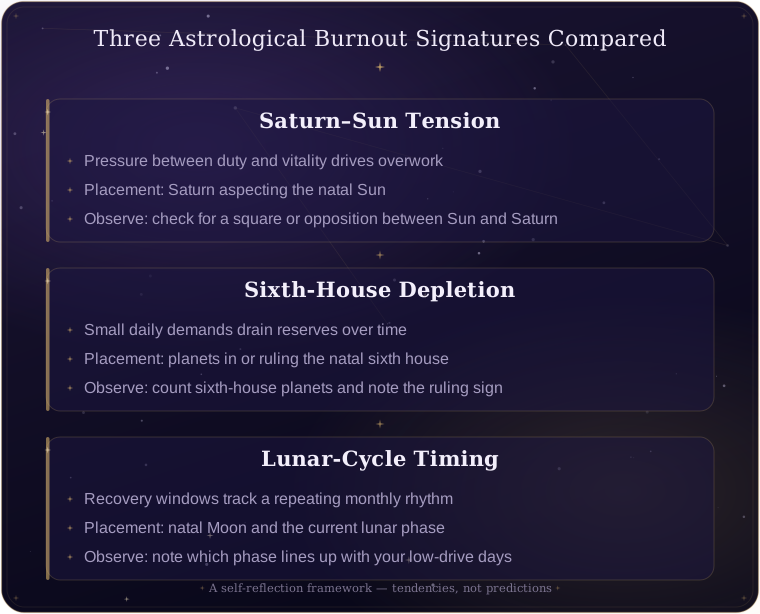
| Property | How It Works | Chart Placement | How to Observe |
|---|---|---|---|
| Saturn–Sun tension | Pressure between duty and vitality drives overwork | Saturn aspecting the natal Sun | Check for a square or opposition between Sun and Saturn |
| Sixth-house depletion | Small daily demands drain reserves over time | Planets in or ruling the natal sixth house | Count sixth-house planets and note its ruling sign |
| Lunar-cycle timing | Recovery windows track a repeating monthly rhythm | Natal Moon and the current lunar phase | Note which phase lines up with your low-drive days |
Common Questions About Stopping Burnout
Can astrology tell me how to stop burnout for good?
No — a chart offers a framework for reflecting on depletion patterns, not a permanent fix. It can point to when and where you tend to run low so you can plan rest, but the practical steps happen off the page.
Which placements are linked to burnout?
Most readings focus on Saturn contacts to the Sun and a loaded sixth house, since both are traditionally tied to duty, work, and the body's upkeep. No single placement is a "burnout planet"; it is the combination that reads as a pattern.
Does the full moon really affect my burnout?
In this framing, the lunar cycle is used as a timing lens rather than a cause. Many people track their low-drive days against the phase and treat the days around the full moon as a cue to slow down.
Is this the same as being diagnosed with burnout?
No. This is a symbolic, reflective reading, not a clinical assessment, and it should not replace guidance from a qualified professional.
Reflection Prompts
- Think of a recent week you pushed through exhaustion — what duty made it feel non-negotiable?
- Recall the last time your drive dropped sharply; what point in the month was it?
- Name one daily task you keep saying yes to that quietly drains your reserves.
Related Reading
- guide to Saturn square aspects — for a closer look at the Sun–Saturn tension behind duty-driven burnout.
- overview of the lunar cycle and moon phases — for the monthly timing lens this reading leans on.
- Occupational burnout (Wikipedia) — for the mainstream definition this symbolic reading sits beside.
Take Action
Ready to see these patterns in your own chart? Explore Astrology Tools to map your Sun–Saturn aspects and sixth house, so you can pinpoint where depletion tends to show up across the year. Once you can see the pattern on the page, the question shifts from "why am I always drained" to "when do I need to protect my rest" — and that small reframe is where real self-awareness starts.
This is not a clinical interpretation or mental health advice.
Sources
- Liz Greene — shaped the psychological reading of Saturn as structure and limits that this framing draws on
- Dane Rudhyar — pioneered the person-centered reading of astrological cycles and timing