What is ashwini nakshatra?
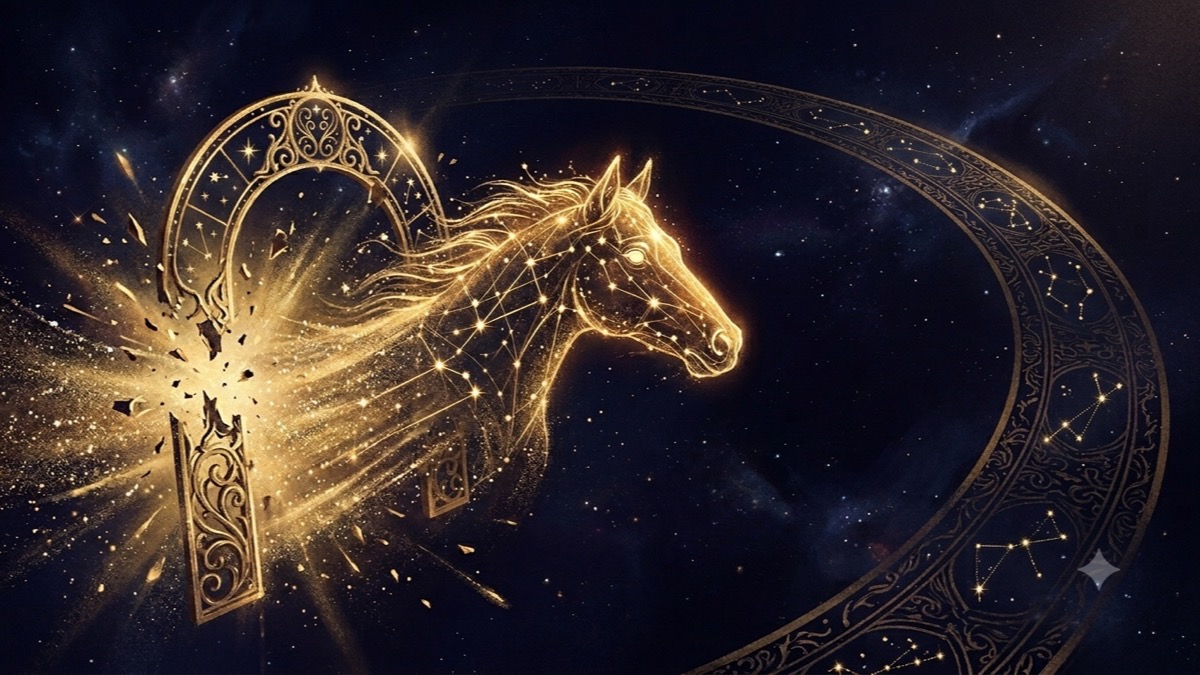
Ashwini nakshatra is Vedic astrology's first lunar mansion — Aries-placed, Ketu-ruled, and built for rapid-onset action. It spans 0°00′ to 13°20′ Aries, the very opening of the zodiac wheel, and its symbol — the horse's head — signals speed, vitality, and instinctive momentum. Within the pillar page on the Vedic nakshatra system, Ashwini holds first-mover position among the 27 lunar mansions. Vedic tradition links it to the Ashwini Kumaras, divine twin physicians whose restorative mode works through immediate energetic transfer rather than slow, stepwise care — a distinction that sits at the center of what makes this placement structurally unusual.
- Governs 0°00′–13°20′ Aries while ruled by Ketu, the south node, setting up the placement's core structural paradox
- Linked to the Ashwini Kumaras, whose mythological function encodes immediate restoration as the nakshatra's defining quality
- Described across classical Vedic sources as instinctive and swift, drawing on refined prior-cycle competence rather than newly developed skill
Why It Matters for Self-Awareness
Understanding ashwini nakshatra matters because the most widely circulated descriptions stop at "fast and impulsive" — a framing that is both recognizable and structurally incomplete. For anyone trying to read this placement accurately in their own chart or another's, that gap creates a predictable misread: the speed gets attributed to personality or temperament when its source is actually the specific planetary combination at work.
The key is Ketu's role. As the south node, Ketu represents what has already been accumulated and refined across prior cycles. In most chart positions, this produces instinctive excellence alongside a tendency to undervalue what comes naturally — the person excels in that area but doesn't treat it as earned. When Ketu governs the zodiac's most forward-facing position, those same qualities surface as an ability to act on accurate instinct before the analytical mind has finished building its case. People with prominent Ashwini placements often describe this as knowing without knowing how they know. The "impulsive" label gets applied from outside because the process is invisible — but the process is there; it predates the present moment.
Recognizing this distinction changes the interpretive frame. Rather than reading Ashwini's speed as a tendency to manage or counterbalance, understanding it as deployed prior competence points toward building on the quality rather than apologizing for it. The overview of Ketu and south node themes in Vedic astrology covers this broader dynamic for comparison.
ashwini nakshatra vs Adjacent Concepts: How It Works + Trade-offs
The structural paradox of ashwini nakshatra — the zodiac's most initiatory position under the rulership of the node of past-life completion — becomes clearer when placed against two nearby comparison points:
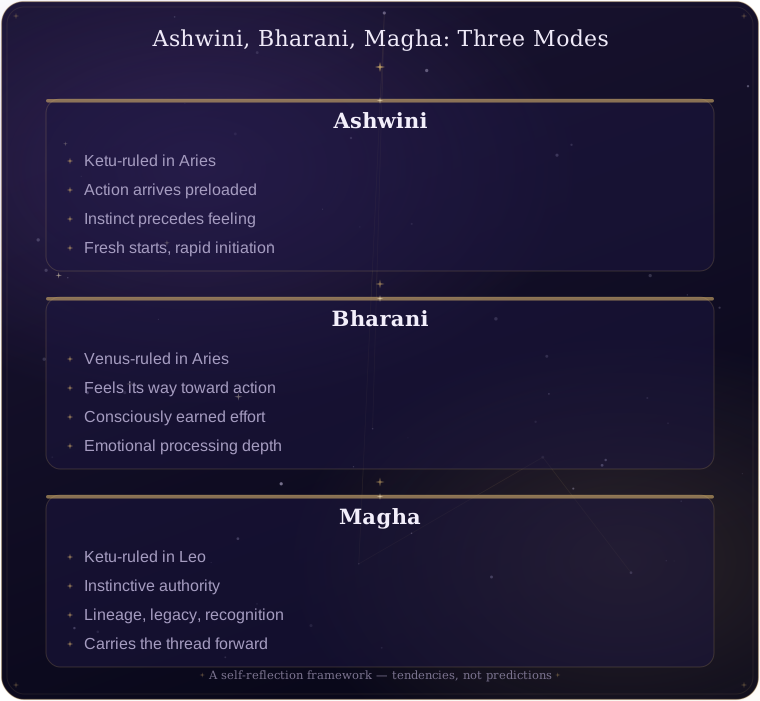
- Ashwini vs Bharani. Both nakshatras occupy Aries; both operate with urgency and forward drive. The ruling planet changes the mode entirely. Bharani is governed by Venus, routing Aries energy through desire, emotional processing, and consciously earned effort — Bharani tends to feel its way toward action. Ashwini's Ketu rulership routes the same Aries urgency through already-refined prior-cycle competence — the action arrives before the feeling does. To get Ashwini's speed, you give up Bharani's emotional processing depth. You act accurately but may not feel your way into the decision. Bharani earns its forward motion; Ashwini arrives with it preloaded.
- Ashwini vs Magha. Magha is the other prominent Ketu-ruled nakshatra, sitting in Leo at 0°00′–13°20′. Both share instinctive authority — acting from a reservoir of prior refinement rather than present-moment reasoning. But Magha's Leo placement turns that authority toward lineage, legacy, and sustained recognition. Ashwini's Aries placement turns the same Ketu energy toward fresh starts and rapid initiation. To get Ashwini's pioneering quality, you sacrifice Magha's sense of unbroken continuity. Ashwini restarts cleanly; Magha carries the thread forward without cutting loose. Neither is more functional — they are the same Ketu energy angled in two different directions.
- Ketu in Ashwini vs Ketu elsewhere in the chart. In other positions, Ketu typically produces detachment and instinctive excellence within a specific house — the person excels there but treats the ability as unremarkable. In Ashwini, that same pattern meets Aries at the zodiac's very first degree, which means detachment reads as momentum and instinctive skill reads as raw speed. The directional quality is different: Ketu-in-Ashwini faces outward and forward. To get that outward momentum, you give up the quiet inward self-awareness Ketu elsewhere can provide — the competence deploys so quickly that it bypasses the moment where you might recognize it as competence.
How to Read ashwini nakshatra in Your Chart
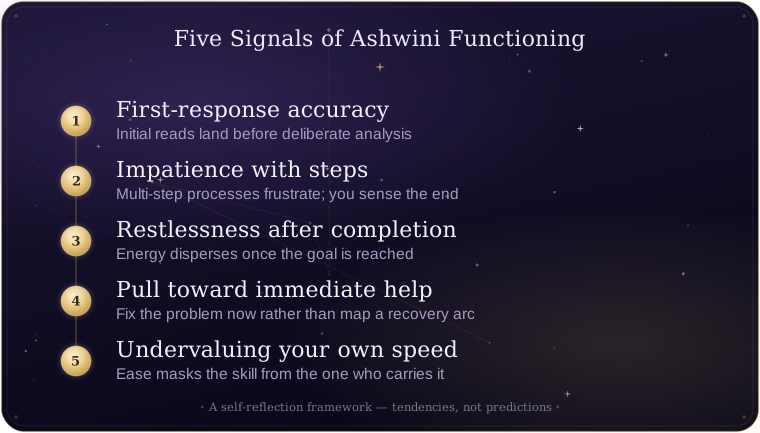
Reading this placement is less about identifying a personality type and more about tracking a specific response pattern across time. These signals point toward Ashwini's functioning in a natal chart:
- First-response accuracy. Your initial read of a new situation — before deliberate analysis — tends to land correctly more often than later, more considered judgments. This is Ketu's refined prior-cycle competence arriving before the reasoning mind has assembled its argument.
- Impatience with intermediate steps. Multi-step processes may feel frustrating not from laziness but because you already sense where they end. Notice whether this surfaces in creative work, practical problem-solving, or decisions made under time pressure.
- Restlessness after completion. Ashwini's energy tends to disperse once a goal is reached. If you feel flat or antsy at the moment a project is finished — rather than satisfied — this pattern is worth tracking over multiple cycles.
- Pull toward immediate, practical help. Many people with strong Ashwini placements describe an instinct to assist others directly and now — fix the problem rather than map a recovery arc. This mirrors the Ashwini Kumaras' mythological mode of direct, swift intervention.
- Undervaluing your own speed. Because rapid competence feels natural, results that required significant effort from others may feel unremarkable to you. The ease is the competence — but ease can mask the skill from the person who carries it.
Common Misreadings
Most descriptions of ashwini nakshatra treat swiftness as a fixed personality trait and leave the structural source unexplained. That pattern produces a set of persistent misreadings that circulate across most SERP results:
- Misreading: Speed here means impulsiveness. Correction: Impulsive implies bypassing judgment. Ashwini bypasses deliberation, which is different. The judgment is already embedded — it arrived through Ketu's prior-cycle reservoir. The action looks rash from outside because the internal process predates the present situation and isn't visible from it.
- Misreading: Ketu weakens or complicates an Aries placement. Correction: Ketu governs what has already been mastered. At the zodiac's opening degrees, that mastery meets the sign most oriented toward new starts. The result is not a weakened Aries but an Aries that acts from depth — initiating from accumulated precision rather than from blank-slate enthusiasm.
- Misreading: The Ashwini Kumaras connection makes this a healer placement. Correction: The Ashwini Kumaras' mythological function is immediate restoration, not ongoing care. The placement is associated with a mode of responding — quick, direct, practical — not with any specific profession. People with prominent Ashwini may show up wherever immediate intervention is valued, but the placement describes a response style, not a career path.
- Misreading: South-node rulership makes Ashwini backward-looking. Correction: Ketu in Ashwini points its accumulated prior-cycle material forward and outward. The karmic content is not being revisited; it is being deployed toward the next initiation. This distinguishes Ashwini sharply from other Ketu placements, which more often produce withdrawal or studied detachment rather than forward momentum.
Ashwini at a Glance
| Property | How It Works | Energy Center | How to Observe |
|---|---|---|---|
| Zodiac span | 0°00′–13°20′ Aries; Ketu governs the nakshatra, Mars governs the sign | Mars (sign) + Ketu (nakshatra) combined | Check if natal Moon, ascendant, or Sun falls within this range |
| Symbol | Horse's head — vitality, speed, instinctive forward motion | Cardinal fire directed by prior Ketu refinement | Notice the speed of your first response in new situations before deliberation begins |
| Deity | Ashwini Kumaras — divine twin physicians of Vedic tradition | Immediate restoration over gradual process | Watch for the instinct to fix situations now rather than plan a recovery arc |
| Guna (quality) | Rajas — active, initiating, forward-moving | Aries cardinal energy | Notice restlessness when action is blocked or a process moves more slowly than you expect |
| Associated rashi | Aries (Mesha); read nakshatra and sign together | Combine with natal Mars placement | Mars house and sign complete the picture of how initiative style actually expresses |
Common Ashwini Questions
What does rashi mean for this placement, and why does it matter?
Rashi is the zodiac sign a nakshatra falls in. Ashwini nakshatra sits entirely within Aries (Mesha rashi), so the nakshatra and the sign are always read together. Aries provides the initiatory, cardinal-fire direction; Ketu's rulership shapes how that initiation arrives — from instinct and prior refinement rather than fresh, deliberate effort.
What characteristics does Ashwini carry consistently across classical sources?
Classical Vedic sources consistently name rapid response, instinctive competence, an impulse toward direct practical action, and difficulty sustaining slow processes. All four qualities trace back to the same Ketu-Aries structure: mastered prior-cycle material meeting the zodiac's most forward-facing placement.
Is Ashwini considered favorable for a natal Moon?
No nakshatra in the Vedic framework is inherently favorable or unfavorable — each describes a specific mode of functioning. An Ashwini Moon may bring decisiveness and quick emotional recovery; the same placement can create friction in contexts requiring sustained emotional processing or patience within long developmental arcs. The full chart provides the relevant context.
How does Ashwini differ from Bharani and Krittika, the other Aries nakshatras?
Aries contains three nakshatras: Ashwini (Ketu-ruled), Bharani (Venus-ruled), and the opening portion of Krittika (Sun-ruled). Where Bharani routes Aries energy through desire and earned attachment, and Krittika routes it through clarity and precision-cutting, Ashwini routes it through instinctive, already-refined competence. Each is Aries, but the planetary ruler determines the mode of initiation.
Reflection Prompts
- Think of a recent moment when your first instinct proved correct before you'd reasoned it through — what did that speed feel like from the inside?
- Recall a situation where a process felt unnecessarily slow and you felt impatient — was that impatience, or a genuine sense that you already knew the endpoint?
- Notice the last time you helped someone immediately and directly without pausing to plan — what was driving that response?
Related Reading
- Bharani nakshatra explainer — the adjacent Aries nakshatra ruled by Venus; useful for seeing how the same sign expresses differently under a different planetary ruler
- guide to Ketu and south node placements in Vedic astrology — covers Ketu's broader signature and why nakshatra positions under its rulership tend toward instinctive, prior-refined expression
- introduction to reading nakshatras in a natal chart — foundational context for placing Ashwini within a full chart interpretation
- Nakshatra (Wikipedia)
Take Action
Generate your free birth chart to see where this lunar mansion lands in your own natal placements. Your chart will show which planets and angles fall in Ashwini's 0°00′–13°20′ Aries range — the specific data that determines how the Ketu-Aries structure actually shows up in your timing, decisions, and instinctive responses. Knowing which houses and signs the Ashwini degrees touch in your chart gives you a concrete, personal framework for recognizing patterns that have likely been operating since early in your life — just without a name for them until now.
Sources
- Parashara — foundational classical authority on Vedic nakshatra classification, planetary rulerships, and the traditional interpretive framework this entry draws on
- Ashwini Kumaras — Vedic mythological figures whose twin-physician role in classical literature encodes the immediate-restoration quality attributed to this lunar mansion