
What is composite chart calculator?
A composite chart calculator is a tool that merges two natal charts into a single chart representing the relationship itself — not either person in it, but the third entity that forms when those two people meet. It works by computing the mathematical midpoint between each planetary pair in both birth charts, producing a unified astrological map of the partnership's character and purpose.
- Treats the relationship as its own astrological entity, separate from both individuals
- Requires two sets of birth data: date, time, and location for each person
- Comes in two distinct calculation methods — midpoint and Davison — that produce structurally different outputs from identical input data
This sits alongside the broader pillar page on relationship astrology techniques, which maps how synastry, composite, and compatibility frameworks each approach the same question from a different angle.
Why It Matters for Self-Awareness
Most people run a composite chart calculator the same way they'd check a daily horoscope: fill in the birth data, receive a chart, and read it as settled fact. The problem is that most platforms never disclose which calculation method they applied — and that silence carries real interpretive consequences. Two platforms running the same birth data can produce charts where the composite Sun lands in different houses because one uses the midpoint method and the other defaults to Davison. Those different house placements are not minor variations. They describe structurally different dynamics.
The composite chart calculator on Site A might show a composite Sun in the fifth house — a reading centred on creative play, shared romance, and self-expression. The same data entered into Site B, using Davison, might place the composite Sun in the seventh house — a reading centred on committed partnership, public identity, and long-term contract. Both outputs feel authoritative. Neither platform disclosed which method it used.
This matters for self-awareness because people make real decisions based on composite chart readings: whether a relationship is suited for the long term, whether recurring tensions reflect a structural incompatibility, or whether a shared creative project is genuinely part of the partnership's nature. When the foundational interpretive frame comes from a method you didn't choose and can't verify, the reading becomes difficult to evaluate or trust. Understanding which method was applied is the first piece of interpretive context a composite chart calculator needs to provide — not a buried technical footnote.
composite chart calculator vs Adjacent Concepts: How It Works + Trade-offs
Three tools appear regularly in relationship astrology, and each handles two natal charts differently. The choice between them isn't cosmetic — it determines what question you're actually answering.
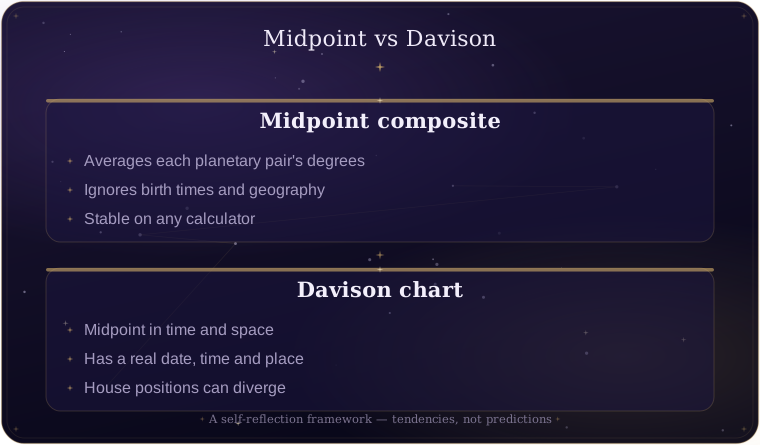
- Midpoint composite. Each planet in a natal chart holds a zodiac position measured in degrees. The midpoint composite method averages those degrees — Sun with Sun, Moon with Moon, and so on across all planetary pairs — and places each result in a new chart. What you gain is a clean, mathematically stable snapshot of the relationship's shared planetary energy that any calculator can reproduce consistently. To get that consistency, you give up sensitivity to time and geography: the midpoint method uses degree position alone and ignores when and where both people were born. Two people born on opposite sides of the planet at the same local time receive the same composite chart, even though their real geographic midpoint would be somewhere in the open ocean.
- Davison chart. Rather than averaging planetary degrees, the Davison method calculates a midpoint in time and space — a literal halfway point between both birth moments and both birth locations. This produces a chart that has its own actual calendar date, time, and place. Building on the interpretive framework Robert Hand established for composite work, practitioners who use the Davison method favour it for this geographic and temporal grounding, particularly when partners were born in different regions or time zones. To get that grounding, you give up the simplicity of the pure degree-average approach, and the resulting house positions can diverge significantly from a midpoint composite drawn from identical data.
- Synastry. Rather than merging two charts into one, synastry overlays them and measures the angular relationships between one person's planets and the other's. Each chart stays intact throughout. The analysis focuses on how two individuals interact as distinct people — neither person's chart is altered by the comparison. The synastry chart interpretation guide covers this method in depth. To get the precise individual-contact detail synastry provides, you give up the composite's capacity to read the relationship as a unified entity with its own persistent character.
The practical takeaway: composite methods fit when you want to understand the relationship's overall nature as a third thing that exists between you. Synastry fits when you want to understand how two specific people act on each other. Neither is more correct — they answer different questions, and using both together gives the fullest picture.
How to Read composite chart calculator in Yourself
Running a composite chart calculator effectively means confirming a few things before interpreting any placement. Working through these steps in order prevents the most common structural misreads.
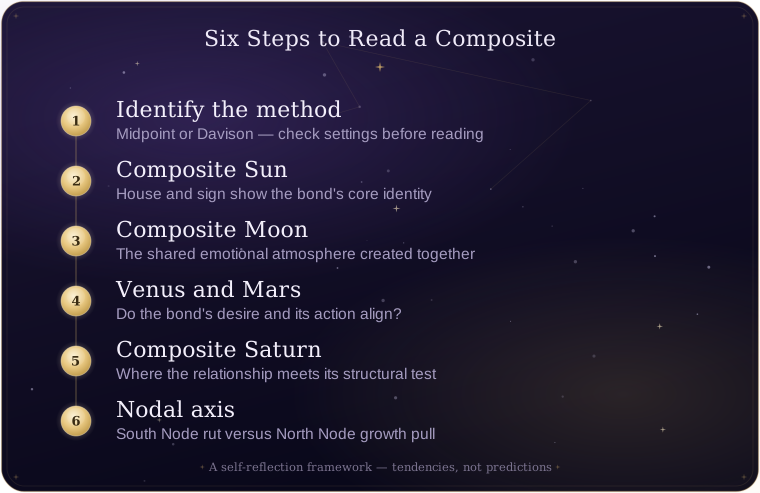
- Identify the calculation method first. Check the platform's settings, chart notes, or "about" section for the words "midpoint" or "Davison." If the method isn't disclosed, generate both from a tool that offers both and compare the composite Sun's house position — significant divergence between the two outputs signals that one is a Davison chart.
- Start with the composite Sun. The composite Sun's house and sign describe where the relationship directs its core energy and identity — where it wants to be seen and how it naturally expresses itself. Read this through the houses and life areas overview: fifth house points to creative and romantic expression; seventh to committed partnership; tenth to shared ambition and public direction.
- Read the composite Moon for relational atmosphere. The composite Moon describes the shared emotional tone the relationship creates — the recurring feeling that arises specifically when both people are together, distinct from either person's individual emotional register. A composite Moon in an air sign often describes a relationship that processes emotion through conversation; in an earth sign, through shared practical routines.
- Read Venus and Mars as a pair. Composite Venus describes what the relationship values and finds attractive; composite Mars describes how it moves toward things and handles conflict. Reading them together shows whether the relationship's desire and its action naturally align or pull in opposite directions — a mismatch here often surfaces as recurring tension between what the partnership wants and how it pursues it.
- Note composite Saturn's house position. Saturn in the composite chart marks where a relationship meets its structural test — where it either builds durability through patience or stalls under obligation and delay. A composite Saturn in the fifth house often describes a partnership where creative expression requires sustained effort; in the second house, shared resources become a recurring point of negotiation.
- Check the composite nodal axis if available. The nodes in the composite chart point toward the relationship's directional pull — the South Node describing a dynamic that comes naturally but may become a rut, the North Node pointing toward where the relationship is drawn to grow. Not all platforms include composite nodes; the lunar nodes and relationship purpose guide covers how to read them when present.
Common Misreadings
The most persistent misreadings of composite work share a common root: treating the composite chart as if it were one person's natal chart, or assuming the calculator produced an error when two platforms returned different results. Four misreadings come up consistently.
- Misreading: "This placement must describe my partner." Composite charts describe the entity formed between people — not either person's individual natal signature. A composite Moon in Capricorn describes the relationship's emotional climate — serious, structured, slow to open — not one partner's emotional style. This confusion is especially easy when a composite placement happens to mirror something prominent in one person's natal chart.
- Misreading: "The tool gave me the wrong chart — I got different results on two sites." This is almost always a method mismatch, not an error. A midpoint composite and a Davison chart drawn from the same birth data reliably produce different house positions, and sometimes different sign placements for angle-derived points. Checking the platform's stated calculation method, rather than assuming an error, resolves the confusion in most cases.
- Misreading: "A difficult composite aspect means the relationship won't work." Composite Mars square Saturn, for example, is frequently read as a fundamental flaw. In practice, it often describes a relationship that builds through sustained effort and friction — a dynamic recognizable in many durable long-term partnerships. Composite aspect interpretation functions differently from natal chart interpretation: what reads as difficulty in a natal chart often describes a structural challenge the relationship navigates together rather than apart.
- Misreading: "The composite and synastry will always agree." These techniques answer different questions and can point in opposite directions without either being wrong. Synastry might show strong interpersonal chemistry between two individuals while the composite describes a relational entity under persistent structural tension — or the reverse. Reading both clarifies the full picture; expecting them to confirm each other leads to confusion when they diverge.
Composite Chart Calculator at a Glance
| Property | How It Works | Relational Focus | How to Observe |
|---|---|---|---|
| Midpoint composite | Averages the zodiac degree of each corresponding planetary pair across both natal charts | Shared planetary signature | Compare composite Sun house placement across two platforms to confirm which method each used |
| Davison chart | Calculates a time-space midpoint — an actual date, time, and location halfway between both births | Geographic and temporal grounding | Check whether the chart carries a real calendar date; Davison charts always do |
| Composite Sun | Places at the midpoint between both natal Suns; describes where the relationship centers its identity | Primary expressive axis | Note the house — fifth = creative/romantic; seventh = committed partnership; tenth = public direction |
| Composite Moon | Averages both natal Moons; describes the shared emotional atmosphere the relationship creates | Relational emotional tone | Observe recurring moods that arise specifically when together, distinct from each person's individual emotional life |
| Composite Saturn | Sits at the midpoint between both natal Saturns; marks where structure, patience, or obligation defines the partnership | Long-term resilience axis | Track recurring themes of delay, serious commitment, or obligation in the Saturn house's domain |
Common Questions About composite chart calculator
Does it matter which composite chart calculator platform I use?
Yes, because platforms apply different calculation methods — midpoint or Davison — without always disclosing which. The same birth data entered into two tools can return composite charts with the composite Sun in different houses, producing readings that describe structurally different relationship dynamics from identical input.
What is the difference between a composite chart and synastry?
A composite chart merges two natal charts into a single chart representing the relationship as its own entity — a third thing that exists between both people. Synastry overlays both charts separately and measures angular contacts between individual planets, focusing on how two specific people interact rather than what the relationship itself looks like as a unified form.
Can I get a reliable composite chart without exact birth times?
Planetary sign positions remain usable without precise birth times, but house placements — which carry most of the interpretive weight in composite chart work — become unreliable. Charts drawn without confirmed birth times for both people should be read with that limitation kept clearly in mind, particularly for any house-based interpretation.
Why do different websites give me different composite charts for the same two people?
The most common reason is method variation: one site defaults to midpoint composite, another to Davison. Both approaches are widely used and theoretically grounded, but they answer the question differently and produce different outputs from the same data. Checking each platform's settings or chart legend for the stated calculation method usually resolves the source of the difference.
Reflection Prompts
- Think back to a relationship that felt like it had its own distinct character — what quality was most specific to that dynamic, not to either person in it?
- If you've run a composite chart calculator before and got results that didn't quite fit, did you check which calculation method the platform used?
- Recall a moment when a relationship fell into a recurring pattern neither person seemed to have chosen — where do you think that dynamic came from?
Related Reading
- lunar nodes in composite charts guide — covers how the nodal axis in a composite chart points toward the relationship's directional pull, extending the nodal overview introduced in Section 4
- Davison chart method deep-dive — extends the method comparison introduced here into full Davison interpretation, including how to read a chart that carries its own real birth date and geographic location
Take Action
Generate your free birth chart to explore composite chart calculator work. Your individual natal chart is the foundation for any composite reading — once you know your own planetary placements, you can see precisely how they combine with another person's to form the relational entity the composite describes. That foundational clarity makes the composite chart interpretable rather than abstract.
Sources
- Robert Hand — practitioner whose foundational work on composite chart interpretation shaped how both the midpoint and Davison methods are approached in modern Western relational astrology