What is synastry chart compatibility?
Synastry chart compatibility is a two-chart comparison that maps attraction signals and developmental pressure points, reading where one person's planetary placements activate another's psychological patterns across the full range of both natal charts. Rather than describing a fixed trait in one person, it describes what emerges between two charts that neither contains on its own.
- Maps angular contacts between planets across two separate natal charts — not a merged or averaged calculation
- Distinguishes attraction indicators (Venus-Mars conjunctions, Sun-Moon trines) from long-term developmental contacts (Saturn squares, Pluto oppositions)
- Adds house overlays to specify where each person's planetary energy lands inside the other's lived life domains
This reading sits within the broader pillar page on how to read a birth chart, which covers the foundational chart language synastry draws on. Synastry chart compatibility treats the relationship itself as the subject of analysis — not either person in isolation — reading what arises when two whole charts interact across their full range of placements.
Why It Matters for Self-Awareness
The friction that brings most people to synastry research is the percentage score. They open a compatibility calculator, enter two birth dates, and receive a number — 72%, 58%, 91% — with no indication of what produced it or whether a higher number means what they hope it means. The score flattens a layered reading into a single output and, in most calculators, weights harmonious aspects (trines, sextiles) more heavily than the harder contacts that practitioners in the field consistently treat as indicators of relational depth.
Understanding synastry chart compatibility in its full form matters because the score-first approach actively misleads. A chart carrying strong Saturn and Pluto contacts across two natal charts may score lower on a percentage tool while describing a relationship with considerably more long-term weight than a high-scoring chart dominated by trines. Two charts with a Venus-Mars trine and little else may generate a higher percentage than a pairing carrying tight Saturn and Pluto contacts alongside their harmonious aspects — and the percentage gives no indication that the second pairing often describes the more durable bond. The psychological astrology lineage descending from Liz Greene — which shifted relationship analysis from "will this work?" to "what is this relationship designed to teach each person?" — treats challenging inter-chart contacts not as problems to solve but as the specific developmental material two people have arranged to work with. Reducing that to a compatibility percentage suppresses the very nuance that distinguishes attraction indicators from depth signals.
A closely related territory is the guide to Saturn return and relational timing, which addresses how the same Saturn themes that appear in synastry also show up in individual natal timing — the connection helps clarify why Saturn contacts read as productive pressure rather than red flags.
synastry chart compatibility vs Adjacent Concepts: How It Works + Trade-offs
Several comparison tools get used interchangeably, though each reads something different. Here is how each one works and what you give up by choosing it:
- Synastry vs. sun-sign compatibility. Sun-sign pairing works at the level of elemental resonance — fire and air, fixed signs, cardinal clashes. It treats each person as a single archetype rather than a full chart. To get the quick-read simplicity of sun-sign analysis, you sacrifice the individual's Moon, rising sign, Venus, Mars, and every aspect pattern that makes a chart distinctively personal. Two people with the same sun sign can have radically different synastry experiences with the same third person, depending on their full chart structures.
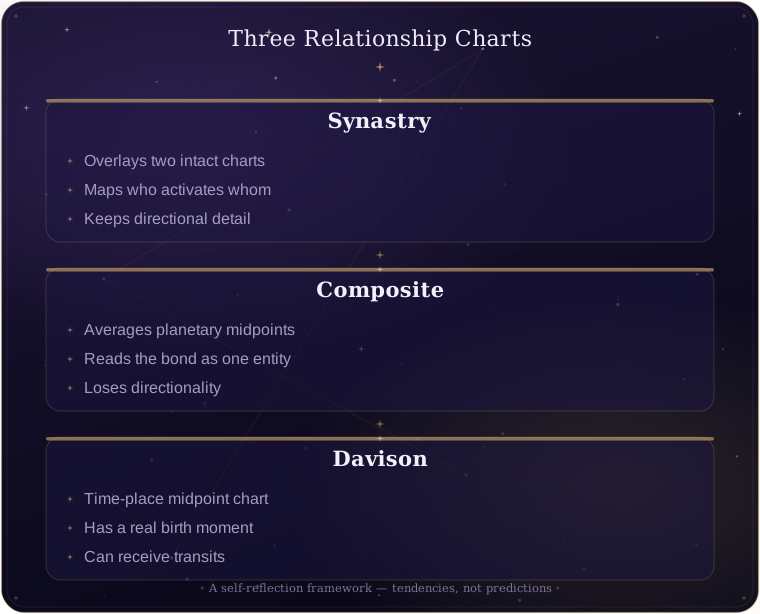
- Synastry vs. composite charts. The composite averages the midpoints of two natal charts to produce a third synthetic chart representing the relationship as an entity. Where synastry chart compatibility shows who is doing what to whom — whose Saturn is landing on whose Moon, whose Pluto is opposing whose Venus — the composite shows the relationship's character without specifying directionality. To get the composite's relationship-as-subject perspective, you lose the inter-chart activation detail that identifies which patterns belong to which person and which direction the pressure runs.
- Synastry vs. Davison chart. The Davison calculates a literal birth moment — a time-place midpoint between two sets of birth data — producing a chart with an astronomical anchor that can itself receive transits. The trade-off mirrors the composite: you gain a chart useful for timing but sacrifice the activation-point map that shows which inter-chart contacts carry the most weight right now.
The way synastry functions is through orb-weighted angular contacts. When one person's Saturn falls within a tight orb of another's Sun, that contact describes a pattern where structuring energy lands on the other's core identity expression. How that reads depends on the natal charts of both people — the same Saturn-Sun square reads differently when Saturn is well-supported in the aspecting chart versus stressed.
How to Read synastry chart compatibility in Yourself
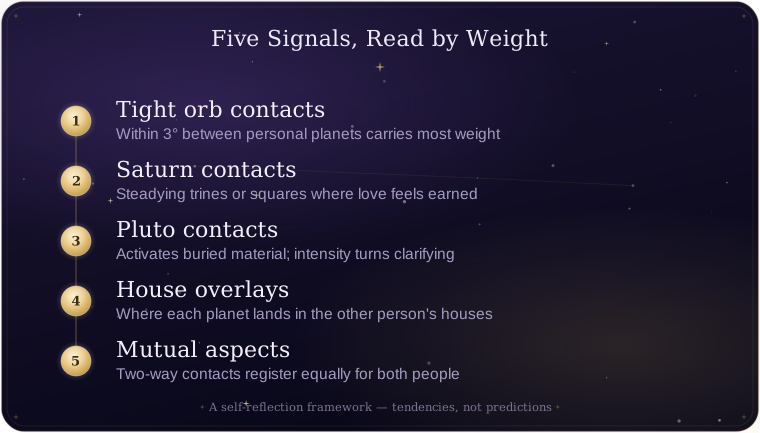
Synastry chart compatibility analysis works by scanning inter-chart contacts in order of weight. Here are the signals to read, from highest to lowest priority:
- Tight orb contacts first. Any aspect within 3° between personal planets (Sun, Moon, Mercury, Venus, Mars) carries more weight than a wide outer-planet trine. Closeness of orb matters more than aspect type — a tight square between two charts often carries more relational significance than a loose trine.
- Saturn inter-chart contacts. Where one person's Saturn aspects another's personal planet, the aspect type shapes the pattern. A Saturn trine to someone's Moon tends to add steadiness; a Saturn square to Venus may surface a pattern where affection feels earned rather than freely given.
- Pluto inter-chart contacts. Pluto aspecting a personal planet in another chart tends to activate buried psychological material — power, transformation, deep-pattern recognition. The contact often reads as intensity early on and, over time, as clarifying pressure rather than threat.
- House overlays. Check which house each of your planets occupies in the other person's chart. Your Venus in someone's seventh house registers as a visible relational presence; the same Venus in their twelfth becomes more private and internalized — felt but not always named by either person.
- Mutual aspects. When your Venus aspects their Mars and their Mars aspects your Venus, both people tend to feel the activation with roughly equal weight. Single-direction contacts can create an asymmetry in how much each person is moved by the connection.
Common Misreadings
A few consistent misreadings steer people away from what synastry analysis is actually showing them:
- "A high score means a strong match." Most compatibility tools produce high scores from an abundance of harmonious aspects. Harmonious aspects correlate with ease and flow, not necessarily with depth or the relational staying power that shows up in long-term partnerships. A score built entirely on trines and sextiles often describes comfort more than commitment.
- "Saturn contacts are warning signs." In most practitioners' readings, Saturn contacts between charts are treated as stabilizing forces — the contacts that keep people engaged through difficulty rather than moving on when friction peaks. Jeffrey Wolf Green's approach to synastry treats Saturn inter-chart contacts as specific developmental agreements two people have arranged, not obstacles to compatibility.
- "Incompatible sun signs can't work." Sun-sign incompatibility describes a difference in core expression style, not a relational outcome. Full synastry analysis frequently shows that rising sign, Moon, and Venus contacts across "incompatible" sun signs carry more relational resonance than the surface-level sign pairing suggests.
- "A Pluto contact means the relationship will be destabilizing." Pluto contacts in synastry tend to surface depth and psychological material that might otherwise stay below awareness. That intensity can read as disorienting at first and clarifying over time — many long-term relationships carry at least one significant Pluto contact alongside their easier aspects.
Synastry Chart Compatibility at a Glance
| Property | How It Works | Aspect Type | How to Observe |
|---|---|---|---|
| Venus-Mars conjunction | One person's desire nature activates the other's action drive; primary attraction signal | Conjunction (0–5°) between personal planets | Notice a pull toward each other's company that feels energizing rather than neutral |
| Saturn square or opposition | One person's structuring energy creates friction against the other's personal planet; long-term developmental contact | Square (90°) or opposition (180°) involving Saturn | Notice where one person tends to feel tested, held to account, or asked to prove reliability |
| Pluto opposition | One person's transformative energy meets the other's personal planet directly; surfaces buried patterns | Opposition (180°) involving Pluto | Notice where one person brings unexamined material to the surface for the other |
| Sun-Moon trine or conjunction | Core identity and emotional need find ease together; produces mutual recognition | Trine (120°) or conjunction (0°) between luminaries | Notice whether the other person's presence tends to settle your emotional baseline |
| House overlay (7th or 8th) | One person's planet lands in the other's relationship or intimacy house | Planet in the receiving chart's 7th or 8th house | Notice whether themes of partnership or depth come up naturally around that person |
Common Questions About Synastry Chart Compatibility
What does synastry chart compatibility actually measure?
It maps every angular contact between planets across two natal charts and identifies which contacts are attraction signals and which are long-term developmental pressure points. The reading goes beyond sun-sign matching by comparing every planet in both charts, along with where each planet lands inside the other person's house structure.
Can two people with many hard aspects still have a strong relationship?
Most experienced readers treat hard inter-chart aspects — squares, oppositions, Saturn and Pluto contacts — as indicators of developmental depth rather than incompatibility. Many long-term partnerships carry heavy Saturn and Pluto inter-chart contacts alongside their easier ones, and practitioners describe those contacts as the ones that tend to hold the relationship together through difficulty.
How do house overlays work in a synastry reading?
House overlays show where one person's planets land inside the other's chart houses. If your Venus falls in someone's fourth house, your presence may feel home-like and anchoring to them; if it falls in their eighth, the connection may register as deeper and more psychologically activating. House overlays specify where the inter-chart energy lands in lived experience.
Is synastry the same as a compatibility percentage?
No. A compatibility percentage is a simplified single output generated by weighting selected aspects according to a tool's algorithm. Synastry chart compatibility is the full interpretive practice of reading those inter-chart contacts in context — including aspect hierarchies, house overlays, and the balance between attraction and developmental tension across the whole chart comparison.
Reflection Prompts
- Think of a relationship where the pull was immediate — which quality in that person seems to have activated something in you that wasn't visible before you met?
- Recall a time when someone close to you maintained steady pressure or friction over months — how did that eventually clarify something about yourself?
- Notice the relationships in your life that have lasted through difficulty — what kind of tension kept them from settling into pure comfort?
Related Reading
- guide to natal chart houses and their life areas — house overlays in synastry become clearer once you understand what each house governs in a single chart
- overview of lunar nodes and karmic path indicators — some synastry readings weight nodal contacts as long-arc relational indicators alongside aspect contacts
- Astrological compatibility (Wikipedia)
Take Action
Generate your free birth chart to explore synastry chart compatibility. Once you have your natal chart in hand, you can place it alongside another person's chart and begin scanning the inter-chart contacts — identifying which aspects land closest in orb and where each of your planets falls in the other person's houses. The contacts you find often name patterns you've already sensed in the relationship but hadn't had language for.
Sources
- Liz Greene — developed the psychological approach to synastry analysis, reframing relationship compatibility as a study of what unconscious dynamics each person projects onto the other
- Jeffrey Wolf Green — extended synastry into evolutionary astrology, treating inter-chart planetary contacts as specific developmental agreements rather than compatibility scores