
What Is Diogo Jota's Birth Chart?
A Diogo Jota birth chart is a symbolic map of the sky as it looked at his birth on December 4, 1996, read as a cultural portrait of the late Portuguese footballer rather than a verified biographical record. At its simplest, it is a symbolic snapshot of the sky the day Diogo Jota was born, organized around his Sagittarius Sun and interpreted the way any pillar guide on how to read a birth chart would suggest — placement by placement, aspect by aspect.
- Anchored by a Sagittarius Sun, which colors the core drive toward directness, freedom, and forward motion
- Read symbolically as persona and pattern, never as a fixed account of a real person's inner life
- Limited by an unknown birth time, so the Ascendant and house positions stay open questions
Why It Matters for Self-Awareness
The reason the Diogo Jota birth chart matters is less about him and more about what a full-placement reading models for anyone curious about their own chart. After his death in July 2025 and the tributes that followed a year on, many people looked him up for the first time and reached for astrology as a familiar language for grief, admiration, and memory. That impulse is worth taking seriously. Grief tends to want structure, and a chart offers one without pretending to have the final word.
Reading a public figure's chart teaches transferable habits you can turn back on yourself:
- Separating headline from whole. A Sun sign is one line of a paragraph; the chart asks you to hold contradictions instead of collapsing a person into a label.
- Naming your own patterns. Sagittarian bluntness, restlessness, and all-in ambition are traits many readers recognize in themselves, which makes the chart a mirror for honest self-reflection.
- Sitting with uncertainty. The missing birth time is a reminder that self-knowledge is partial, and that a good reading holds what it cannot confirm.
According to the Pew Research Center, about 29% of U.S. adults have said they believe in astrology, which is why a well-known name draws so much interest to a chart in the first place.
A Full Birth Chart vs a Sun-Sign Profile: What Actually Differs
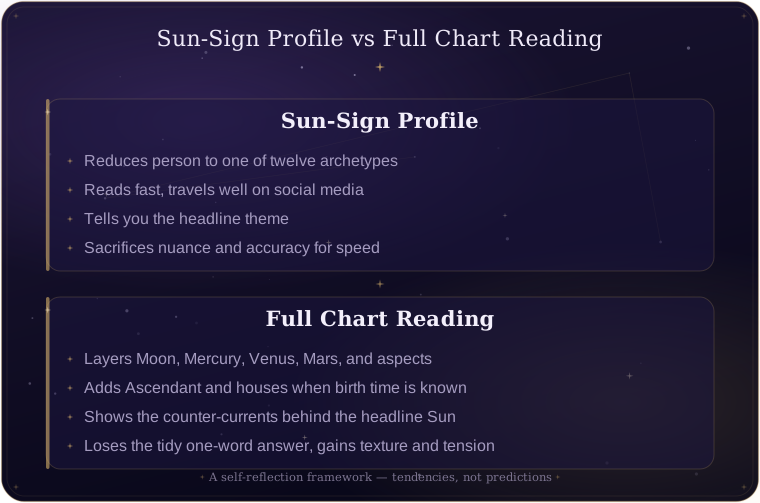
Most search results stop at a Sun-sign summary — "he was a Sagittarius, so he was adventurous" — and a Diogo Jota birth chart done properly refuses that shortcut. The two are easy to confuse, so it helps to see how each one works and where it gives out.
A Sun-sign profile works by reducing a person to one of twelve archetypes, which reads fast and travels well on social media. A full-chart reading works by layering the Moon, Mercury, Venus, Mars, the aspects between them, and — when a birth time exists — the Ascendant and houses, so the picture gains texture and tension. To get the speed and shareability of a Sun-sign take, you sacrifice nuance and accuracy. To get the depth of a full chart, you lose the tidy one-word answer.
The trade-off is real either way. A Sun sign tells you the headline theme; the cost is missing every counter-current. A full chart shows the counter-currents — the quiet Moon behind the loud Sun, the way a placement like the meaning of the ascendant and rising sign frames how a persona lands — but the cost is that it demands data he never made public. Blending the two, as many pages do, is where readers get misled: they take a Sun-sign generalization and present it with full-chart authority. The honest move is to name which layer you are actually working from, and to keep the two clearly separate.
How to Read Diogo Jota's Birth Chart as a Cultural Profile
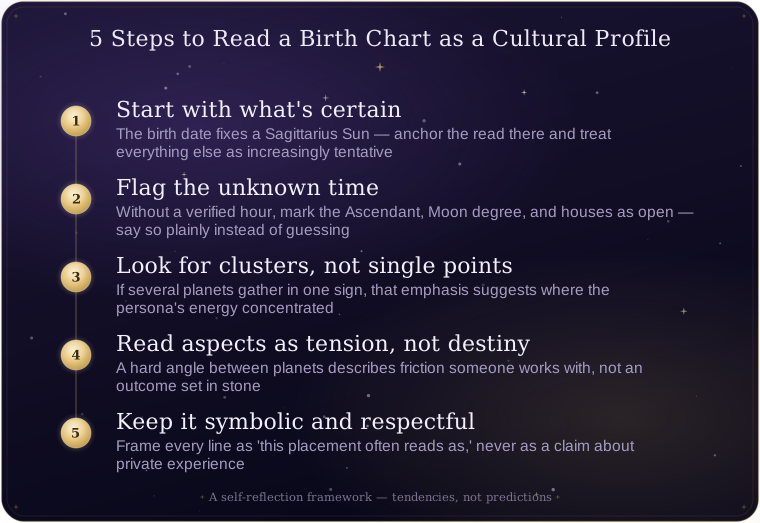
Reading the Diogo Jota birth chart honestly means treating it as a set of symbolic cues, not verified facts. Here is how to keep the interpretation grounded:
- Start with what's certain. The birth date fixes a Sagittarius Sun, so anchor the read there and treat everything else as increasingly tentative.
- Flag the unknown time. Without a verified hour, mark the Ascendant, Moon degree, and houses as open — say so plainly instead of guessing.
- Look for clusters, not single points. If several planets gather in one sign, that emphasis (sometimes called a stellium) suggests where the persona's energy concentrated.
- Read aspects as tension, not destiny. A hard angle between planets tends to describe friction someone works with, not an outcome that was set in stone.
- Keep it symbolic and respectful. Frame every line as "this placement often reads as," never as a claim about his private experience or his passing.
Common Misreadings
Because most casual write-ups skip the caveats, a few misreadings show up again and again:
- "His Sun sign explains everything." In reality, a Sagittarius Sun is one factor; the Diogo Jota birth chart only becomes meaningful when Moon, Mercury, and aspects enter the picture.
- "The chart predicted his life or death." Astrology describes tendencies and themes, not events — reading fate into a memorial chart is both inaccurate and disrespectful.
- "We know his rising sign." Without a documented birth time, any confident Ascendant claim is invented; honest readers leave it blank.
- "Celebrity charts reveal hidden truths about the person." They mostly reflect public persona and cultural projection, not a verified interior world.
Diogo Jota's Birth Chart at a Glance
| Property | How It Works | Energy Center | How to Observe |
|---|---|---|---|
| Sun in Sagittarius | Sets the core drive toward directness, freedom, and forward motion | Fire, mutable | Blunt honesty and restless ambition often read as Sagittarian |
| Chart shape (possible cluster) | Concentrated placements weight one area of the personality | Late-autumn Scorpio–Sagittarius emphasis | A one-track, all-in intensity in how goals get chased |
| Ascendant | Frames how the persona first comes across | Depends on an unknown birth time | Cannot be fixed without a verified time, so left open |
| Mercury near the Sun | Ties thinking style closely to identity | Fire-leaning communication | Quick, plain-spoken, competitive expression |
Common Questions About Diogo Jota's Birth Chart
Is the Diogo Jota birth chart based on a verified birth time?
No public, verified birth time exists, so any Ascendant or house placement is speculative. The date fixes the Sun sign and rough planetary positions, but the finer structure stays uncertain.
What is Diogo Jota's zodiac sign?
Born on December 4, 1996, he is a Sagittarius Sun, associated with directness, independence, and a forward-leaning drive. That single placement is the most confident thing anyone can say about the chart.
Can you read a birth chart for someone who has passed away?
Yes, and astrologers often do so as a form of reflection or tribute. The respectful approach keeps the reading symbolic and persona-focused rather than treating it as prediction. Read that way, the exercise honors the person instead of mining their life for hidden meaning.
Why do fans look up the Diogo Jota birth chart now?
Interest surged around his death in July 2025 and the tributes that followed, as people used astrology to process loss. A familiar name simply draws more curiosity to the chart than an unknown one would.
Reflection Prompts
- Think of a recent moment when speaking bluntly cost you something — was the honesty worth the friction it caused?
- Recall a time your public image differed from how you felt inside; what did that gap teach you?
- Name one goal you chased all-in this year, and notice what that intensity gave you and what it took.
Related Reading
- birth chart profile of Serena Williams — another public-figure chart read as persona, useful for comparing interpretive styles
- meaning of the trine aspect in a birth chart — explains one of the aspect patterns that shape a full-chart reading
- guide to the twelve astrological houses — shows why an unknown birth time leaves so much of a chart open
Take Action
Generate your free birth chart to explore Diogo Jota birth chart — start with our step-by-step guide to reading a birth chart walkthrough at https://astrologywiki.com/en/wiki/how-to-read-birth-chart. You will get a full placement map of your own Sun, Moon, and rising, laid out the same way a celebrity profile is, so you can see the patterns instead of a single label. Read symbolically, that map becomes a quiet tool for noticing how your public self and private self line up — and where they don't.
This is not a clinical interpretation or mental health advice.
Sources
- Dane Rudhyar — pioneered the psychological, person-centered approach to reading a chart as a whole rather than a list of traits
- Liz Greene — advanced the symbolic, depth-oriented interpretation of planetary placements and aspects
- Diogo Jota (Wikipedia)
- Sagittarius (astrology) (Wikipedia)