
What is a Trine?
A trine in astrology is the 120-degree angle between two planets, and it marks the easiest, most natural flow of talent between two parts of a chart. The two planets sit a third of the way around the circle from each other, usually in signs of the same element, so they cooperate without being asked. Whatever they each govern tends to support the other automatically. This sits inside the broader vocabulary of the glossary of astrology terms, which defines the angles charts are built from. Working through chart structure as a data analyst for years, I have found this to be the placement people most often overlook.
- Connects two planets at 120 degrees, almost always in the same element
- Produces ability and ease without effort or conflict
- So smooth it is easy to take for granted and never develop
Why It Matters for Self-Awareness
Understanding the trine in astrology matters because the smoothness is exactly what hides it. A talent that arrives without struggle rarely announces itself; you assume everyone has it, or you never notice it at all. The friction-free placements are the ones that demand nothing, so most people leave them idle while pouring attention into the harder angles that hurt. Stephen Arroyo made this point clearly when he argued that aspects should be read as specific dynamics rather than good or bad labels, and that a chart full of easy angles can quietly dull a person's drive to grow. The reader who searches for this term is usually trying to resolve one quiet worry:
- The "pure luck" misread. People treat a trine as a free pass, a lucky charm that runs by itself, and miss that the gift only pays off when it is picked up and used.
- The dormant talent. Because the flow never demanded work, the ability it marks can stay asleep for decades; ease is not the same as activation, and an unused strength is functionally invisible.
- The comparison trap. It is tempting to envy someone else's hard-won skill while ignoring the one that was handed to you, simply because yours felt too easy to count as real.
- The wasted window. Many people only realize a smooth talent existed once a deadline or a hard season forces them to reach for it, by which point it has had no practice behind it.
Trine vs Adjacent Concepts: How It Works + Trade-offs
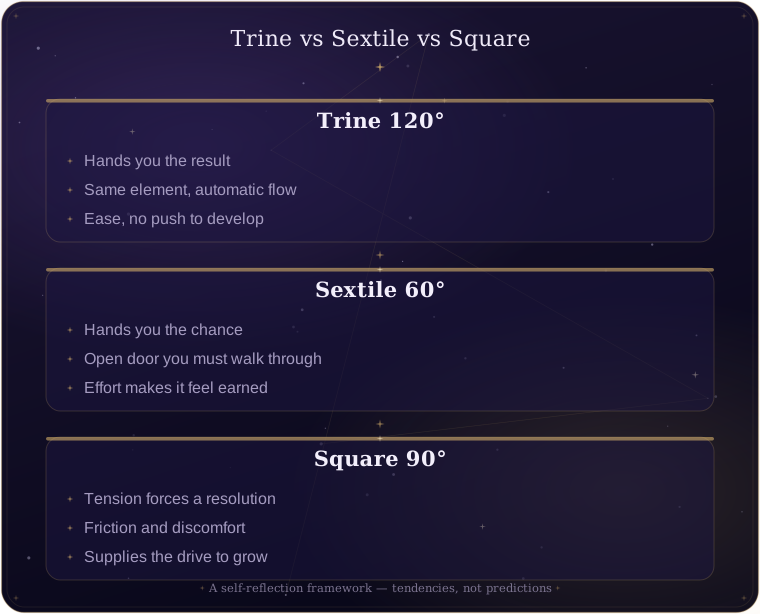
A trine in astrology is best understood against the angles it sits next to, because each one describes a different quality of cooperation between two planets. Robert Hand grounded all of these in pure geometry, arguing that the meaning of an angle comes from how it divides the circle, not from any fixed fortune attached to it. Here is how each compares and where the trade-off lands:
- Trine vs square. A square is a 90-degree angle of tension; the two planets pull against each other and force a resolution. To get the square's drive to grow, you accept friction and discomfort; to get the trine's ease, you sacrifice the pressure that would have pushed you to develop. A chart with a strong explainer on the square aspect often achieves more precisely because the discomfort never let it rest.
- Trine vs sextile. A sextile is a 60-degree angle, an open door of opportunity that still asks you to walk through it. The trine hands you the result; the sextile hands you the chance. To get the trine's automatic talent, you give up the small spark of effort that makes a sextile feel earned and memorable.
- Trine vs conjunction. A conjunction fuses two planets into one blended force you cannot easily separate. The trine keeps the two planets distinct yet friendly. To get the conjunction's raw intensity, you lose the trine's ability to step back and direct each planet on its own terms.
How to Read a Trine in Your Chart
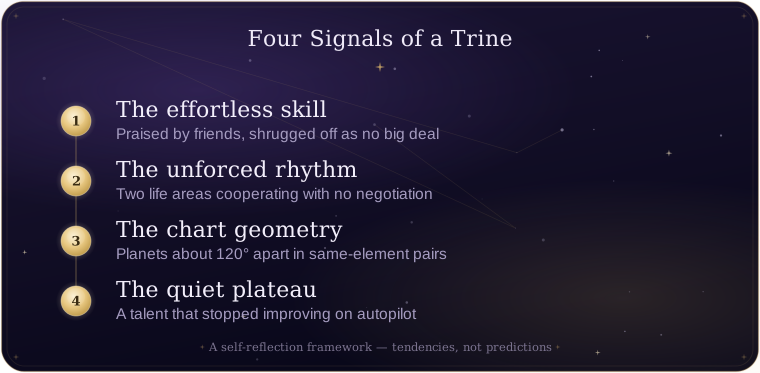
You can spot a trine in astrology by looking for the places where life has always felt suspiciously easy. Watch for these signals:
- The effortless skill. Notice an ability you have never had to practice, the thing friends praise that you shrug off as "no big deal."
- The unforced rhythm. Look for an area where two parts of your life cooperate on their own, like work and rest, or thinking and speaking, with no negotiation needed.
- The chart geometry. Find two planets roughly 120 degrees apart, usually in fire-fire, earth-earth, air-air, or water-water pairings.
- The quiet plateau. Spot a talent that stopped improving years ago because you never needed to push it; that stall is often a trine left on autopilot.
Common Misreadings
Popular write-ups tend to flatten the trine into something it is not. Here are the misreads worth correcting:
- Misread: a trine is always good luck. Reality: it marks ease, not guaranteed reward; an unused trine produces nothing at all, no matter how favorable the angle looks on paper.
- Misread: a trine means you do not have to try. Reality: the flow is the starting fuel, not the finished result; the talent still needs direction and a goal to mean anything.
- Misread: more trines make a "better" chart. Reality: a chart loaded with them can drift, because nothing inside it ever demanded the discipline that struggle builds.
- Misread: a trine cancels out the hard angles. Reality: it does not erase a square's tension; it simply gives you a separate, easier resource you can lean on while you work through the harder placements.
Trine at a Glance
| Property | How It Works | Element Pattern | How to Observe |
|---|---|---|---|
| Angle | 120 degrees between two planets | Same element on both ends | Locate two planets a third of the wheel apart |
| Quality | Ease and natural support | Fire, earth, air, or water matched | Find a skill that never needed practice |
| Risk | Talent stays dormant | Flow with no built-in pressure | Notice an ability that stopped growing |
| Best use | Deliberate activation | Direct the matched pair on purpose | Pick one trine and set a real goal for it |
Questions People Ask About a Trine
What does a trine mean in a birth chart?
It signals two planets that support each other at a 120-degree angle, giving you a built-in talent in the areas they govern. The ability flows on its own, but it still needs to be used deliberately to produce anything lasting.
Is a trine in astrology good or bad?
A trine is traditionally read as favorable because it brings ease rather than conflict. The catch is that ease can slide into complacency, so the value depends entirely on the effort you put behind it.
What is the difference between a trine and a sextile?
A trine is a 120-degree angle that delivers talent automatically, while a sextile is a 60-degree angle that offers opportunity you must act on. The trine gives the result; the sextile gives the invitation.
How many trines is too many?
There is no fixed number, but a chart heavy with them can lack drive, since nothing pushes the person to grow. The talent is there, but the motivation to develop it has to come from somewhere else.
Reflection Prompts
- Think of a skill people praise that you brush off because it always came easily to you.
- Recall a recent week when two parts of your life cooperated without any effort on your part.
- Name one natural talent you have left on autopilot, and decide what using it on purpose would look like.
Related Reading
- overview of the five major aspects — places the trine alongside the other angles so you can see where it fits.
Take Action
Open your full birth chart and trace the lines that connect planets 120 degrees apart, then write down each trine you find next to the talent it points to. You will end up with a short list of abilities that already run smoothly but may have been coasting for years. Reading the full guide to reading a birth chart helps you find the trines in your own chart, and once you can see where talent flows for free, you can decide where to finally put it to work. Start with the full guide to reading a birth chart.
Sources
- Stephen Arroyo — framed aspects as specific dynamics rather than good or bad labels, and noted that too many easy angles can dull a person's drive to grow.
- Robert Hand — grounded each aspect in the geometry of dividing the circle, arguing the meaning comes from the division itself, not a fixed fortune.