
What Is the Elliot Page Birth Chart?
The Elliot Page birth chart is a symbolic map of the sky at his exact moment of birth, read here as cultural narrative rather than verified biography.
- Plots the Sun, Moon, and planets across twelve signs and houses to sketch tendencies, not fixed facts
- Commonly anchored by a Pisces Sun, tied to themes of empathy, imagination, and a rich inner life
- Framed as a reading of his public arc as actor and advocate, never as private biographical proof
Like any natal chart, it turns a birth moment into a set of themes an astrologer can interpret. Page is widely listed with a late-February birth date, which places the Sun in Pisces — a sign linked to sensitivity and a fluid, imaginative temperament. Approached this way, the chart becomes a story to read rather than a verdict to confirm. For anyone new to natal work, the broader pillar page on how to read a birth chart shows how these pieces connect before any single placement gets interpreted in isolation.
Why It Matters for Self-Awareness
Understanding why the Elliot Page birth chart draws attention says as much about the reader as about the actor. A public figure gives you a familiar, low-stakes story to test astrological ideas against, so abstract symbols start to feel legible. Famous charts resurface every time a star trends — a new film, a memoir, an interview — because a recognizable name makes the astrology feel concrete. According to the Pew Research Center, a 2017 survey found that about 29% of U.S. adults said they believed in astrology, which is part of why these readings travel so quickly through pop culture. The real payoff, though, is self-knowledge, and it shows up in a few concrete ways:
- It separates persona from placement. You learn to notice where a chart describes a public image versus a private pattern no outsider can confirm.
- It builds symbolic literacy. Practicing on a known arc trains you to read the Sun, Moon, and rising as one interacting system instead of three separate labels.
- It models honest limits. Watching where the reading has to stop for someone famous makes it easier to hold the same humility about your own chart and your own guide to rising sign profiles.
Read this way, a famous chart is really a mirror. The questions it raises — how identity gets performed, how private need differs from public image — are the same ones your own chart quietly invites you to sit with.
Full-Chart Reading vs Sun-Sign Shorthand: What Actually Differs
The most common mix-up around the Elliot Page birth chart is treating a Sun sign as if it were the whole chart. Two people can share the same Pisces Sun and still come across as completely different, because everything else in the chart reshapes the meaning.
Where the shorthand breaks down
Sun-sign shorthand takes one placement and generalizes it into a personality summary. A full-chart reading works differently: it weighs the Sun against the Moon, the rising sign, and the aspects between planets, so no single symbol carries the whole story. Sun-sign shorthand gets you speed and shareability; the cost is accuracy — to fit on a horoscope tile, it flattens ten placements into one. To get the depth of a full-chart reading, you sacrifice that instant simplicity, because tracing how Pisces energy interacts with the rest of the chart takes time and context.
Symbol versus proof
There is a second confusion worth naming: astrology as a symbolic framework versus astrology as biographical proof. The chart can suggest themes that rhyme with a public story, but it cannot confirm private facts, diagnose anyone, or say what a person must do next. Blending those two — symbol and proof — is where most pop-culture readings go wrong, a distinction the psychological-astrology tradition associated with Liz Greene takes seriously. Keep them apart and the chart becomes a set of interpretive questions rather than a fixed answer.
How to Read This Chart as a Story
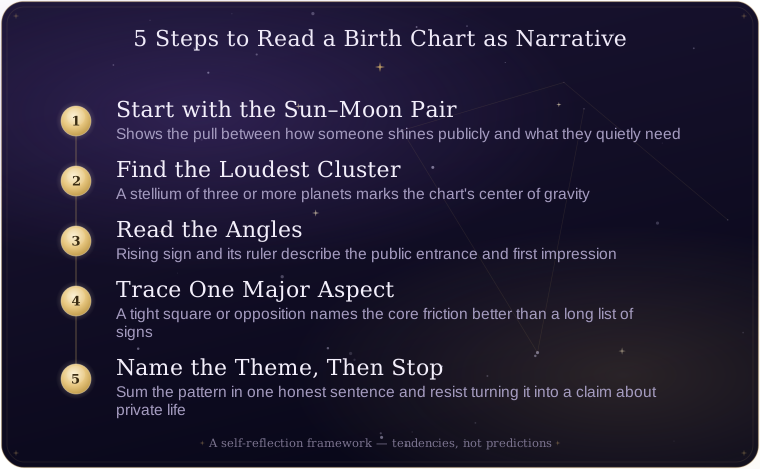
Reading the Elliot Page birth chart as narrative means looking for patterns you can name, not outcomes you can predict. Building on the person-centered approach Dane Rudhyar established, the aim is to read a chart as a portrait of growth rather than a fixed script. A few practical entry points make the symbols observable:
- Start with the Sun–Moon pair. A Pisces Sun beside any Moon shows the pull between how someone shines publicly and what they quietly need.
- Find the loudest cluster. Look for a stellium — three or more planets grouped in one sign or house — as the chart's center of gravity.
- Read the angles. The rising sign and its ruler describe the public entrance, which matters for a figure known largely through screen and interview.
- Trace one major aspect. A single tight square or opposition often names the core friction better than a long list of signs.
- Name the theme, then stop. Sum the pattern up in one honest sentence and resist turning it into a claim about anyone's private life.
None of these steps needs a confirmed birth time to be useful as practice. Where the time is unknown, the Sun and the sign-to-sign aspects still hold, while the Moon, rising, and houses stay provisional — which is itself a good lesson in reading responsibly.
Common Misreadings
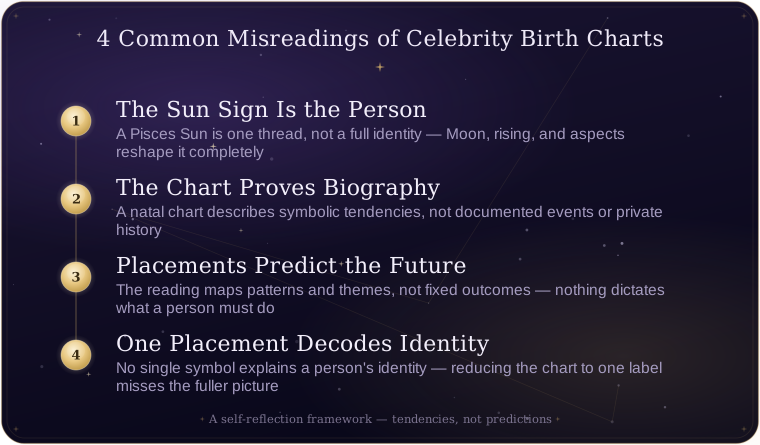
Popular takes on this chart repeat a handful of errors. Each one is easy to correct once it's named:
- The Sun sign is the person. A Pisces Sun is one thread, not a full identity; the Moon, rising, and aspects can reshape it completely.
- The chart proves biography. A natal chart describes symbolic tendencies, not documented events, and cannot verify anyone's private history.
- Placements predict the future. The reading maps patterns and themes, not fixed outcomes — nothing here dictates what a person must do.
- One placement decodes identity. No single symbol explains a person's identity, and reducing this chart to that one search misses the fuller picture.
The Elliot Page Chart at a Glance
| Placement | How It Works | Element / Domain | How to Observe |
|---|---|---|---|
| Pisces Sun | Colors core identity with empathy and imagination | Water / self and vitality | Watch for a fluid, adaptive public presence |
| Moon (sign varies by time) | Shapes emotional needs beneath the persona | Depends on the sign | Notice what a figure protects or retreats toward |
| Rising sign / Ascendant | Frames first impressions and public entrance | Depends on the sign | Read the on-screen and interview presence |
| Stellium (if present) | Concentrates energy in one area of life | House-dependent | Spot a recurring theme across a career arc |
Treat every row as a starting question, not a settled fact. Without a verified birth time, the Moon, rising, and house columns stay tentative, which is exactly why a responsible reading names its own uncertainty instead of papering over it.
Questions People Ask About Elliot Page's Chart
What is Elliot Page's Sun sign?
Page is commonly listed with a Pisces Sun, based on a late-February birth date. Read symbolically, that placement is linked to empathy, imagination, and a flexible sense of self.
Can this chart tell us anything real about him?
It can suggest symbolic themes that rhyme with a public story, but it cannot confirm private facts. A chart is an interpretive lens, not evidence about anyone's inner life.
Do we know Elliot Page's exact birth time?
Reliable birth times for public figures are often uncertain or unverified, which changes the Moon sign, rising sign, and house placements. Without a confirmed time, treat those details as tentative rather than settled.
Is a celebrity birth chart different from my own?
Structurally, no — every chart uses the same signs, planets, and houses. The difference is that you can verify your own lived experience, while a public figure's chart stays a reading made from the outside.
Reflection Prompts
- Think of a recent moment when your public image and your private feeling pulled in different directions.
- Recall a time a single label about you missed the fuller story — what did it leave out?
- Notice when you last treated a sign or symbol as proof rather than a prompt to reflect.
Related Reading
- companion reading of Teyana Taylor's birth chart — compare how the same symbolic method reads a different public performer.
- the 12th house that Pisces traditionally rules — go deeper on the house tied to Pisces, the sign most often linked to this chart.
- overview of synastry and compatibility charts — see how two charts get read together rather than one alone.
- Elliot Page (Wikipedia)
Take Action
Ready to move from reading a celebrity's chart to reading your own? Learn how to read your own birth chart step by step, and you'll get a full map of your Sun, Moon, and rising in one place — the same structure used here — so you can start spotting the quiet patterns that shape how you show up in the world.
Sources
- Dane Rudhyar — pioneered the person-centered, psychological reading of the birth chart this approach draws on
- Liz Greene — helped shape the modern psychological-astrology tradition that keeps symbol and biography distinct