
What are Highly Sensitive Person?
A highly sensitive person is someone whose nervous system processes sensory and emotional input more deeply than average. If that description already sounds familiar, the signs of high sensitivity checklist is a good place to test it against your own day-to-day experience before reading further. This is not a clinical interpretation or mental-health advice; for assessment or support, consult a qualified professional.
- A cluster of related tendencies that travel together, not a single on-off characteristic
- Each tendency maps to a different everyday domain — thinking, energy, feeling, and perception — with heavy overlap between them
- Read as a spectrum of intensity, not a label you either have or do not have
The idea comes from psychologist Elaine Aron, who named the underlying trait sensory processing sensitivity. Most accounts group it into four recognizable facets, often remembered by the shorthand DOES, and Aron's work puts the figure at roughly 15 to 20 percent of people scoring high on the trait. Reading it as a family of facets rather than one switch matters, because two sensitive people can look very different depending on which facets run strongest in them. That framing is what keeps the term useful instead of turning it into a box you climb into. Someone with this trait does not have a weaker nervous system; they have a more responsive one, registering more of what is already in the room and doing more with each piece of it before it reaches conscious thought.
Why It Matters for Self-Awareness
Most people meet the phrase highly sensitive person as either a weapon or an excuse. Someone gets called "too sensitive" as a child, carries the word like a bruise, and either turns it into an identity that explains everything or rejects it as proof that something is wrong with them. Both reactions miss the same thing: sensory processing sensitivity is a neutral temperament trait with real strengths and real costs, not a weakness and not a flaw to be corrected. Seeing the trait clearly starts with seeing it as a set of related tendencies rather than one global verdict about who you are.
Seeing the trait this clearly takes a few related moves, and each one turns a vague sense of being different into something workable:
- Understand the whole family before zooming in on any single facet. If you only know the overstimulation piece, you might conclude you are simply anxious; if you only notice the empathy piece, you might decide you are just emotional. Looking at all four facets together shows how they interact — deep processing feeding emotional reactivity, subtle perception feeding overstimulation — and that fuller picture is usually what finally makes a lifetime of feeling out of step click into place. Readers who want a concrete starting point often begin with a signs of high sensitivity checklist and then come back to see how the pieces fit together rather than treating one trait as the whole story.
- Keep the trait from collapsing into nearby words. Shyness is a fear of social judgment, introversion is a preference for lower-key social settings, and anxiety is a state of persistent worry — a person can be sensitive without being any of those, or be sensitive and also shy. Holding the four facets in view lets you ask which part is actually firing in a given moment, instead of grabbing the first label that fits. That single habit, asking "which facet is this," is what makes the difference day to day.
- Tell the trait apart from anxiety, introversion, and shyness in ordinary moments. An introvert leaves a party early because they have run out of social appetite; a sensitive person may leave because the noise, lighting, and overlapping conversations have stacked up past a sensory ceiling, even when they are enjoying the company. Anxiety narrows attention onto threat and tends to persist whether the room is calm or not; sensory processing sensitivity widens attention onto everything — a colleague's hesitation, a change in the music, the warmth of the light — and settles once the input eases. Shyness holds someone back from speaking; sensitivity often has them noticing the very thing worth speaking about. Mistake overstimulation for anxiety and you reach for the wrong tools; read deep processing as indecision and you push for speed exactly where slowing down produces your best thinking.
- Hold both halves of the trait at once. The strengths and the costs are the same wiring seen from two sides. The depth that makes someone slow to decide is the same depth that catches the flaw everyone else walked past. The empathy that leaves a person wrung out after a hard conversation is the same empathy that makes them the one a friend calls at two in the morning. The subtlety that registers a stranger's discomfort is the same subtlety that drinks in a piece of music more fully than most. Costs and gifts are not two separate ledgers to be balanced; they are one quality showing up in different rooms, and the work is learning which rooms ask for which side.
The Highly Sensitive Person at a Glance
| Facet | Core Theme | Everyday Domain | Common Misread |
|---|---|---|---|
| Depth of Processing | Thinking things through before acting | Decisions, reflection, planning | Mistaken for indecision or overthinking |
| Overstimulation | Reaching a limit in loud, busy, or intense settings | Energy, environments, crowds | Mistaken for fragility or being antisocial |
| Emotional Reactivity & Empathy | Strong feeling responses and attunement to others | Relationships, mood, caregiving | Mistaken for being dramatic or having no boundaries |
| Sensitivity to Subtleties | Noticing small details others miss | Perception, surroundings, tone | Mistaken for being picky or paranoid |
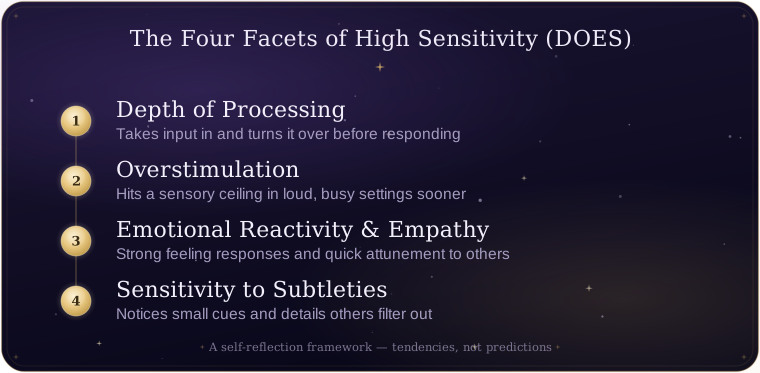
The Highly Sensitive Person: Quick Guide
Being a highly sensitive person is best understood through four facets, each one a different angle on the same trait. Each facet below gets a short brief explaining how it shapes the everyday experience of the trait, with the deep dive living on its own linked page. Taken together they describe what makes a sensitive temperament tick rather than reducing it to a single headline.
- Depth of processing is what sits underneath the trait: a tendency to take information in, turn it over, and connect it to past experience before responding. It shows up as rich inner reflection, noticing implications others skip, and needing a beat before deciding. The common misread is to hear this as slowness or chronic overthinking, when it is closer to thorough processing running quietly in the background. For how this facet drives the rest, see the depth of processing explainer.
- Overstimulation is what happens when all that deep processing meets a loud, bright, or busy environment and the system hits its limit sooner than other people's. It can feel like leaving a party early, dreading open-plan noise, or going flat after an intense day. The misread is treating it as weakness or being antisocial, when it is really a faster route to a ceiling everyone shares. An overstimulation in sensitive people explainer covers practical ways to pace it.
- Emotional reactivity and empathy describes the strong, fast feeling responses many sensitive people have, both to their own emotions and to other people's, often paired with reading a room almost instantly. The misread is to call it dramatic or to assume sensitive people have no boundaries, when the feeling and the boundary are two separate skills. The emotional reactivity and empathy explainer looks at how to feel deeply without absorbing everything around you.
- Sensitivity to subtle stimuli is the facet that catches the small things — a shift in tone, a change in lighting, a detail out of place — that others filter out. At its best it powers attentiveness and craft; misread, it gets dismissed as fussiness or paranoia. Knowing this facet explains why ordinary rooms can feel information-dense rather than neutral. The sensitivity to subtle stimuli explainer goes deeper on where it shows up.
How Shade and Combination Shift Readings
No two sensitive people read the same way, because the intensity of each facet and the combination of facets vary from person to person. The intensity of a highly sensitive person's traits — how hot depth, overstimulation, empathy, and subtlety run — changes how you read them, and so does the particular combination those traits arrive in. The trait is a gradient, not a switch, and the same underlying wiring can present as a quiet observer or an intense empath depending on which facets dominate and how strongly. A few concrete combinations show how the intensity and mix shift the way you read someone as highly sensitive in practice:
- High depth plus high overstimulation. This is the classic deep thinker who fades fast in crowds. To get the rich, careful inner processing, you sacrifice stamina in high-input settings — the same wiring that produces insight also fills up quickly, so a long meeting can leave this person more drained than anyone else in the room.
- High empathy plus a higher overstimulation ceiling. This person can stay in emotionally intense rooms far longer, absorbing and steadying other people's feelings. The trade-off is a tendency to lose track of their own state while tuned into everyone else's, surfacing the exhaustion only hours later when the room has emptied out.
- High subtlety plus high emotional reactivity. Tiny cues land hard here — a clipped reply or a flicker in someone's face can set off a real response. The gift of noticing early comes paired with the cost of reacting to signals other people never registered, which is easy to mislabel as being "touchy."
Intensity also drifts with context. The same highly sensitive person can look unflappable in a familiar one-on-one conversation and overwhelmed thirty minutes into a crowded event, which is why a single snapshot rarely captures the trait fairly. Public figures who describe running this way — performers, writers, and athletes among them — tend to talk about exactly this swing between depth and overload; a roundup of famous highly sensitive people examples collects several of those firsthand accounts. Many sensitive people also gravitate toward the inner, boundary-thin symbolism of the 12th house in astrology overview when they go looking for language that matches that interior weather. The practical takeaway is to read your own mix of facets, at their own intensities, instead of asking whether you are sensitive in some all-or-nothing way.
Common Misreads + Framework Limits
The family frame is useful, but it has edges worth naming. The most common errors come from asking this framework to be more than it is:
- Reading it as a diagnosis. Sensory processing sensitivity is a temperament trait, not a clinical condition. Framing it as something to be fixed misses the point: there is nothing broken to repair, only a setting that runs differently from the majority.
- Forcing one label when traits overlap. Sensitivity can sit alongside introversion, anxiety, or autistic traits, and the surface behavior can look similar from the outside. Untangling them is its own task; readers sorting this out often start with a high sensitivity versus autism comparison to see where the real lines fall.
- Letting the term become an identity. A frame that explains a tendency becomes a trap when it explains everything — every reaction, every boundary, every cancelled plan. The trait is one input into who you are, not the entire story of your choices.
- Expecting the framework to do clinical or relational work. Naming a facet does not process a hard feeling or repair a strained relationship. The emotional side of running sensitive still asks for real work, which sits closer to working through old emotional patterns than to any label you can apply to yourself.
The limit underneath all four is the same: this trait is interpretive vocabulary, a way to describe a pattern, not ground truth about your nervous system and not a substitute for professional support when you actually need it. Used as a lens, the framework clarifies; used as a verdict, it flattens. The difference is whether you let it open questions about how you operate or close them.
Common Questions About Highly Sensitive People
Is being a highly sensitive person a mental health diagnosis?
No. It describes a temperament trait that Elaine Aron named sensory processing sensitivity, not a clinical condition, so it is something to understand and work with rather than something to fix.
How is high sensitivity different from shyness or introversion?
Shyness is a fear of social judgment and introversion is a preference for lower-stimulation settings, while sensitivity is about how deeply input is processed. A person can be sensitive and outgoing, or shy and not especially sensitive.
What share of people are highly sensitive?
Aron's framework estimates that roughly 15 to 20 percent of people score high on the trait. That makes it uncommon enough to feel isolating but common enough that you almost certainly know several others.
Can men be highly sensitive too?
Yes. The trait appears at similar rates across genders, even though cultural messaging often pushes men to hide it, which is part of why it goes unrecognized for so long.
Reflection Prompts
- Think back to a recent moment you were called "too much" or "too sensitive" — which single facet was actually firing in you?
- Notice the last time a busy room drained you faster than the people around you; what were you quietly processing that they were not?
- Recall a small detail you caught that others missed, and ask honestly what that attentiveness both costs you and gives you.
Related Reading
- A facet-by-facet depth of processing explainer for the trait's core engine
- The signs of high sensitivity checklist for readers asking whether the trait actually describes them
- A high sensitivity versus autism comparison for untangling overlapping traits
- A broader overview of temperament and personality traits for where sensitivity sits among other dispositions
- An adjacent introversion and the nervous system explainer for a related but distinct framework
Take Action
Curious how your chart frames life as a highly sensitive person? Read the birth-chart guide and look at the watery, 12th-house corners many sensitive people recognize. The guide leaves you with a map of where your chart mirrors the trait — the placements that line up with depth of processing, strong empathy, and a lower overstimulation ceiling. Read that way, a sensitive temperament stops looking like a flaw to fix and starts looking like a shape worth understanding and working with on its own terms. The next move is simple: name which facet of your sensitivity runs hottest, and use that as the starting point rather than a verdict.
Sources
- Elaine Aron — the psychologist who introduced the term highly sensitive person and described sensory processing sensitivity as a temperament trait rather than a clinical condition